

"The graduates booing Eric Schmidt at the University of Arizona this week understood something most of the executive class still refuses to admit: the AI revolution they're being sold runs on physical infrastructure their elders systematically dismantled."
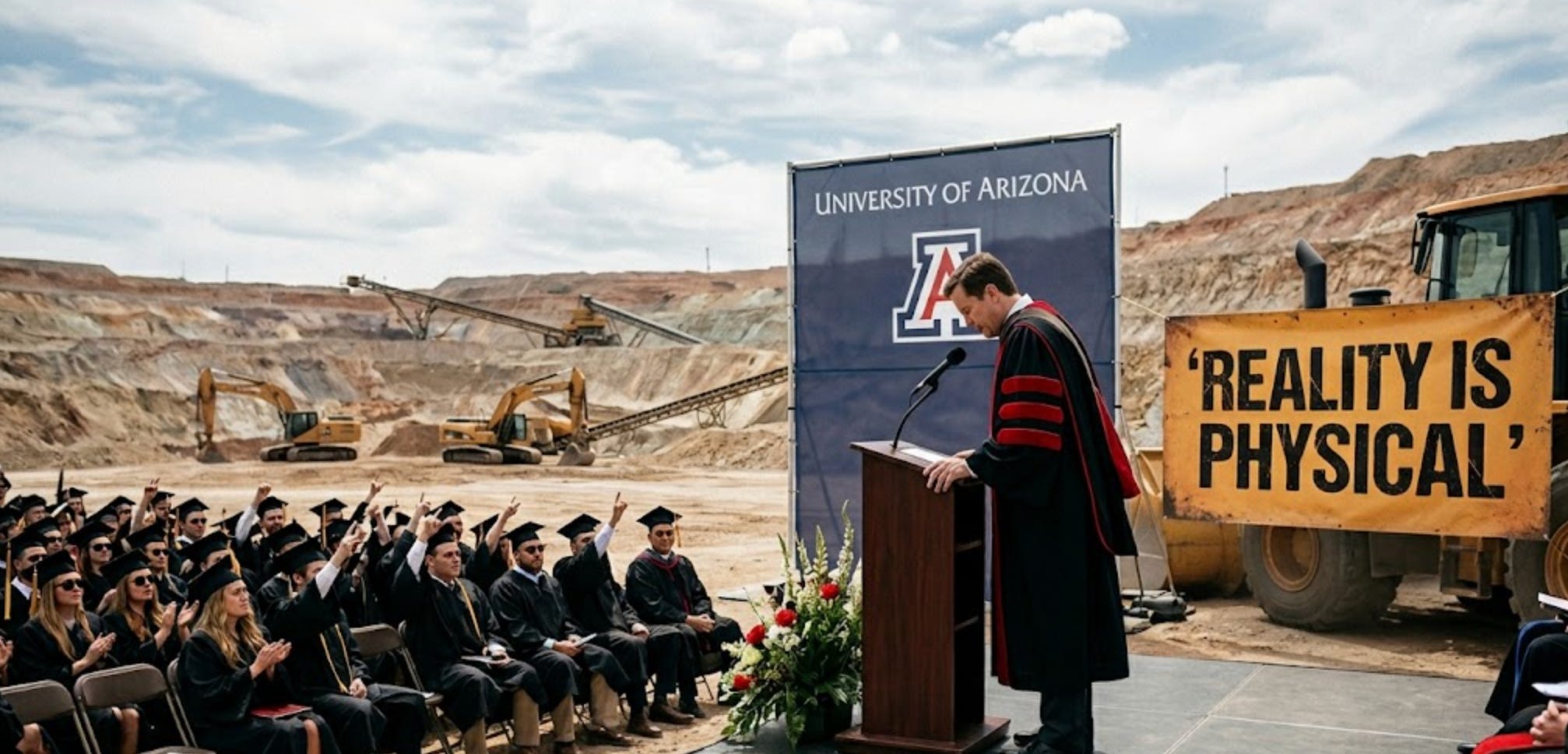
A former Google CEO walked onto a graduation stage in Tucson and got booed over and over again. Similar scenes unfolded across other American universities, where commencement speakers extolling the virtues of the AI revolution were met with audible contempt by the very generation expected to participate in it.
This is not a generational tantrum of spoiled young graduates seeking 6-figure entry-level jobs, but an authentic market signal.

There is another dimension to this that is considerably more interesting, and it has to do with the discrepancy between what the technology industry is promising and what the physical economy underpinning it is actually capable of delivering.
Having spent over a decade in technical product marketing, I am professionally predisposed to scrutinising the discrepancy between a product’s actual capabilities and its marketed ones. Much of my work has involved understanding technology at a sufficiently granular level to identify its legitimate use cases, limitations, commercial viability, and the economic value it generates for different constituencies.
It also makes you rather good at recognising a shitty marketing campaign.
One of the more sophisticated tricks in technology marketing is to sell the prospective value of a product whose underlying capabilities cannot yet substantiate its commercial proposition. In a sufficiently speculative investment environment, you can finance the discrepancy between the two for years. Much of the contemporary AI discourse strikes me as a particularly expensive iteration of this practice.
What makes the situation particularly absurd is that some of the companies making these promises are already struggling to adequately service the demand they have generated. They are attempting to reconcile the economics of an extraordinarily capital-intensive technology with the growth expectations we have inherited from the relatively asset-light software industry.
Those are two very different economic propositions.
A more sustainable commercial strategy would involve managing demand, prioritising customers with demonstrable use cases and a willingness to pay, and expanding capacity in accordance with the available infrastructure. Yet the incentives of speculative capital favour rapid user acquisition and market capture, even when the resulting economics are questionable and the quality of the product deteriorates.
I have little doubt that several of these companies will eventually become extraordinarily successful enterprises. I am considerably less convinced that their present valuations, growth strategies and projections bear much resemblance to the material reality in which they operate.
And it is that material reality that I want to examine here.
Because somewhere beneath the discussions about AGI, the future of work and the prospective obsolescence of humanity, there is a much less glamorous economy of mines, chemical processing facilities, power grids, maritime chokepoints and skilled industrial labour.
It happens to be the very economy that much of the developed world spent the better part of four decades dismantling.
I. The upstream economy of AI
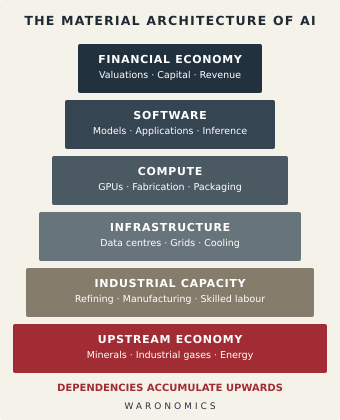
Let’s start with helium - a commodity that rarely features in discussions about the future of AI.
The disruption to QatarEnergy’s operations at Ras Laffan following the outbreak of hostilities involving Iran exposed an extraordinary vulnerability in the global semiconductor industry. Qatar accounts for roughly 30% of global helium supply, and the disruption to its production and exports sent spot prices soaring.
Why should anyone investing in AI care about helium?
Because helium is critical to several stages of advanced semiconductor manufacturing, including thermal management, leak detection in vacuum systems and certain fabrication processes requiring exceptionally precise environmental conditions. Its physical properties make substitution particularly difficult in some of these applications.
The problem is further compounded by the logistics of helium itself. It requires highly specialised cryogenic transportation infrastructure, and prolonged disruptions to shipping can result in losses through boil-off.
At the time of writing, reports suggest that approximately 200 specialised helium containers have been stranded in the vicinity of the Strait of Hormuz, while some Asian semiconductor manufacturers are operating with only weeks of buffer inventory. South Korea, one of the most important semiconductor manufacturing economies in the world, sources nearly 65% of its helium imports from Qatar.
Consider the extraordinary (and fragile) chain of dependencies here - the commercial prospects of American AI companies depend on the availability of advanced semiconductors, whose production in East Asia depends, in part, on the availability of an industrial gas extracted in the Persian Gulf and transported through one of the most geopolitically exposed maritime chokepoints in the world.
There is very little about this particular dependency that can be resolved by the ingenuity of a software engineer in California.
Helium is only one such example.
According to the International Energy Agency, China is the leading refiner of 19 out of 20 strategic minerals, accounting for an average of approximately 70% of their processing. The distinction between extraction and processing is important here, because the geographical diversification of mineral deposits does not necessarily translate into the diversification of industrial supply chains.
A mineral can be extracted in Australia, Africa or South America and still enter a Chinese-controlled processing ecosystem before becoming commercially useful to a Western manufacturer.
In October 2025, Beijing demonstrated the extent of this leverage by introducing extraterritorial rare earth export restrictions that could apply even to certain products manufactured outside China. Their subsequent suspension following negotiations with Washington did little to alter the underlying distribution of industrial capabilities.
The West may have negotiated temporary relief from the exercise of Chinese leverage. It has not eliminated the conditions that make that leverage possible.
II. The competition for copper
Where helium illustrates the vulnerability of concentrated industrial supply chains to geopolitical shocks, copper illustrates a much longer-term structural problem.
BloombergNEF projects a copper supply deficit of approximately 6 million tonnes by 2035. S&P Global estimates that annual copper demand could reach 42 million tonnes by 2040, representing an increase of roughly 50%.
AI data centres alone are projected to consume an average of 400,000 tonnes annually over the coming decade, with demand potentially peaking at 572,000 tonnes in 2028.
The problem with assessing these figures in isolation is that the AI industry is hardly the only industry planning to significantly expand its copper consumption. We are simultaneously attempting to electrify transportation, modernise ageing power grids, expand renewable energy infrastructure, re-industrialise Europe, rebuild Western defence manufacturing capabilities and develop an entirely new robotics industry.
S&P estimates that a hypothetical deployment of one billion humanoid robots by 2040 could require an additional 1.6 million tonnes of copper annually.
Each of these industries produces its own growth projections, often without adequately accounting for the material requirements of the others. What interests me is what happens when we superimpose all those projections on one another. Suddenly, the growth trajectory of the AI industry becomes a question of competition between industrial priorities.
How will governments reconcile the energy demands of hyperscale data centres with the electrification of their economies? How will European rearmament compete for materials, labour and industrial capacity with the energy transition? And what happens when several of these sectors simultaneously encounter the same upstream constraints?
These are questions of political economy, and they will increasingly require political decisions about resource allocation. Copper prices reached a record closing level of $13,943 per tonne on the London Metal Exchange on May 11, 2026. Meanwhile, Washington launched Project Vault earlier this year to establish a strategic critical minerals reserve.
The growing interest of governments in securing industrial inputs reflects an important development: access to certain commodities is becoming too consequential to national security to be left entirely to the fluctuations of the commercial market.
China, of course, arrived at this conclusion considerably earlier. While Western economies were celebrating the virtues of asset-light business models, Chinese companies were acquiring mining assets, developing processing capabilities and securing long-term off-take agreements across the developing world.
We are only now beginning to appreciate the geopolitical implications of those investments.
III. The electrician problem
Of all the contradictions associated with the AI buildout, perhaps my favourite is the shortage of electricians. Microsoft President Brad Smith has identified it as one of the most significant impediments to data centre expansion in the United States. Microsoft’s estimates suggest that the country needs approximately half a million new electricians this decade.
Industry estimates cited by Fortune suggest that AI-related demand alone could require another 300,000 electricians, while roughly 200,000 are expected to retire over a comparable period.
Nearly 30% of union electricians are between the ages of 50 and 70. The apprenticeship required to replace them generally takes several years. There is also a rather uncomfortable sociological dimension to this.
For decades, we cultivated a hierarchy of professional prestige in which physical and industrial labour occupied the lower end, while an increasingly credentialised white-collar economy occupied the upper end. We encouraged young people to pursue university degrees, often irrespective of their commercial utility, while treating vocational education as something of a consolation prize for those who were insufficiently academically inclined.
An electrician, a machinist or a welder was somebody whose children were supposed to aspire to become management consultants. It was a remarkably effective way of engineering ourselves into an industrial labour shortage.
And now, in a particularly amusing turn of events, the industry promising to render white-collar workers obsolete finds its own expansion contingent on the availability of precisely the kind of labour that our educational and economic institutions have spent decades devaluing.
There are limits to what capital can accomplish within a given timeframe. You can increase wages, finance apprenticeship programmes and incentivise immigration, but you cannot instantaneously produce a generation of experienced industrial workers.
Nor is this a problem exclusive to artificial intelligence. The European defence industry is confronting a similar demographic and vocational problem. So are shipbuilding, nuclear energy, grid infrastructure and advanced manufacturing.
The second-order consequence of Western deindustrialisation was the erosion of the human capital required to reverse it. Industrial competence is accumulated over generations. It is transmitted through institutions, apprenticeships, professional communities and the practical experience of solving problems that rarely conform to the abstractions of an academic curriculum.
Once that ecosystem has been dismantled, rebuilding it is considerably more complicated than allocating a few billion euros in a government budget.
IV. The industrial externalities of war
I have written previously about the inadequacy of examining contemporary conflicts exclusively through their immediate kinetic and geographical dimensions.
The economic consequences of a war are often transmitted through industrial relationships that have very little apparent connection to the belligerents themselves. The conflict involving Iran offers a particularly instructive example.
Most of the economic analysis surrounding the Strait of Hormuz understandably concentrates on oil and natural gas. These are commodities whose disruption is relatively easy to quantify, and the transmission mechanisms through which rising energy prices affect inflation, industrial output and political stability are well established.
I am equally interested in the less visible industrial dependencies.
Beyond helium, the region is an important source of aluminium, petrochemical feedstocks and specialised chemical products used throughout manufacturing supply chains. Naphtha, solvents, semiconductor-grade neon, bromine and various other industrial inputs rarely command the attention of financial markets until something happens to their supply.
Prior to Russia’s full-scale invasion of Ukraine, for instance, two Ukrainian companies accounted for roughly half of the world’s semiconductor-grade neon supply.
There is something quite extraordinary about the fact that the world’s most technologically sophisticated industry can find itself exposed to a regional conflict through a gas purification facility that most people working in that industry have never heard of. This is one of the fundamental problems with the way we conceptualise economic warfare - we tend to concentrate on the strategic assets whose importance is immediately apparent: oil fields, ports, semiconductor fabrication plants and military manufacturing facilities. But industrial dependencies are often obscure, highly specialised and several tiers removed from the finished product.
The economic significance of an asset is not necessarily proportional to its monetary value - a relatively inexpensive input can compromise the production of a disproportionately valuable finished product if there are insufficient alternatives.
A prolonged disruption to semiconductor inputs could therefore have financial consequences well beyond the relatively modest size of the markets for those inputs. Given the extent to which the valuations of some of the world’s largest companies depend on expectations of uninterrupted compute expansion, it is worth considering how such a disruption would propagate through the equity markets.
The geopolitical exposure of the AI industry cannot be adequately assessed by examining the countries in which its companies are headquartered. One needs to examine the entire industrial ecology that makes their existence possible.
V. China’s geopolitical economy of AI
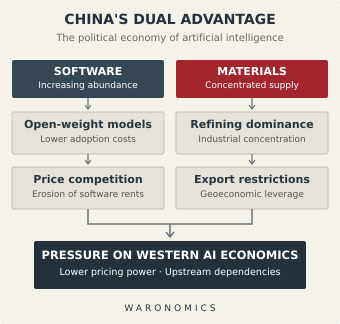
What I find most interesting about China’s approach to artificial intelligence is the complementarity between its software strategy and its industrial strategy.
In the West, we tend to discuss the emergence of Chinese AI models and Chinese dominance over strategic minerals as two separate geopolitical developments. I would argue that they ought to be examined together.
DeepSeek’s emergence in early 2025 demonstrated that the commercial exclusivity of American frontier models was considerably more vulnerable than many had assumed. The subsequent development of Chinese open-weight models by DeepSeek, Alibaba, Moonshot and others continues to exert downward pressure on the price of accessing advanced AI capabilities.
Whether or not these models consistently outperform their American counterparts is somewhat beside the point from a geopolitical perspective. They need to be sufficiently capable, accessible and inexpensive to erode the commercial advantages associated with proprietary models.
For the vast majority of commercial use cases, the distinction between the world’s best model and a considerably cheaper model with adequate capabilities may not justify the difference in price. This is particularly relevant to the developing world, where the economics of adopting Western AI products are fundamentally different from those of a well-capitalised American enterprise.
If Chinese models become widely embedded in the technological ecosystems of emerging economies, the geopolitical returns to Beijing may be considerable, irrespective of whether the companies developing those models generate the kind of profits their American counterparts are expected to produce.
Meanwhile, China retains an extraordinary degree of influence over the industrial inputs required to build the physical infrastructure upon which both Chinese and Western AI capabilities depend.
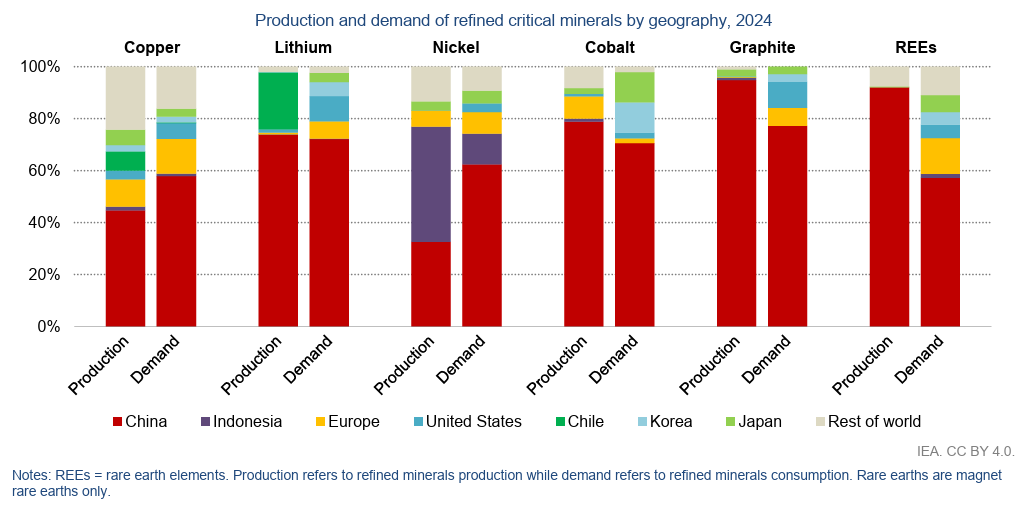
Its export licensing regimes for gallium, germanium, antimony, graphite and various rare earth elements, alongside the development of a broader industrial and supply-chain security framework, provide Beijing with an increasingly sophisticated architecture of economic coercion.
The strategic logic is compelling - by contributing to the commoditisation of the software layer, China can erode the economic rents available to Western technology companies, while retaining influence over parts of the physical economy that are considerably more difficult to replicate.
One can reproduce and distribute a software model at relatively low marginal cost. Replicating decades of accumulated expertise in mineral processing, metallurgy and industrial manufacturing is an altogether different undertaking.
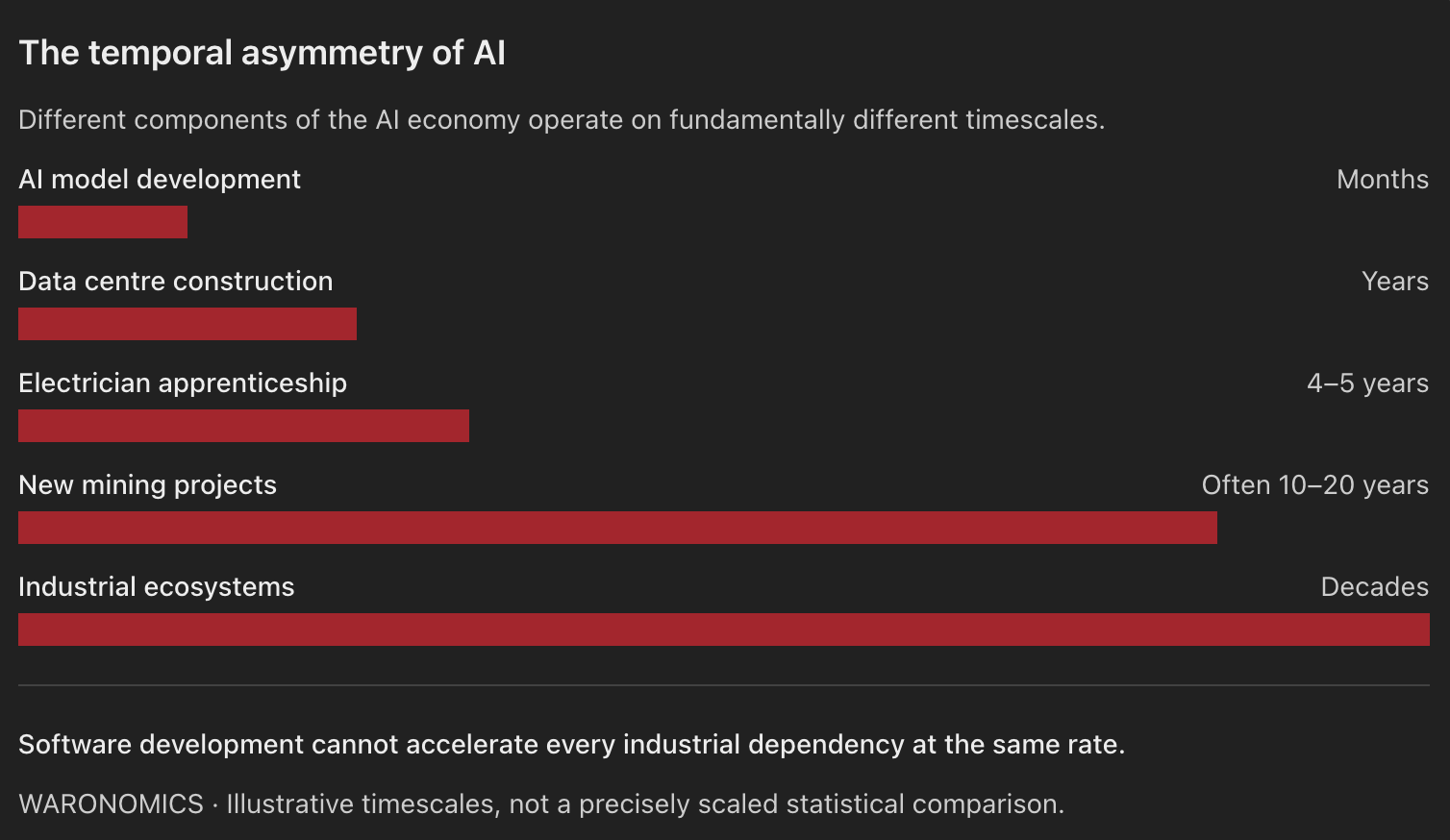
There is a temporal asymmetry here that works to China’s advantage. Software can evolve over months; industrial ecosystems develop over decades.
The emergence of Chinese AI hardware ecosystems around Huawei and its Ascend processors introduces another complication for Washington. It suggests that restrictions on access to Western semiconductors may accelerate the development of a parallel technological ecosystem, even if that ecosystem continues to face substantial technical and production constraints.
American export controls should therefore also be evaluated against the industrial capabilities they incentivise China to develop domestically.
I suspect that the long-term geopolitical significance of Chinese AI will have as much to do with its capacity to undermine the economics of Western technology companies as with the technical sophistication of the models themselves.
What are we actually pricing into AI?
My primary reservation about the current AI investment cycle concerns the number of assumptions that need to simultaneously hold true for its more ambitious projections to materialise.
We are assuming that sufficient energy infrastructure will be available, that advanced semiconductor production can expand without significant disruption, that mineral extraction and refining will keep pace with demand, that specialised industrial labour can be sourced, and that the geopolitical environment will remain sufficiently permissive for these globally distributed supply chains to function.
We are making these assumptions at a time of accelerating geopolitical fragmentation, rearmament, economic warfare and competition for industrial resources.
Over the 2026–2028 period, I would pay particular attention to the following developments:
Helium and specialised semiconductor inputs: the duration of disruptions to Qatari production, the depletion of buffer inventories in East Asia and the industry’s capacity to diversify its suppliers.
Copper: the competition between electrification, defence manufacturing, AI infrastructure and robotics, alongside actual additions to global mining and processing capacity.
Industrial labour: apprenticeship enrolment, retirement rates and competition for experienced electricians and other skilled trades between strategically important industries.
Chinese export controls: the status of the November 2025 suspension of extraterritorial rare earth restrictions and the progress of alternative Western processing ecosystems.
AI commercial economics: the relationship between capital expenditure, paying customer retention, inference costs, declining model prices and the ability of companies to generate sustainable returns.
The developments that would make me substantially more optimistic about the Western AI buildout are unlikely to originate in Silicon Valley. I would like to see new mines entering production, operational mineral processing facilities, completed grid connections, growing apprenticeship enrolment and the restoration of industrial capabilities in Europe and North America.
Actual industrial output, rather than investment announcements, would be a considerably more useful measure of progress.
Nobody can give you what I am able to promise you
My father used to keep proverbs carved into decorative stone plates on our kitchen wall. One of them has stayed with me throughout my life:
Nobody can give you what I am able to promise you.
He meant it primarily as a commentary on politicians. Having grown up under communism, he belonged to a generation that had considerable practical experience with the discrepancy between an official representation of economic reality and economic reality itself.
I increasingly find myself thinking about that proverb when listening to some of the leading figures in the technology industry - there is an almost ideological quality to the contemporary conviction that technological ingenuity can compensate for the deterioration of the material and institutional foundations of our economies.
Perhaps it is a consequence of having spent so long in an economic environment in which production was geographically removed from consumption, industrial labour was removed from our immediate surroundings, and the physical complexity of the things we used was concealed behind increasingly elegant digital interfaces.
We began to mistake our distance from the physical economy for our independence from it, and now the emergence of AI is forcing us to confront the consequences of that mistake.
We have developed an extraordinarily sophisticated technology whose further development requires the restoration of industrial capabilities we once considered economically obsolete. We need the mines, the refineries, the power stations, the factories and the vocational institutions whose relative decline was once presented to us as evidence of economic progress.
Nothing like an upstream supply dearth for a DUD technology
The AI valuation reset is going to be epic. Makes previous market hype cycles (remember EVs?) look ordinary. A LOT of money is riding on the market not realizing how fragile the AI ecosystem is.