


As hybrid attacks - from cyber to sabotage - continue to proliferate and destabilise our way of life, it got me thinking about solutions. As an analyst I am comfortable with connecting the dots. I’ve always struggled with solutions, so in the following lines I would dip into the wisdom of some great thinkers like Nassim Taleb, Alfred Korzybski, Friedrich Hayek, Gilles Deleuze, Félix Guattari, and Elinor Ostrom to try and present something that doesn’t come naturally to me - probable solutions to complex problems.
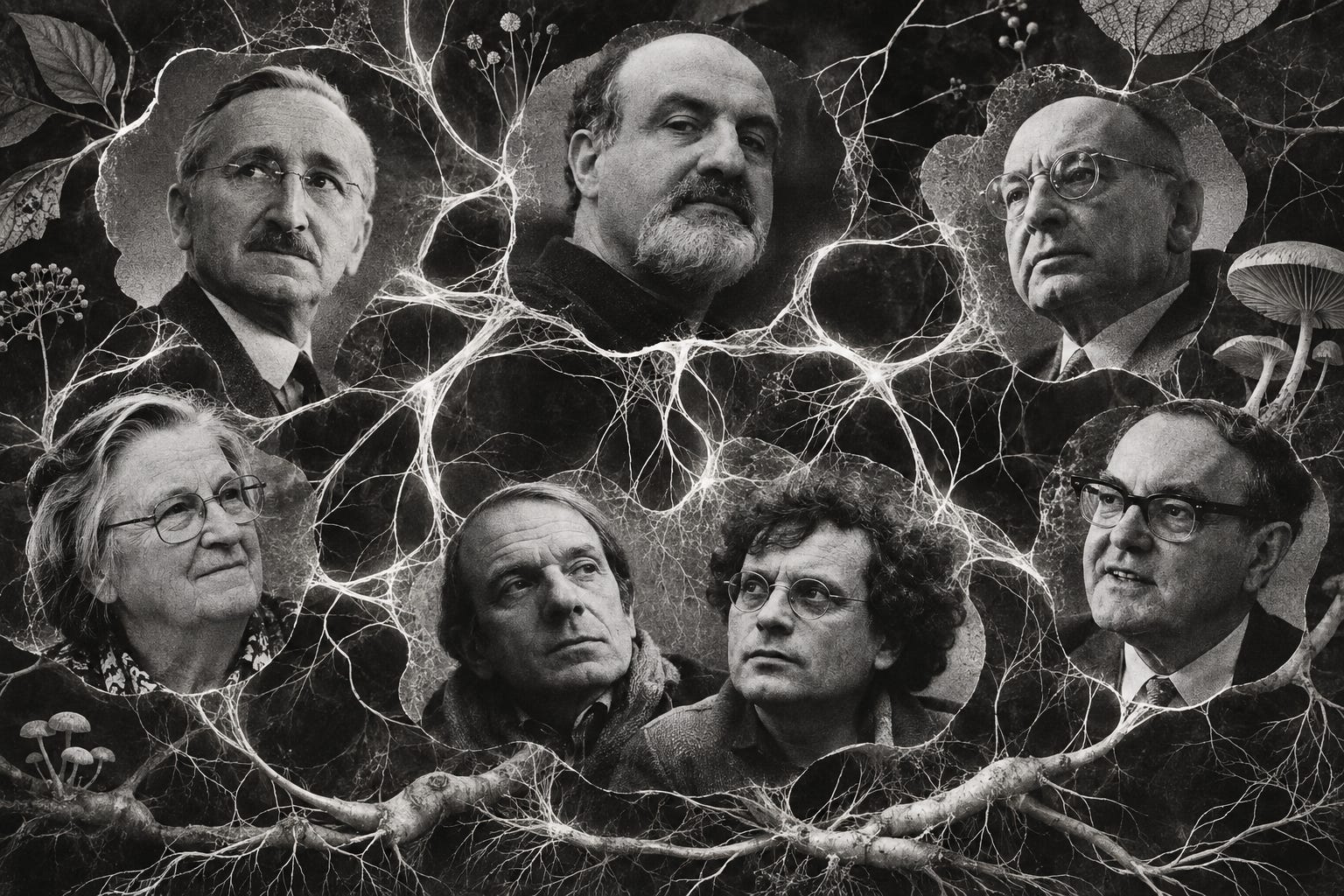
Over several decades, we have (re)organised much of modern civilisation around the pursuit of efficiency, scale, standardisation, and predictability. We consolidated suppliers, eliminated inventories, centralised technological capabilities, and constructed increasingly integrated systems around a shrinking number of indispensable actors (e.g. Microsoft, Starlink, China, Taiwan, etc.).
Every decision is rational within the economic framework in which it was made. Collectively, however, those decisions produced a civilisation capable of extraordinary performance under ordinary conditions, but increasingly vulnerable to extraordinary, Black Swanesque ones.
This pathology extends far beyond corporate procurement of a productivity suite, which single point of failure shut down the work of hospitals, institutions, and businesses last week. It permeates our industrial supply chains, financial institutions, energy infrastructure, and increasingly the political architecture of globalisation itself.
So it got me wondering: what if the problem is not simply that these systems are poorly managed, inadequately regulated, or insufficiently innovative? What if the problem lies in the principles according to which we have organised them?
The paradox of individual rational decisions: nobody gets fired for choosing Microsoft
As someone coming from the tech sector (and ironically - has past work experience with Microsoft’s legacy systems), let me let you in on a secret: within and outside of Microsoft, everyone knows that working on these systems is a dead end job with little career prospects. Everything is now focused on shipping AI, and Microsoft executives - like so many others - have decided that mass layoffs and differed maintenance for these critical systems is the way to go about growth and shareholder satisfaction during an economic downturn (I am lowkey exaggerating, calm down techbros). I know that, you know that (or at least - suspect it), yet when it comes to choosing a productivity suite, everyone goes for the “industry standard”. Why? Because nobody gets fired for using Microsoft.

Picture the CIO of your average mid-sized European enterprise choosing a productivity suite. If he picks the market leader, he can point to its market share, its certifications, the analyst reports and the fact that every peer institution made the same choice. If it fails, it fails for everyone, and no board dismisses an executive for an outage that also hit the competition. If he picks a smaller rival and it fails, the failure is his alone.
Given these incentives, this is the rational choice, since the upside of the unconventional choice goes to the institution, but the downside goes to the career of the decision-maker. So he buys what everyone buys, and so does everyone else.
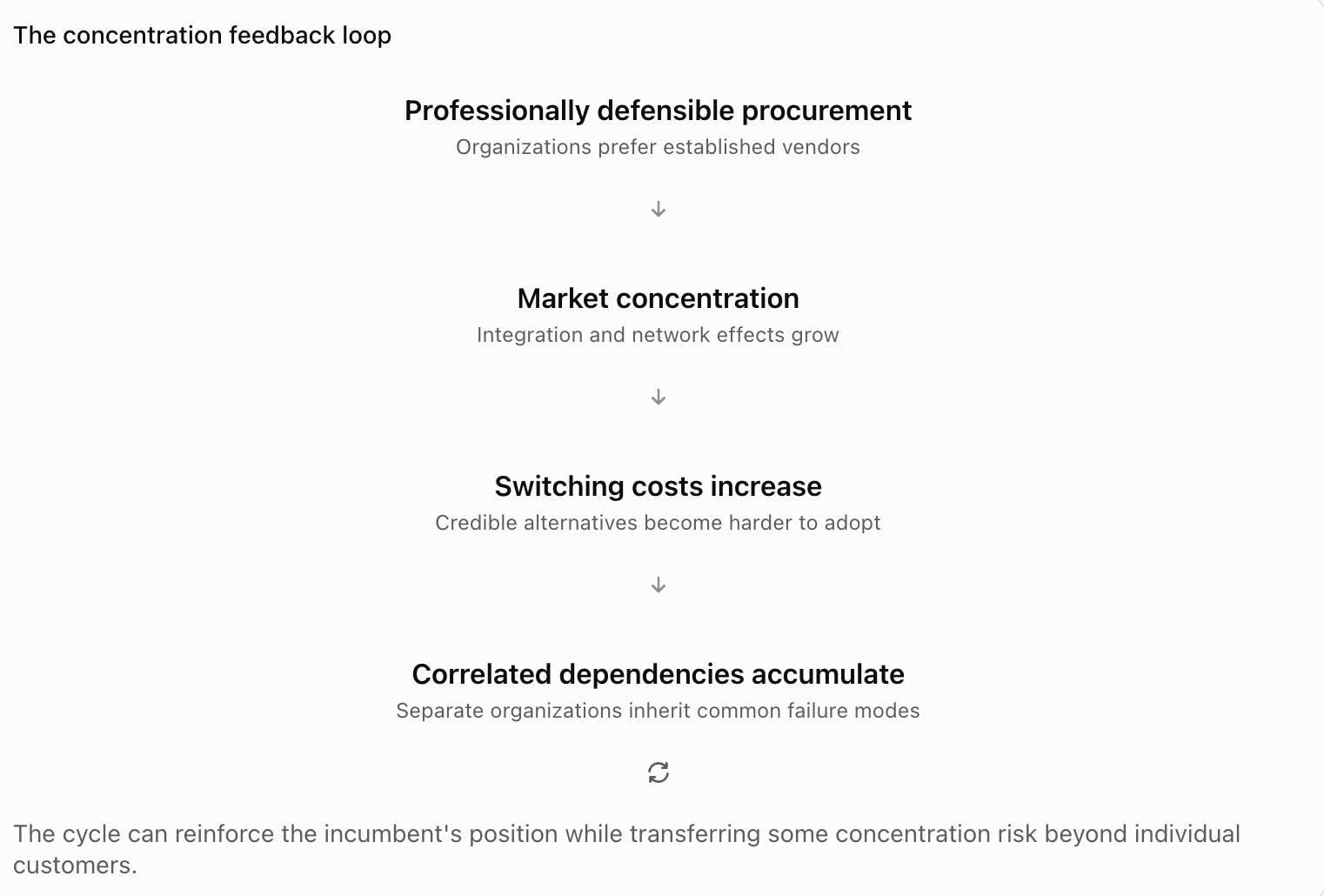
This is why the stability of concentrated systems is so misleading and frankly - dangerous. A dominant platform is usually more reliable than its smaller rivals on any ordinary day - it can afford better engineers and more redundancy. Its record of uptime is excellent right up to the moment that matters, like the turkey in Taleb’s parable whose confidence in the farmer peaks on the Wednesday before Thanksgiving. Measured by frequency of failure, concentration looks safe. Measured by the size of the failure when it comes, it is the opposite.
The cult of efficiency: when optimisation destroys optionality
For decades, the governing philosophy of economic management has revolved around an almost theological devotion to efficiency. Businesses have pursued practices that deliver significant measurable benefits, e.g.:
Just-in-time production and reduced inventory.
Consolidation of suppliers and procurement contracts.
Outsourcing of noncore capabilities.
Higher utilisation of industrial and logistical assets.
Centralisation of shared infrastructure and services.
A manufacturer carrying less inventory improves working capital, a corporation consolidating suppliers secures better prices, a technology company centralising infrastructure reduces duplication, and a government importing inexpensive energy improves industrial competitiveness (*cough* Germany *cough*).
These practices are not inherently irrational - they have supported enormous productivity gains. The problem emerges when organisations optimise a narrow set of performance metrics and fail to account adequately for severe disruptions.
Example: Toyota pioneered just-in-time manufacturing, then the 2011 Fukushima disaster disrupted Japanese supply chains, and the company recognised that semiconductor replenishment times made its manufacturing system highly vulnerable to prolonged shocks. The company subsequently developed arrangements requiring suppliers to maintain between 2-6 months of inventories for particular chips.
A Civilisation of Bottlenecks
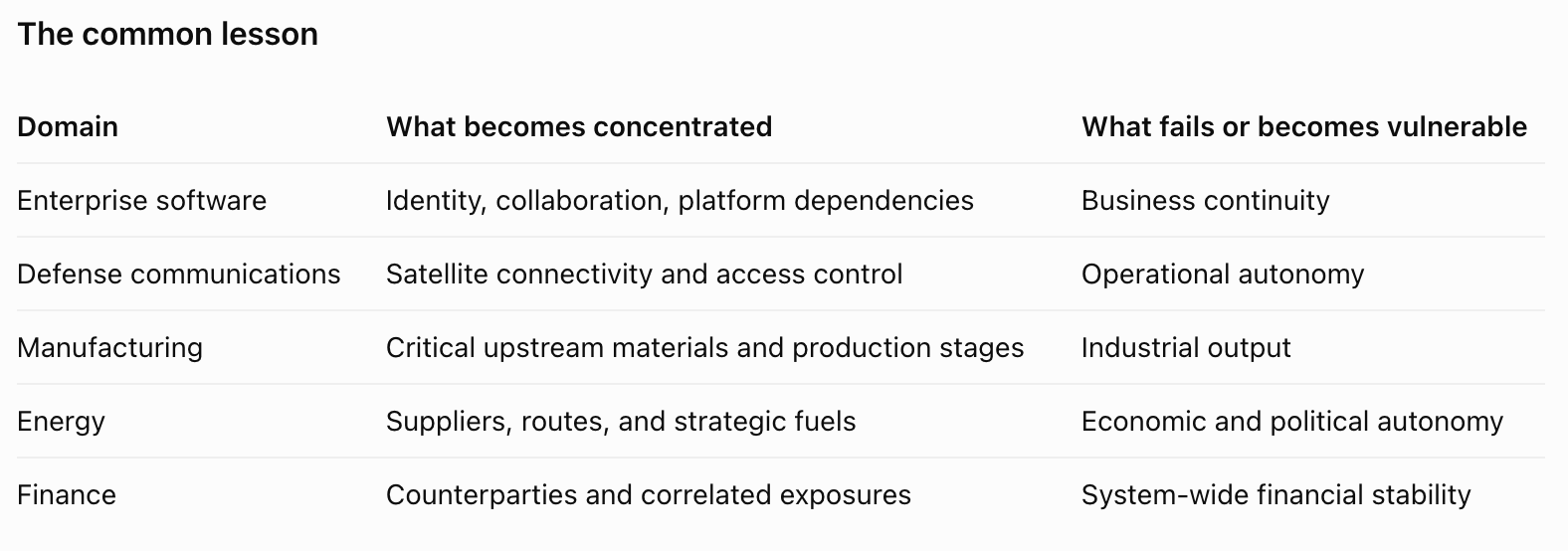
The Microsoft outage isn’t the only evident example of this problem. Remember the CrowdStrike security update which affected around 8.5 million Windows devices? It sounds small, until you realise that the consequences extended across airlines, hospitals, banks, and critical services. At that time, I was meant to be at a tech conference in Berlin (thankfully, plans changed last minute), but my colleagues ended up stuck there and unable to come home. So, a relatively small disturbance generated consequences vastly disproportionate to its original scale.
Now consider Ukraine - a country in the midst of existential war.
Since Russia’s full-scale invasion, Starlink has provided indispensable communications capabilities, helping Ukrainian forces maintain connectivity under extremely difficult conditions. But its success has created a dangerous strategic dependency. We have had several occasions where that dependency was weaponised as political leverage, and the cost was actual human lives. A technological system can function perfectly and still create a geopolitical vulnerability if an external actor possesses the ability to restrict its use.
The same pattern can be observed in industrial supply chains. As of today, China accounts for 71% of mining and processing minerals capability, which has some darn serious implications for industries supposedly characterised by competition.
A dozen European manufacturers may compete fiercely in EVs, batteries, or defence equipment while depending on the same limited upstream processing capabilities. Competition at the end of the supply chain does not guarantee diversity at its foundations.
Another fine example: Europe’s (quasi-former) reliance on Russian gas. In 2021, Russia supplied approximately 45% of EU gas imports. The arrangement made commercial sense for many European industries, providing access to comparatively inexpensive energy, but at the same time it exposed Europe’s industrial economy to the decisions of a hostile authoritarian state.
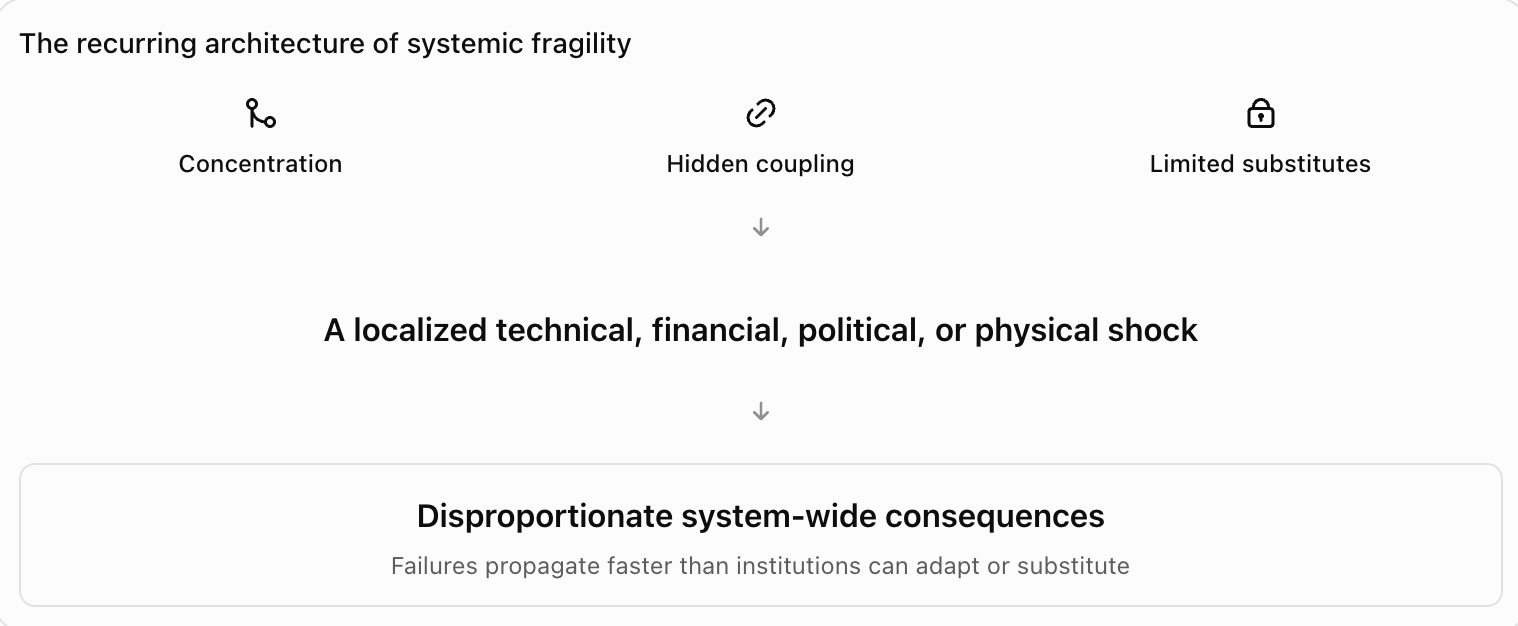
Different industries, different failures, and different consequences, yet the same structural similarities of concentrated dependencies, insufficient or outright non-existent contingencies, and failures that propagate faster than the system can reorganise itself.
The obvious question is how so many sophisticated institutions repeatedly fail to recognise vulnerabilities that become painfully apparent after a crisis? Part of the answer, I think, lies in how we represent reality.
The Map Is Not the Territory: Why sophisticated models can conceal dangerous realities
In 1933, Alfred Korzybski articulated the following gem: the map is not the territory. A map represents reality, but it is not reality itself.
At a first glance, this distinction appears trivial, but its implications for modern economic management are profound.
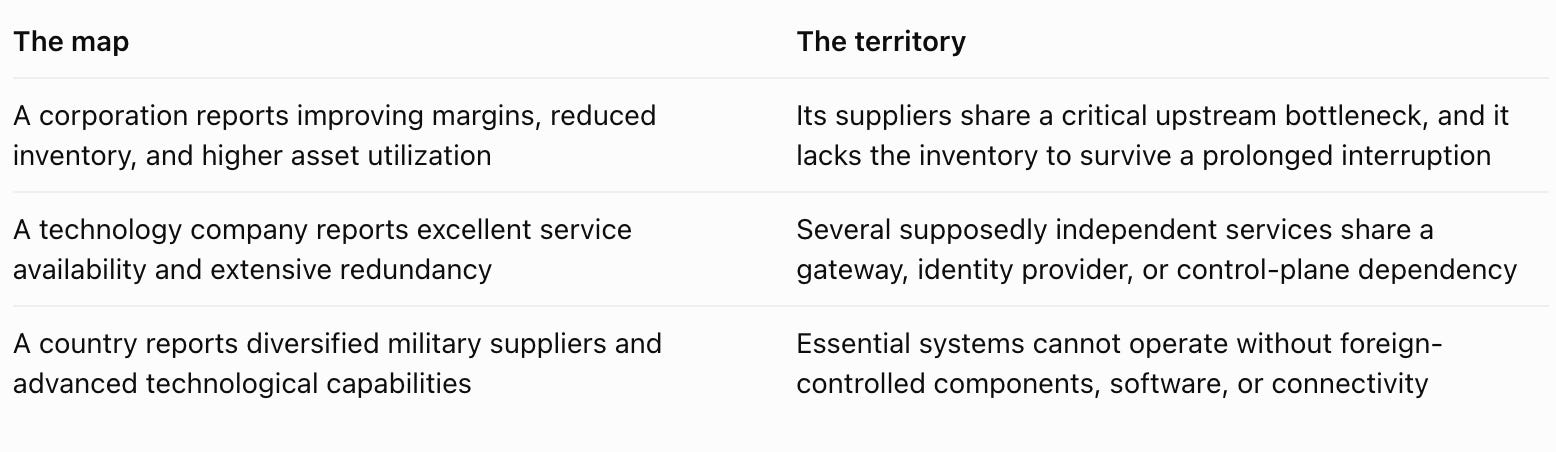
So in a nutshell: a map can be accurate within its parameters while remaining dangerously incomplete. And the consequences become particularly serious when institutions begin reorganising themselves around the map, and not the territory.
Businesses eliminate inventories because financial models identify working capital as an opportunity cost.
Procurement departments consolidate suppliers because purchasing models reward volume discounts.
Corporations centralise technological infrastructure because integrated systems promise economies of scale.
Each decision improves performance against the indicators used to evaluate it, yet those same decisions also end up concentrating risk. The models continue reporting improvements while the underlying system becomes progressively less capable of absorbing disruption.
We have reached a point where we aren’t just mistaking the map for the territory, we are actively trying to reshape the territory to conform to the map.
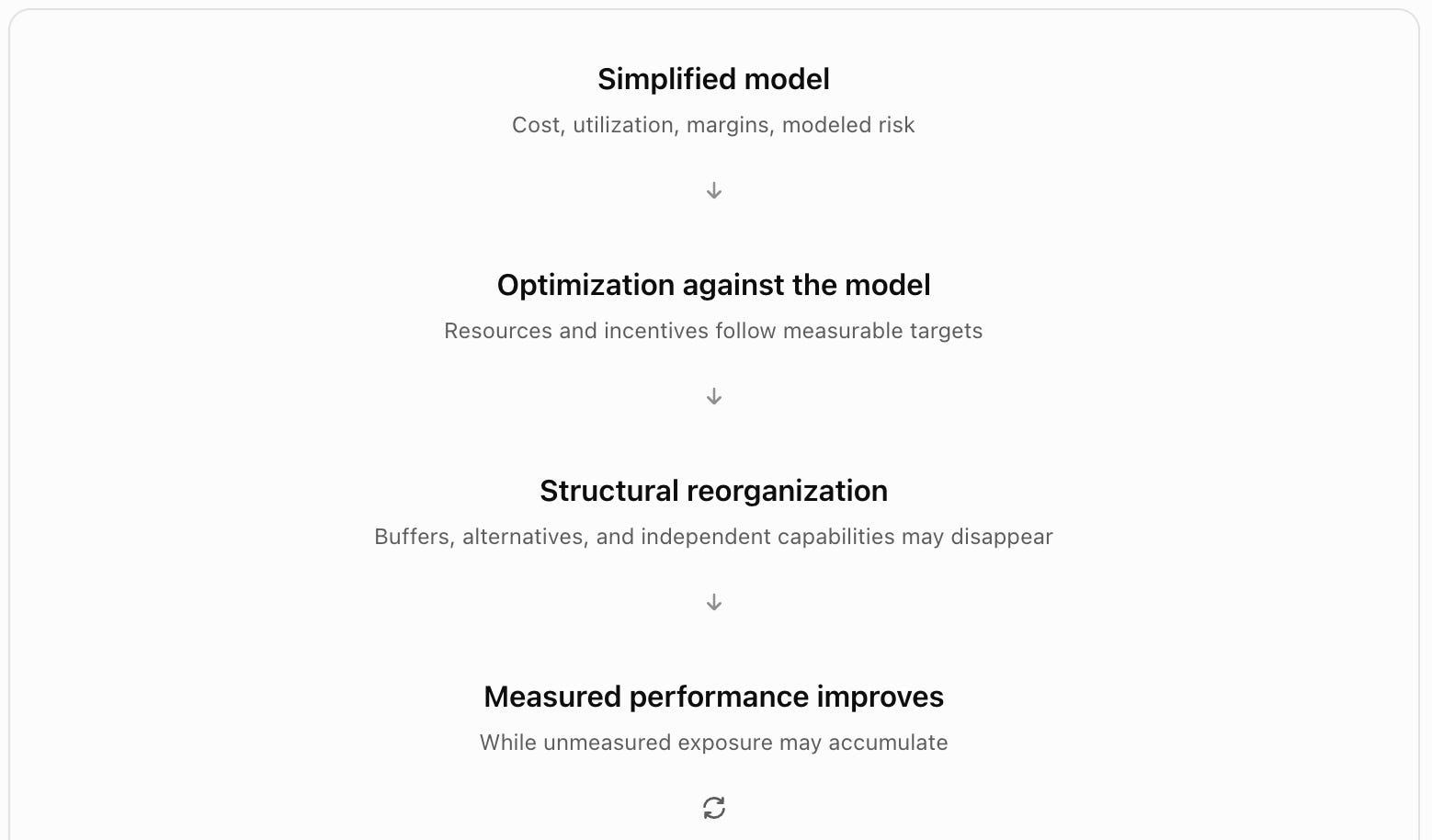
This is where I see Korzybski’s insight intersects with Taleb’s philosophy of fragility - the problem is not that human beings use models. The problem is when we forget the limitations of those models and mistake favourable performance under ordinary conditions for evidence of resilience under extraordinary ones.
No mathematical model can fully capture a complex, continuously changing world, nor can any institution possess complete knowledge of all the relationships and dependencies within the systems it governs. So this leads to a more fundamental question: if our maps will always remain incomplete, why do we continue designing economic systems whose survival depends on the accuracy of said maps?
Perhaps the solution is not to improve our representations of reality, but to organise institutions so that the consequences of our mistakes remain survivable? And that, dear readers, requires reconsidering the architecture itself.
The Tree and the Rhizome
In A Thousand Plateaus, Gilles Deleuze and Félix Guattari developed a philosophical concept that offers an alternative to hierarchical, centrally organised systems: the rhizome.

They contrasted arborescent structures, organised around roots, trunks, branches, and privileged points of connection, with rhizomatic arrangements characterised by multiplicity, heterogeneity, and the possibility of continually forming new relationships.
A tree’s organisation follows a hierarchy, while a rhizome spreads through interconnected, heterogeneous elements without requiring a singular organising centre. Anyone with a big enough garden knows how much easier it is to cut down a tree vs a vine.
To me, one of the most interesting characteristics described in the book was the asignifying rupture: a rhizome can be disrupted and continue developing along existing or newly formed lines. Now, when those two Frenchmen were writing their book, they weren’t designing industrial supply chains or distributed computer networks, nevertheless their philosophical project concerned much broader questions of knowledge, organisation, and even social relations.
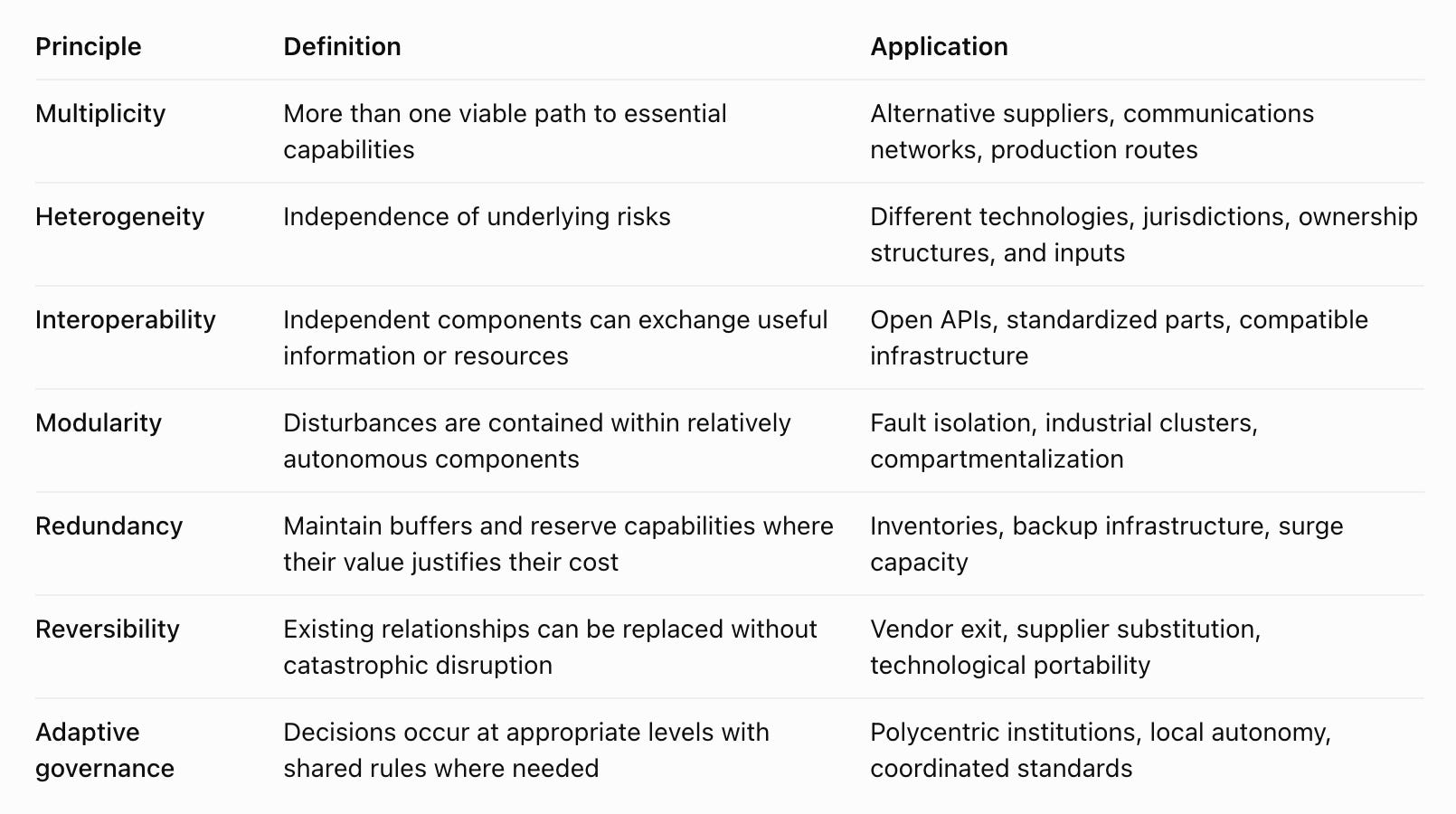
The challenge is designing systems that embody these principles simultaneously. Consider the difference between supplier diversity and genuine supply-chain resilience - a company might purchase from five different suppliers, but all five depend on the same refinery. Yes, in theory it possesses commercial diversity, but not meaningful upstream independence.
The number of suppliers matters less than the independence of their critical dependencies.
Therefore, a genuinely rhizomatic economic network should possess three capabilities:
Survive removal: essential functions can continue when an important node or connection disappears.
Reconfigure: remaining components can establish alternative relationships without rebuilding the entire system.
Learn: local failures generate information that improves future decisions without threatening the whole.
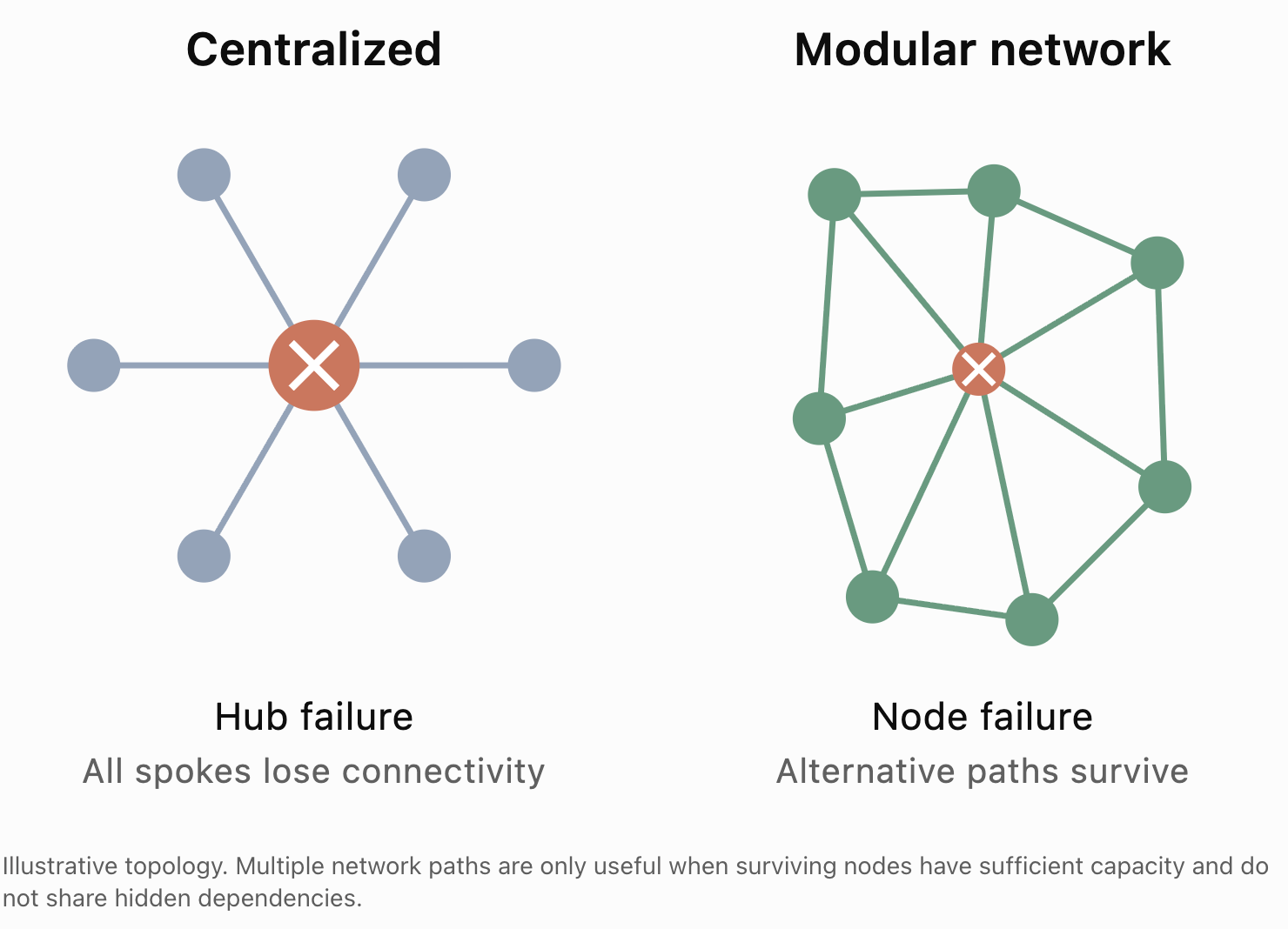
These capabilities can be tested, at least within specified scenarios, which takes the argument of a rhizomatic economy out of the realm of philosophy and into something we can actually tinker with via trial-and-error.
Important qualification: a rhizomatic economy would not eliminate central institutions. Air-traffic control, military command, electricity grids, public-health systems, etc. all require forms of common coordination. The objective is not maximum fragmentation, but interoperable autonomy combined with appropriate coordination.
The Architecture of Complexity
In his 1945 essay, The Use of Knowledge in Society, Friedrich Hayek provides made the argument that the knowledge an economy runs on could be concentrated within a single decision-making authority. Knowledge is dispersed among individuals, businesses, and institutions. It is often local, contextual, incomplete, and constantly changing - no central authority can readily possess all the information necessary to coordinate a complex economy.
However, as much as I am a fan, I also have to admit - decentralisation fails too.
This is where the work of Elinor Ostrom on polycentric governance becomes particularly valuable. Her best-known case is in my adopted country (Switzerland, the pinnacle of modern decentralised governance). In the Valais village of Törbel, farmers have run their shared alpine pastures under written rules since 1483. Nobody nationalised them and nobody privatised them. The core rule: no family may send more cows up to the summer pasture than it can feed through the winter. That’s the definition of Lindy - an arrangement that has survived five centuries deserves far more respect than one that has survived say, five quarters.
A decentralised system without governance can become chaotic. A centrally governed system without local autonomy can become rigid and incapable of responding adequately to changing circumstances.
Herbert Simon’s 1962 essay, The Architecture of Complexity, adds another valuable insight to this argument. In his essay, he examined how complex systems can be composed of relatively autonomous subsystems whose internal interactions are stronger than their external ones.
In practical terms, such an architecture can contain disturbances instead of allowing them to propagate indiscriminately. Think of a ship divided into watertight compartments - the compartments remain part of one vessel, but a breach does not necessarily flood the entire structure.
This is the principle that should govern our understanding of the rhizomatic economy:
Systems should be interconnected enough to cooperate, but sufficiently independent to contain one another’s failures.
The Value of Redundancy
One of the more consequential implications of this approach to (re)organising our economic order is that we need to reconsider what constitutes economic waste.
Conventional accounting treats unused capacity as an expense - an idle manufacturing line consumes capital without producing output; a secondary communications network requires maintenance even when the primary network works perfectly.
However, we have to realise that these assets possess something conventional performance metrics either do not capture or simply undervalue: the option to adapt.
A country maintaining reserve industrial capacity possesses the ability to expand production when circumstances demand it. A manufacturer retaining alternative suppliers possesses the ability to reorganise production when an established relationship fails. An enterprise maintaining independent recovery infrastructure preserves the ability to continue functioning when its primary provider becomes unavailable.
These are economically valuable capabilities even when they remain unused for prolonged period of time.
However, that does not justify unlimited redundancy, as former U.S. Secretary of Commerce Gina Raimondo had explained in the past regarding industrial policy. A country attempting to domestically reproduce every stage of every supply chain would fail by default because it will incur enormous costs, sacrifice specialisation, and potentially create new domestic concentration risks.
The argument for a rhizomatic economy should never become a disguised argument for autarky - international trade and specialisation are not the enemy. The vulnerability emerges when interdependence becomes so concentrated that losing one relationship threatens the functioning of the entire system.
A more resilient economy could remain deeply globalised while diversifying critical capabilities, building alternative production networks, maintaining appropriate strategic reserves, and developing interoperable technologies.
The objective is to preserve the economic advantages of cooperation without sacrificing the freedom to reorganise when circumstances change.
Sovereignty Through Substitutability
The geopolitical implications of all this are considerable.
For decades, technological sophistication has often been confused with technological sovereignty. A country may possess advanced industries, sophisticated military capabilities, and highly developed digital infrastructure while remaining dependent on foreign actors for the components necessary to operate them.
Think of the recent energy shocks Europe has experienced. First, it made itself dependent on gas imports from Russia for decades, but due to the war - it began diversifying on those commodities…from the Middle East. The same region that is now disrupted by yet another war, and yet another breakdown of supply chains an blockade of maritime trade routes.
Government can formally diversify suppliers while still remaining exposed to common upstream bottlenecks. Truth is, we need a more serious approach to measuring dependence.
For critical infrastructure, enterprises, and strategically important industries, resilience assessments should examine the independence of upstream suppliers, the existence of substitutes, the time required to recover from disruption, and the ability to continue functioning when essential services disappear.
The ultimate objective - and what I am advocating for in this essay - would be to reach an economic system in which dependence is a choice that can be reconsidered, rather than a condition from with no practical escape.
We cannot map away uncertainty, but we can build a civilisation that does not collapse when our maps prove to be wrong.
"All models are wrong, but some are useful." Fantastic article! I'm a controls engineer now doing a little teaching. In my controls courses, I always start with architecture and Herbert Simon's 1962 paper. And as I tell my students, company managerial systems and governmental institutions are simply control systems. They should be designed with this - and particularly Herbert Simon's insights - in mind. (And a little Functional Safety goes a long way to ensuring adequate redundancy.) As the sociobiologist E.O. Wilson remarked back in 2009: "The real problem of humanity is the following: we have Paleolithic emotions; medieval institutions; and god-like technology. And it is terrifically dangerous, and it is now approaching a point of crisis overall." We have created an incredibly complex world via local optimization of systems. I don't think we can afford to ignore the global system any longer.
This is great work and something I have been musing about recently in the context of communication system resilience. I also see a deeper connection to the emerging field of “evolutionary coding” (see Mo Bitar, youtube/substack) where humans define success criteria at the boundary and then AI does what it wants within that - and humans don’t care about the internal details anymore. Lots more to say about that.