

Dear readers, I’m writing this on a chilly autumn evening in Switzerland, from a 2025 MacBook Air, wearing Bose noise-canceling headphones, while my Siemens dishwasher does the dishes and my English evening tea brews. All of these physical products - the laptop, the headphones, the dishwasher, the tea - exist because of an insanely complex web of supply chains and trade routes.
Let’s use the MacBook Air as the example. I’ll keep it simple enough not to bore you to death: this is what a real-world supply chain looks like.
A MacBook is not just a product - it’s a choreography of mines, smelters, fabs, chemical plants, cleanrooms, CNC mills, and freight corridors.
A MacBook starts with rocks and sand. Bauxite from Australia or Guinea is refined in Quebec or the Persian Gulf, then milled and anodized in China to make the aluminum body.
Sand from the U.S. or Malaysia becomes glass; films and polarizers are coated in Japan and Korea.
Indium - often a zinc by-product from China or Canada - becomes transparent electrodes.
Display backplanes are patterned in Korea, Japan, and China, then bonded into full panels in Guangdong or Bac Ninh.
Chips begin as quartz. Wafers are made in Taiwan and South Korea. Apple’s SoC is etched at TSMC in Hsinchu.
Memory comes from Korea (Samsung, SK hynix), Japan (Kioxia), and the U.S. (Micron).
Batteries pull lithium from Chile/Argentina or Western Australia, cobalt from the DRC, nickel from Indonesia, and graphite mostly from China - then cathodes, anodes, and cells are built in China or Korea and packed with a BMS in China/Vietnam.
The smallest parts have the biggest footprints. Neodymium magnets trace to Inner Mongolia (Bayan Obo) or Australia (Lynas ore, processed in Malaysia) before they become speakers and haptics.
Tantalum capacitors draw on Rwanda and Brazil. Palladium and gold plating lean on Russia/South Africa and global refiners.
Final assembly runs through EMS plants in Chengdu, Shanghai, and northern Vietnam. Boxes move to Yantian or Haiphong, fly to Louisville or Leipzig, or sail to Rotterdam and Los Angeles.
Behind the scenes: Taiwanese fabs drinking ultra-pure water, Japanese photoresists, U.S./EU industrial gases, Brussels and Washington for compliance, London for insurance, and customs codes everywhere.
Bottom line: the MacBook on my desk is a chain stretched across Australia, the Andes, the Congo, Inner Mongolia, Hsinchu, Osaka, Seoul, Shenzhen, Hanoi - and plenty more. The supply chains behind a single product are mind-boggling in complexity, scale, and reach.
And now those chains are being weaponized, trade corridors and chokepoints are under attack (e.g. the Red Sea), and the prosperity we took for granted is gradually evaporating.
History as Context: The Post-WWII Order
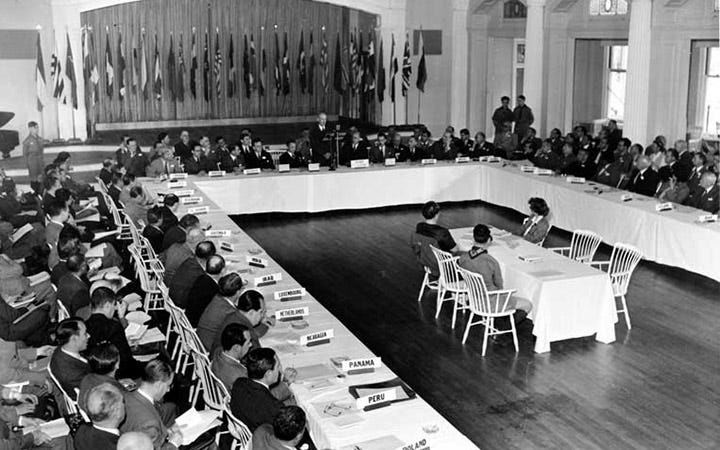
After 1945, the U.S. built the operating system for global trade - Bretton Woods, IMF/World Bank, GATT→WTO - and paired it with hard power: a Navy keeping sea lanes open, freedom-of-navigation, and the Carter Doctrine guarding oil chokepoints.
The deal was simple: allies got access and security; America kept the commons safe so containers moved through Hormuz, Bab el-Mandeb, Malacca, and the Taiwan Strait.
And yes, the U.S. profited tremendously - everyone acts first and foremost in their own interest. They understood that steering the lanes, keeping the naughty ones in line (via means soft or hard power), and keeping trade open meant more prosperity for them and, by extension, others.
It worked - until the consensus cracked. Back in the late 2000s, war-weary voters, cheered Obama’s line - “America is not the world’s policeman” - which signaled a pullback in ambition even as ships still sailed. The Navy didn’t quit, but the political will did: fewer resources, more cuts, and a new era of American isolationism.
The result: the postwar bargain began to crack. Premiums rose at every chokepoint, and supply chains took the hit, because when the guarantor hesitates, logistics pay. And your cost of living didn’t catch with with your wages.
Those signals echoed through Trump 1 (not fully), Biden, and Trump 2 administrations. Voters and much of the political class are drifting away from policing global supply chains, while the Pentagon tries to hold the line (e.g. military operations against Iran, the Houthis, etc.).
The Xi Doctrine: Capturing the Supply Chain
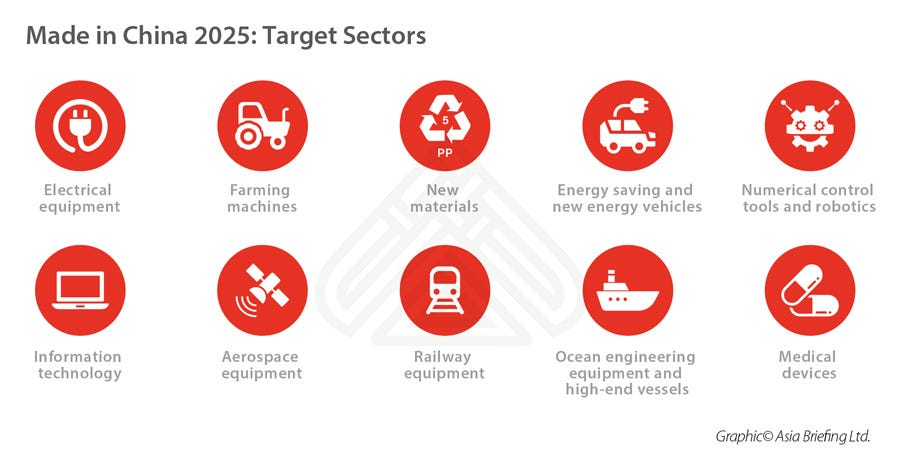
China didn’t “join” global supply chains - it captured the upstream and midstream. Under Xi, Beijing set out to own mines, refineries, converters, and the tooling everyone else outsourced. The Made in China 2025 doctrine (launched in 2015) spelled out the climb up the value chain; production and supply chains must be controlled for national security.
The results are visible: rare-earth processing and magnets concentrated in China; solar PV dominated end-to-end; batteries routed through Chinese graphite, cathode precursors, and cell lines; PCB, packaging, and components clustered in the PRC. When leverage is needed, Beijing uses export controls - gallium, germanium, graphite - to remind rivals their “global” chains run through Chinese permits.
The world still trades; but Beijing sets the tempo.
EaaS: Economy-as-a-Service
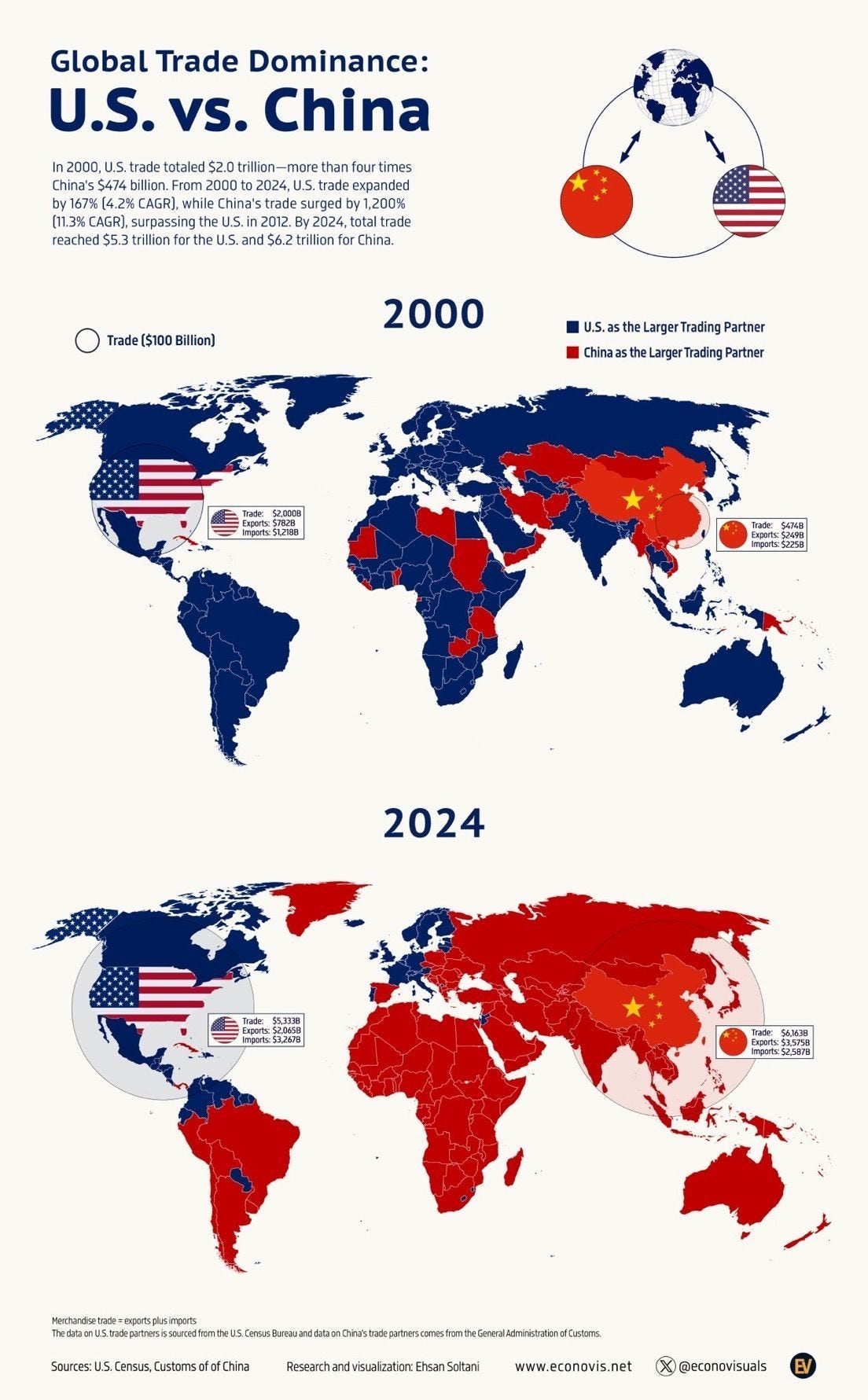
For decades, the West shifted from a production-based economy to a service-based economy. This wasn’t an accident; it was engineered. We offshored the hard, low-margin, politically messy parts of capitalism - factories, mines, processing plans - to cheaper jurisdictions. Boards closed plants and kept the brand, IP, and billing. Shareholders got margins; consumers got cheap everything; and the industrial muscle of the Western world atrophied quietly because ships kept arriving with cheap goods.
The dollar did the true magic here. As the reserve currency, it let us run deficits at low rates and buy the world’s output. Every crisis (‘08, Eurocrisis, COVID) got the same medicine with new branding: QE, zero rates, backstops. Asset prices got as ripped as a gym bro on illegal steroids - houses, stocks, startups, you name it.
Services bloomed because profits moved to intangibles: finance, consulting, SaaS, marketing, law, administration. Strong currency + import deflation meant desk jobs paid more than making real things, as in actual physical products. We told kids to chase credentials, not apprenticeships.
Cheap money sealed the deal. Refinance the assets, lever the portfolio, hire another layer of compliance and product managers. Hospitals, universities, big tech, they all hired armies of well-paid office roles. Comfortable, yes. Also fragile.
The unfortunate reality is that the white-collar premium exists only if ships carrying cheap goods arrive, the dollar clears, and central banks keep inflating assets.
Break any link in that web of dependencies and the comfort premium evaporates - and it evaporates fast.
Prosperity Is Dead? Or a New Age of Work?
If the West wants to reverse the slide, it has to make hard choices. Very, very hard choices.
First, accept that power and only power, protects trade. There’s an old saying: if goods stop crossing borders, soldiers will. Where soft power fails, hard power fills the vacuum. Which means that any current wars (Ukraine, Israel/Iran) or upcoming ones (e.g. Venezuela) are not “warmongering”, they are necessary. Soldiers will fight, and soldiers will die.
Second, rebuild domestic and allied supply chains. Neither bloc - China/Russia/Iran/NK/BRICS nor US/EU/AUKUS/APJ allies - controls the full upstream. Both sides depend on each other. Decoupling will be slow and very, very painful. But it’s still necessary (in my opinion), because as we demonstrated - trade didn’t liberalize autocracies.
Third, everyone pays - Boomers, Gen X, Millennials, Gen Z - for at least two decades to rebuild capacity so the next centuries can be peaceful and prosperous. No, French boomers don’t get to have higher pensions than the average French full-time employed adult; no, Gen Z doesn’t get to make a career out of being a TikTok influencer.
This is the reality, dear readers.
I don’t like it either, but that’s where we are, and the choices are both limited and unpleasant.
And for anyone that doesn’t like the American world order we had until yesterday, I can guarantee you with 1000% certainty - you will loathe the one that the CCP would impose if given the chance.
Too much comfort has consequences, some discomfort might be our salvation.
But this discomfort as you say needs to be collective and most importantly perceived as such.
I recently watched a very clever entrepreneur on a French show about the Zucman Tax. The idea behind the Tax is absolutely vital to restore trust between masses, elites and large fortunes.
But it’s implementation instead of being a source of unity is a source of division, because it’s imposed without a two-way dialogue.
While it is necessary that everyone contributes to the effort, the political elite needs to be the one to lead the way:
First by cutting themselves into their own benefits and reducing the top-heavy part of the administration, and relocate those funds into infrastructure and the bottom part of the public service, the part that is actually servicing the public.
Not by imposing taxes on “rich people” but by convincing them it’s the right thing to do for everyone and help them structure how that “sacrifice” will take place.
If this is done and demonstrated through effective measures that people can feel in their daily lives, 10-15 years down the road you have a transformed country and a positive dynamic.
Great article! How confident are you the we can cohesively have this kind of conversation on a national scale and make these choices? I just don’t see how…