

Waronomics is free to read, but entirely reader-supported - if you find this work valuable, you can support it by becoming a paid subscriber or buy me a coffee.

There is an old parenting philosophy, particularly well represented in Balkan households: after you have explained for the 15th time why something is a stupid idea, you let your toddler discover the reason for himself.
Back home, we call it: остави го да си счупи главата - let him break his head. The expression is usually less literal than it sounds. Well, usually.
When I first wrote The Politics of the Impossible, several people asked me about the antidote to populism. At the time, I didn’t have a good enough answer. Explaining why a promise cannot be delivered is one thing, getting someone who desperately wants to believe it to listen is quite another.
Over the past few years, I have entertained some fairly radical answers to that question. Admit that our security environment is already defined by war and suspend elections for a decade. Give the military more influence. Have the intelligence services undermine movements that threaten the democratic order. Each proposal eventually ran into the same problem: I would be dismantling the liberal democratic system I wanted to preserve.
Then I came back to something considerably less sophisticated, and considerably more…Balkan. Sometimes, the only way out of hell is through.
Earlier this year, Rumen Radev’s Progressive Bulgaria won 131 seats in our 240-seat parliament. I had expected him to get, at most, around 110 and spend his time in a shaky coalition on the verge of collapse. Instead, he got a majority. My opinion of such Soviet-coded and deeply incompetent political saviour, aside, when my anger subsided I realised that a majority also removes a very useful excuse. Now, he has the votes to pass legislation and enact the reforms he promised. If he cannot deliver, blaming an obstructive coalition partner becomes impossible when there isn’t one.
Will bad decisions hurt people who never voted for him? Of course. But if an electorate insists that an incompetent man can perform miracles, there may come a point when they need to drink from the bitter cup of their own medicine.
Yes, I realise this is a huge political gamble, but at that point, I don’t see another option than letting the populists obtain a lawful mandate and face the responsibilities that come with it, while preserving the institutions through which they can be scrutinised and removed. Stop allowing them to occupy the position of permanent opposition.
Why populism is...popular
Governing is the best way to become unpopular, rather quickly. Even governments made up of competent people have to make choices whose costs arrive before their benefits, which plummets their approval ratings among the demos.
Populists always exploit that gap - they can point to something that is wrong, identify someone to blame and promise to put it right without asking the electorate to give up anything it wants. Lower taxes, better services, cheaper energy, fewer workers from abroad, more domestic production, earlier retirement, etc. Everybody gets everything.
Nobody can deliver what I can promise you.
It would make an excellent campaign slogan for populism. Well, at least it would be an honest one.
Yes, the grievances are real - people have watched their purchasing power deteriorate, their communities lose industry and their public services struggle. Established parties have also supplied plenty of incompetence, complacency and outright dishonesty. Being angry about any of that does not make someone stupid.
The trouble begins when the proposed remedy requires pretending that an economy has no constraints, or that reality doesn’t exist. Populism adds a useful explanation for anyone who points them out: the experts, courts, civil servants and other inconvenient people must be protecting the corrupt establishment. In that environment, loyalty becomes a much safer career choice than telling the leader that his numbers do not add up.
Human nature will be human naturing. Many people spend their younger years confusing excitement with compatibility: boys only want to date the 10/10 hot girl, girls are attracted to the troubled and sometimes dangerous guy. Once their frontal cortex fully develops, they discover rather painfully that the people they liked back then were not necessarily the types with whom we can (or even should) build a life with. Eventually, maturity and reliability starts looking considerably more attractive.
I suspect electorates can undergo a similar reassessment. After enough drama, the unglamorous politician who understands the budget might begin to look appealing than the incompetent charmer or the entertaining populist.
The lesson is, of course, not guaranteed. A disappointed voter can conclude that the promise was fraudulent, or that the leader was betrayed (e.g. Good Tsar, Bad Boyars kind of situation) and needs even more power. A movement can lose an election, change its name and return. Trump has already demonstrated that a first term and an electoral defeat do not necessarily settle the matter.
Governing, however, can expose the fraud. Whether the electorate recognises it depends on who gets blamed, what information survives and whether a credible alternative exists.
The rise and fall of MAGA
MAGA is the ideal case study to examine the distance between the sales pitch of a populist movement and the actual product they delivered. The 2024 Republican platform promised to end inflation, restore affordability, revive manufacturing, secure the border and restore peace. Trump’s promise of a rapid settlement in Ukraine was already being quietly extended into months or longer before his inauguration.
We know what they promised, now let’s examine what they actually delivered:
Start with the tariffs - they were sold to as a means of making other countries pay while rebuilding American industry. There are circumstances in which tariffs can protect strategic production, but that protection has a cost, and the government does not get to decide that foreigners will absorb it just because that sounds better at a rally.
New York Fed researchers, using import data through November 2025, found that nearly 90% of the economic burden of the 2025 tariffs fell on American firms and consumers. Some businesses absorbed costs in their margins; others passed them on. Either way, the bill was overwhelmingly landing on the people that were promised someone else will pay it.
And the American manufacturer is also an importer - its machinery, components, metals and intermediate inputs do not become locally available because the finished product has an American flag on the box. Tax those inputs and you can make the factory you claim to be helping more expensive to operate. Building replacement capacity requires investment, skilled labour, electricity and time. A tariff announcement supplies none of those by itself.
On affordability, July 2026 consumer prices were 3.4% higher than a year earlier, with energy prices up 14.7%. Inflation has several causes, and a lower inflation rate would not mean a return to the old price level anyway. But voters were sold relief at the checkout, and instead they got even higher prices at the gas station and the grocery store.
Then there is peace. As of early September, the administration was still sending envoys to negotiate an end to Russia’s war in Ukraine. Meanwhile, the United States had spent six months involved in a war with Iran - the resulting pressure on fuel prices has helped turn a foreign-policy decision into a domestic cost-of-living problem. Reuters’ six-month assessment describes that political consequence quite well.
Populists didn’t bother to inform their voters that a war affecting energy flows reaches them through transport, manufacturing, food distribution and household bills.
Some promises have produced results. NATO allies did agree in 2025 to a 5% defence and security spending commitment by 2035, including at least 3.5% for core defence. Trump can reasonably claim a role in applying pressure for that commitment - in a way, Trump might be one of the better things that has happened to a permanently asleep Europe when it comes to the realm of defence. It is also future spending on allied capabilities, rather than a payment into an American collection jar, which is a net positive for European industry.
In the Reuters/Ipsos poll conducted on 14–17 August, 33% approved of Trump’s performance and 64% disapproved - as I said in the beginning, the easiest way to become unpopular fast is to actually start governing.
The downfall of the Brexiteers
Britain has already conducted a rather expensive experiment in turning a populist campaign slogan into a governing programme, and failing spectacularly.
The Leave movement was a coalition of different actors: Boris Johnson and Michael Gove in the official Vote Leave campaign; Nigel Farage and UKIP, campaigning separately; Conservative Eurosceptics; and a smaller Labour Leave contingent. Their motives were not identical - some wanted a more deregulated economy, others less immigration, and others a stronger protective state. Brexit was a sufficiently vague vessel for all of them.
Once the Leave campaign prevailed and Brexit had to be implemented, the contradictions became far less accommodating.
First, the NHS money. Remember the bus suggested that Britain could redirect £350 million a week from the EU to the health service? The UK Statistics Authority’s rebuke explained that the figure confused gross and net contributions and ignored the rebate and money returning to the UK.
Theresa May subsequently announced substantial additional NHS funding. So the useful criticism is not that no government ever allocated more money to the NHS, it is that an NHS funding settlement does not demonstrate that Brexit generated the advertised £350 million of free money every week.
Then, immigration. Ending free movement did give Westminster greater discretion over who could come to Britain, yes. What followed was a British government choosing a new visa regime in an economy that still needed workers, and a university sector that still recruited international students.
The latest ONS series puts net migration at a peak of 944,000 in the year ending March 2023. It then fell sharply, to a provisional 171,000 in 2025, following tighter rules. EU+ net migration was negative, while non-EU+ net migration remained positive. The composition changed dramatically; for several years, the total rose rather than delivering the reduction many Leave voters expected.
Those later reductions matter, because immigration policy can change numbers. But ending free movement did not make an ageing population younger, train a replacement workforce or remove employers’ demand for labour. The government gained control over the rules and then had to make choices about what that control would cost. Brussels was no longer making those choices for it.
Next came liberation from bureaucracy. Leaving the single market and customs union introduced customs formalities and rules-of-origin requirements into trade that had previously moved within a common system. The House of Commons’ July 2026 briefing sets out the resulting requirements. Britain could change domestic regulations, but exporters still had to meet the conditions of the market they wanted to sell into.
Apparently, abolishing Brussels bureaucracy involved creating additional British paperwork. Who could have foreseen it, apart from the people explaining it at the time?
And then there was Global Britain. The UK did acquire an independent trade policy and sign agreements. Those are real changes, yes. The promise that they would compensate effortlessly for making trade with nearby Europe more difficult was another matter.
The government’s assessment of joining the Pacific trade agreement, CPTPP, estimated a long-run GDP gain of around 0.06%, with uncertainty around the estimate and scope for larger benefits if the bloc expands. A useful agreement can still be a very modest economic gain. Australia and Japan were not going to relocate to the other side of the Channel to help the numbers along.
Brexit does not explain every British economic failure, yes, but it will forever be blamed for it - even for the failures it did not incur on its tap. Underinvestment, the pandemic, the energy shock and domestic policy mistakes all belong in the account. Adding barriers to your nearest major market did not make those problems easier to solve.
The Conservatives eventually paid an enormous electoral price, falling to 121 seats in 2024. But Farage’s Reform UK, the renamed Brexit Party, won 14.3% of the vote and five seats. In YouGov’s poll of 30–31 August 2026, Reform was on 23%, level with Labour.
The party that implemented Brexit was punished, however the politician most associated with demanding it remained available to explain that the others had done it wrong.
This is the problem with assuming that failure teaches its own lesson. The people selling the idea can survive by distancing themselves from its implementation, which is a risk we need to acknowledge.
AfD in Germany
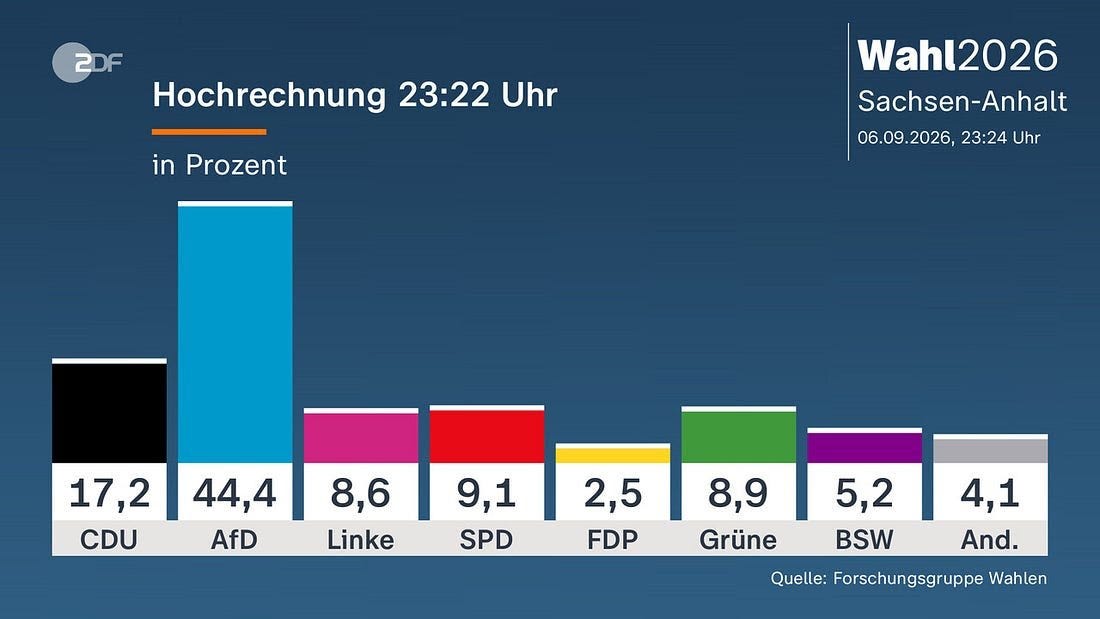
AfD has spent years selling the politics of the impossible from the comfort of opposition - typical populist strategy. Now it may get the opportunity to demonstrate whether it can manage anything more complicated than a Zoom meeting.
Its 43.8% of the vote in Saxony-Anhalt on 6 September brought it closer to running a state government, although 39 of 83 seats still leaves it short of a majority.
Saxony-Anhalt is a rather inconvenient place to discover how much your promises depend on other people’s money. In 2025, it received roughly €1.95 billion through Germany’s financial equalisation system, before additional federal grants. It also benefits from EU development funds.
For anyone from the former communist bloc, the spectacle is depressingly familiar: talk big against the “collective West”, as if you are somehow not part of it, then expect the trade, investment and financial support to keep arriving. The more prosperous parts of Germany and the much-despised EU remain rather useful when the bills come in.
Radev has the Bulgarian version of this problem: a projected budget deficit of 5.7% of GDP and a state that still has salaries and services to pay for. The people expecting their pay cheques are unlikely to accept a political speech dipped in Soviet-coded nostalgia, because those don’t pay the bills.
AfD would face its own arithmetic if it starts governing. The Halle Institute for Economic Research estimates that its programme leaves a financing gap of at least €2.2 billion a year. More benefits, lower taxes and no new debt. Apparently, somebody else is supposed to work out how that combination functions.
If AfD forms a government, let it explain to its own voters which promises survive the budget negotiations. By the next federal election, expected in 2029, Germany could have a much clearer idea of the actual governing abilities of the AfD. Saxony-Anhalt would be paying for the lesson, of course. And they will pay dearly, mark my words. But I would rather the electorate saw the governing capabilities of these populists before handing over the whole country - and the biggest and most powerful one in Europe at that.
Le populisme français
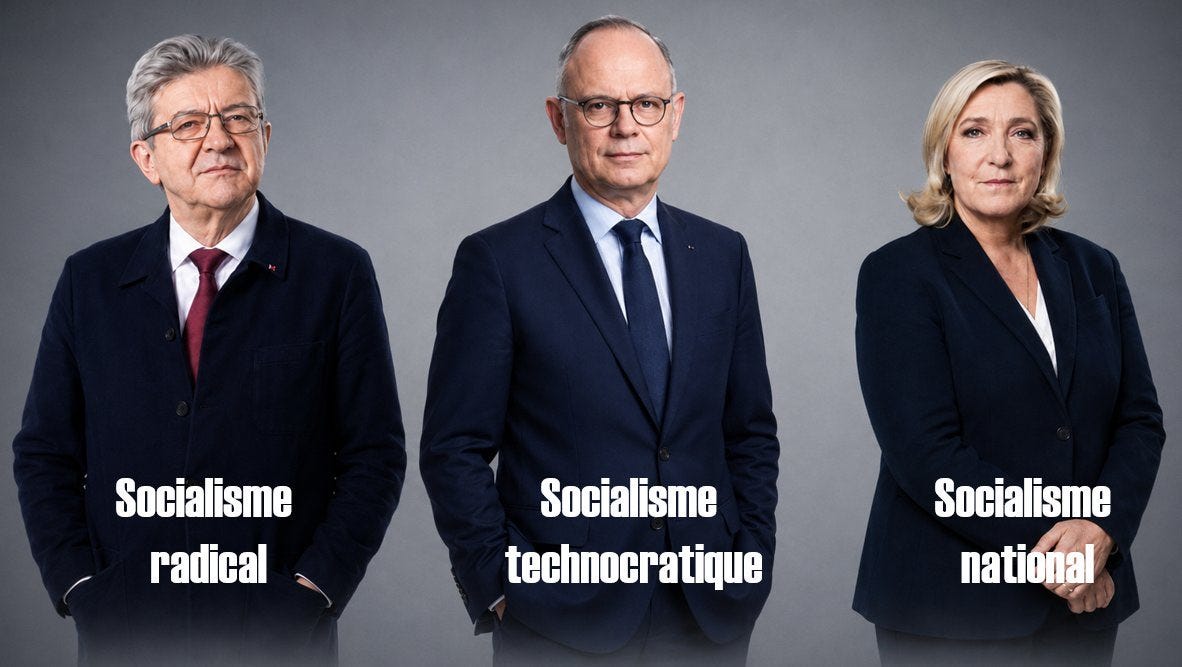
Say what you will about the French, but they know how to do even bad things in style.
This is by far my favourite meme on the French election - the Mélenchon–Philippe–Le Pen triad captures a familiar French instinct: whatever the problem, ask the state.
Despite their differences, all would inherit the same arithmetic: a 2025 deficit of 5.1% of GDP and public debt of 115.6%. There is considerably less room for additional promises than the campaigns would suggest.
Mélenchon
LFI offers retirement at 60, a higher minimum wage, price freezes and restoration of the wealth tax. I doubt their voter base has been informed that earlier retirement needs financing, and a decree lowering the price of energy does not produce more of it.
His version of sovereignty is equally selective. In his August 2025 essay, Mélenchon described prospective Ukrainian and Georgian NATO membership as annexation by the alliance and a declaration of war against Russia. LFI subsequently proposed withdrawing France from NATO, beginning with its integrated command.
France gets to choose its security arrangements; Ukraine’s choice becomes a provocation, and from this side of the former Iron Curtain, that argument sounds very familiar. I wonder where else have we heard it? Oh, yes. In Russia.
Le Pen
The RN has combined national preference with promises of lower energy taxes, support for public services and much lower immigration. The attraction is straightforward: keep the protections, remove those blamed for making them unaffordable.
Lower taxes still reduce revenue. Excluding someone from a benefit does not create another nurse, another apartment or more generating capacity. Savings from fighting fraud need to be demonstrated before they are spent several times over.
The sovereignty argument also comes with a footnote: the party’s €9.4 million Russian bank loan in 2014, repaid in 2023. Apparently, some foreign dependencies were more acceptable than others.
Édouard Philippe
Édouard Philippe is a different proposition. Horizons advocates a less costly state concentrated on essential functions, while his support for longer working lives and a funded pension component acknowledges a financing problem the populists prefer to minimise. The transition would still need funding: contributions saved for future pensions cannot simultaneously pay today’s pensioners.
France’s populists owe an explanation of how their promises add up - or don’t. Its establishment owes proof that it can solve the problems those populists exploit. Governing should make both harder to evade.
Balkan Candor
When I was around 3 or 4 years old, I used to circle around my mother while she was ironing. She told me, repeatedly, not to touch the iron because it was hot and I would burn myself. She kept shooing me away until, eventually, she let me touch it.
I got burned, cried, and never got near the iron again.
Pain taught me something that explanations had failed to get through my head. Unfortunately, the political version of that lesson comes with a much larger bill, and it is shared with people who had understood the explanation perfectly well.
Europe is already living with war and its economic consequences. Rearmament, energy security and the rebuilding of critical industrial capacity require money, labour and time. Those resources have competing uses. We can make better or worse decisions about them, but we cannot conduct the whole adjustment while pretending that the security arrangements and cheap inputs of the post-Cold War period remain available on the old terms.
That is the long gone world the populists keep promising to resurrect. The electorate wants the life it remembers, and the politician wants the votes attached to promising it. Reality is left outside until after the election.
However, there is a limit to my childhood analogy. A politician can damage the institutions that would otherwise allow the electorate to correct its mistake. If courts are subordinated, scrutiny obstructed and elections made less competitive, disappointment may never translate into a fair opportunity to remove the people responsible.
So I do not think a “deep state” can safely arrange a controlled dose of incompetence and decide exactly how much damage the public needs to experience. That assumes an extraordinary degree of competence in the people supervising the incompetence.
The necessary work here is more ordinary. Civil servants implement lawful decisions and record what they cost. Courts enforce the law. Parliaments investigate. Journalists follow the money and the results. Security services address actual espionage, corruption and foreign interference within their remit. Elections remain capable of removing an incompetent government.
And the opposition has to offer something more useful than a recurring declaration that the electorate has disappointed it. People still need functioning services, affordable housing and a plausible economic future. If the available alternative cannot improve those things, the next populist has an opening before the previous one has even packed his office.
I cannot promise that one disastrous term will cure a country for a generation or two. That would be my own contribution to the politics of the impossible. But I do think governing can strip away an advantage that argument alone often cannot: the ability to claim that everything would work if only the people making the promise were allowed to try.
I would prefer that we learned by listening, unfortunately many citizens appear determined to learn by experience. Where they insist, the task is to keep the democratic means of correction intact and make sure that the decisions, the costs and the people responsible remain visible.
The only way out of this populist Hell is through. We had better make sure there is still a way out at the other end.
Your points are good.
In my reply, I apply this to the country where I grew up: The white fascist South African government was sort of like an Afrikaner version of MAGA running the country since 1948. It was very fascist early on but by the late 1970s it started gradually becoming less so, under cultural pressure from the white populace calling out the extremes of its unfair policies and saying "this isn't right" until it occurred to enough white people that really the entire structure wasn't right.
As an example, the "Guess who's coming to dinner" American movie was about a white girl dating a black guy, and bringing him home to meet her family. The movie had been made in 1967 but it was allowed in South Africa only ten or so years later. When I was a teenager in South Africa, I watched it with my mother. After the movie she mused "makes one think, doesn't it" and the thought bubble above my head was "I've been thinking about this for a very long time and I'm way past the point where any of this racism and fascism is okay with me. This entire culture sucks and I look forward to leaving it" but the cultural gap between my mother and I was so vast that it was pointless to say such things out loud anymore. I just kept learning about the world outside South Africa and I prepared for the day when I could leave forever.
During that time, I saw the early stages of the implosion of the fascist regime that I hated while the populism of the near-communist ANC party under Nelson Mandela gained credibility. It came into power after I left. Replacing white racist fascism with black racist near-communism changed several things for the better and several things for the worse.
The key point here that ties into your essay is that as the outgoing white fascist guy, FW De Klerk, handed over the government to Nelson Mandela, De Klerk allegedly said: "and now you will see how little power I actually do have." The premise of telling a populist leader: "well, you're in charge now, see how you like it, and probably you won't" ties in with your point.
South Africa no longer has white racism or any of the typical ills that come with an Afrikaner version of MAGA but as I understand the situation from my comfortable vantage point, very far away, South Africa has a vast amount of other problems, including the sort of power grid availability that Ukraine has due to russian missile attacks, but without the South African equivalent needing russian missile strikes to be in such bad shape.
It is a good generalization that the incoming near-communist ANC government blamed its every problem on the mess left to it by the white fascist previous government, but as the years and decades went by, this became ever less of a credible claim yet cynically it continued to be said with everyone including the speaker knowing it was a lie, sort of like the russian approach of "I'm lying, and you know it, and I know you know it, but I continue to lie even so."
The deeply corrupt populist near-communist ANC government stayed in power from 1994 to 2024, and it's not as if South Africa became a shining example of good government even after 2024.
Your vision, whereby a mechanism had better exist to expeditiously vote out a failing populist government, is essential. This point is sadly not lost on populist governments who make it a priority to entrench themselves.
I agree with what you said but would add maybe the rise of populism should be viewed as a warning klaxon by the political establishments in democratic countries. If they listened to and heeded the warning they could defuse the populist bomb before it explodes. The case in point is Denmark. After 2015 they moved to a more restrictive immigration policy and also worked to limit some of the social damage immigration causes such as ghettoization. Because of this populism never took hold in Denmark and doesn't seem likely to in the foreseeable future.