


If you want to cripple the global economy today, you don’t need to bomb a capital city or hack a stock exchange. You just need a cheap drone and a map of the Red Sea. 99% of the world’s internet traffic travels through subsea cables, 80% of global trade volume moves by ship, and our energy - from offshore wind to deep-water oil - is increasingly anchored to the seabed.
The global maritime domain is currently undergoing a structural transformation of historical magnitude, characterized by two simultaneous and colliding forces:
A rapid intensification of economic activity and infrastructure development;
A deterioration of the geopolitical security order that has governed the oceans since the end of the WWII.
The problem? We forgot to secure it.
This is the state of play in the maritime domain today: there’s widening gap between the exploding economic value of our oceans and our ability to protect it. And whenever there is a gap between value and security, there is an opportunity for asymmetric warfare.
Subsea Infrastructure: The Invisible Backbone of Today’s Economy
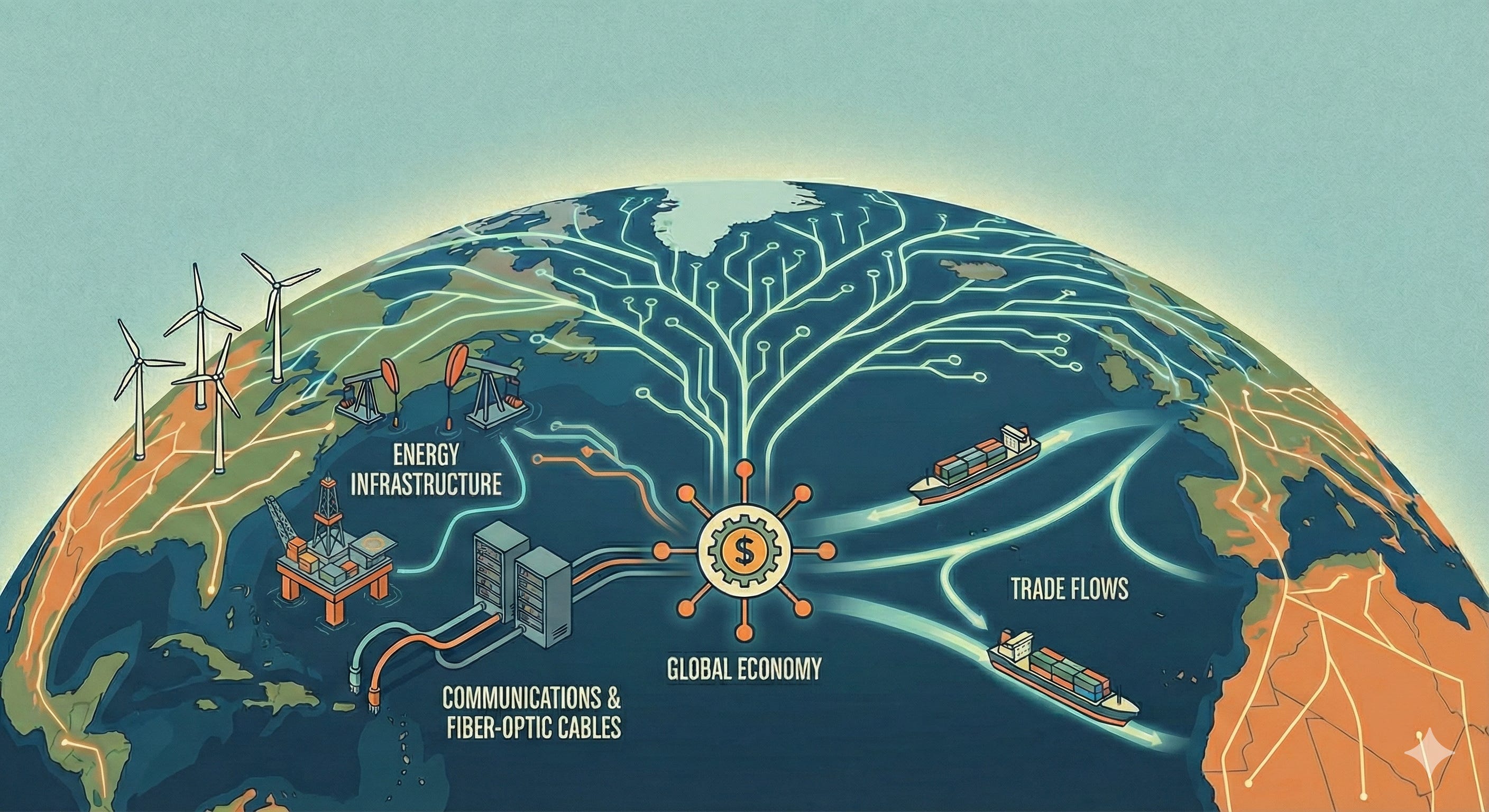
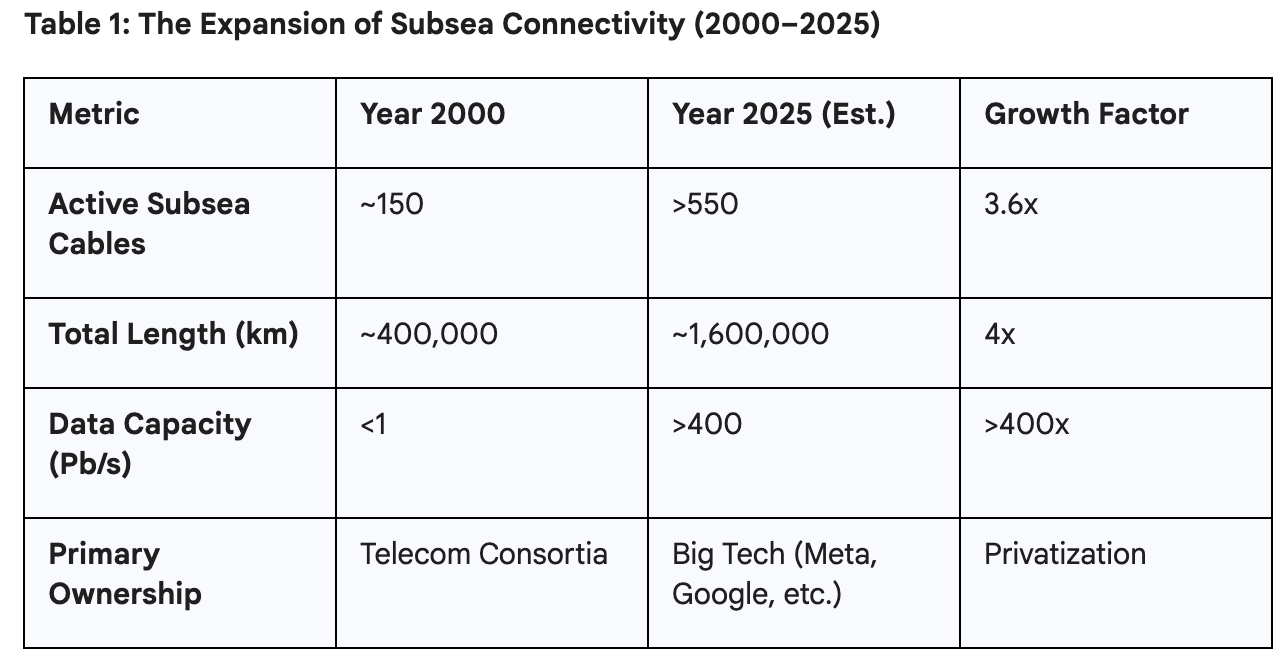
As of today, a network of approximately 1.6 million kilometers of fiber-optic cables rests on the ocean floor, facilitating 99% of all international digital traffic, including an estimated $10 trillion in daily financial transactions.
This infrastructure has become the central nervous system of our modern civilization. Unlike the decentralized nature of the internet’s logical layer, the physical layer is geographically concentrated and surprisingly fragile.
Between 2016 and 2022, international bandwidth usage essentially doubled every two years. This growth is not merely linear but exponential, driven by the data appetites of AI models and the globalization of digital services.
However, this expansion has created a paradox: as the global economy becomes more dependent on these cables, they become more attractive targets for adversaries seeking asymmetric leverage. Recent cable-cutting incidents in the Baltic and Red Seas, demonstrated that subsea infrastructure is a prime target for “gray zone” warfare - attacks that inflict significant economic damage but remain below the threshold of armed conflict that would trigger collective defense treaties like NATO’s Article 5.
The Industrialization of the Seabed: Energy and Resources
Parallel to the digital expansion is the physical industrialization of the ocean for energy and resources. The offshore oil and gas industry has pushed into deep waters, requiring complex subsea architecture including pipelines, risers, and monitoring systems. There are now over tens of thousands of kilometers of subsea pipelines operating worldwide, a complex vascular system that transports the lifeblood of the global energy market.
Simultaneously, the renewable energy transition has driven a massive buildout of offshore wind, that will transform coastal seas into dense grids of turbines and substations by 2030, according to Global Wind Energy Council projections.
Furthermore, deep-sea mining is transitioning from speculation to reality. With the International Seabed Authority (ISA) licensing over 1.5 million square kilometers of seabed for exploration, the extraction of polymetallic nodules - critical for the batteries powering the green transition - is imminent. Additionally, the recent Chinese embargo on rare earth minerals is accelerating deep-sea mining for these vital materials.
The Clarion-Clipperton Zone (CCZ) in the Pacific alone contains more nickel, manganese, and cobalt than all terrestrial reserves combined. This creates a new geopolitical point of tension, as nation states compete for access to strategic minerals in areas beyond national jurisdiction, effectively extending terrestrial resource wars.
Oceanic Global Supply Chains
Over 80% of global trade by volume now moves by sea, but this efficiency has come at the cost of resilience. The global supply chain relies on a “just-in-time” delivery model that assumes open sea lines of communication and secure chokepoints. That, unfortunately, is no longer the case as we have seen with the Red Sea lanes today, and previous blockades of the Suez canal.
The modern maritime economy is characterized by extreme concentration. Traffic is funnelled through a handful of narrow waterways - the Suez Canal, the Strait of Malacca, the Strait of Hormuz, and the Panama Canal. These chokepoints are the single points of failure for the global economy. When these arteries are threatened, the economic consequences are immediate and global, manifesting in inflation, delayed production, and increased insurance premiums.
The Expansion of Asymmetric Risks
The increase of economic value of the ocean has been met with an equal expansion in threats and risks. The maritime domain, once permissive for Western naval powers following the collapse of the Soviet Union, has become highly contested again. The threat landscape has bifurcated into acute geopolitical confrontations and systemic risks, both of which exploit the vastness of the ocean and the limitations of traditional naval policing.
The Red Sea Crisis: A Case Study in Asymmetry
The Houthi campaign in the Red Sea and Gulf of Aden, beginning in late 2023 and extending through 2025, serves as the definitive case study for this new era. Utilizing Iranian-supplied anti-ship ballistic missiles (ASBMs) and one-way attack drones (OWA-UAVs) costing as little as $2,000 to $20,000, the Houthis successfully disrupted a trade route carrying 12-15% of global commerce.
The strategic victory for the Houthis was not necessarily in sinking ships - though they achieved this - but in imposing a “war risk premium” on the global economy. Insurance rates for transiting the Red Sea surged from 0.07% to over 1%, forcing major carriers like Maersk to reroute around the Cape of Good Hope. This detour adds approximately 10-14 days and 4,000 miles to a voyage, burning significantly more fuel and tying up container capacity, which in turn spikes global freight rates.
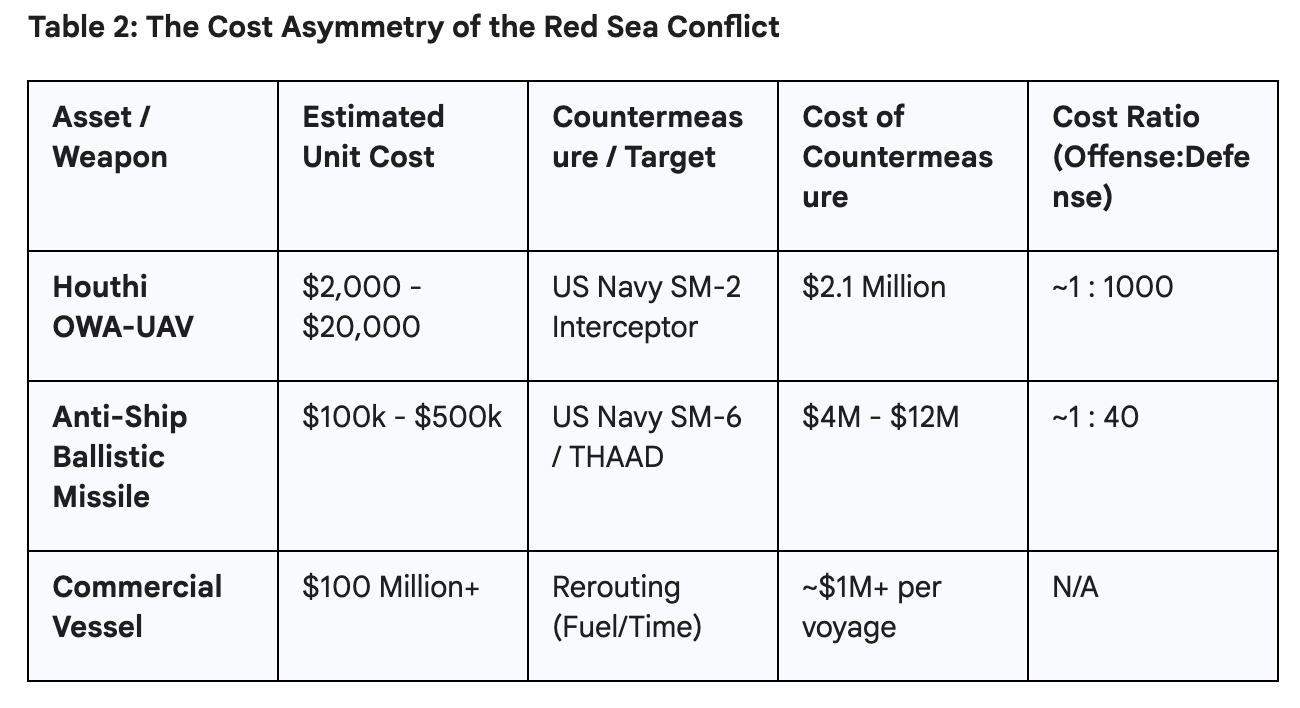
This conflict demonstrated that a non-state actor, with no navy, could effectively close a global chokepoint by leveraging cost asymmetry. Navies operating traditional multi-billion-dollar destroyers found themselves on the wrong side of the cost curve, firing scarce, multi-million-dollar interceptors at cheap drones - a sustainment model that is mathematically impossible to maintain over the long term.
The South China Sea and Gray Zone Tactics
In the Indo-Pacific, the threat is less about kinetic destruction and more about coercive “gray zone” operations. China has pioneered the use of a maritime militia - civilian fishing vessels that operate under military direction to enforce territorial claims without triggering open war.
These tactics represent a sophisticated integration of civilian and military capabilities:
Swarming: Deploying hundreds of vessels to surround disputed features or harass foreign oil and gas operations, creating a physical blockade that is difficult to break without lethal force.
Electronic Warfare: Spoofing AIS signals (making vessels appear where they are not) or jamming GPS to disrupt rival operations. This creates confusion and operational hazards for commercial and military vessels alike.
Dual-Use Research: Utilizing scientific research vessels to map seabed terrain and test subsea communications. This data has direct military application for submarine warfare, allowing the People’s Liberation Army Navy (PLAN) to understand the acoustic properties of potential battlegrounds.
China’s strategy exploits the legal and operational gaps of Western navies. A US Navy destroyer is ill-suited to engage a swarm of fishing boats; using lethal force would be a diplomatic disaster, while non-lethal maneuvering is dangerous and ineffective against mass numbers. This “salami slicing” tactic gradually changes the status quo, effectively annexing territory through persistent civilian-military presence.
The European Theatre: Seabed Warfare
In Europe, the war in Ukraine has spilled into the maritime domain, turning the Black Sea into an active naval warzone and the Baltic Sea into a theatre of hybrid tension. Russia has demonstrated a capability and willingness to target subsea infrastructure. The presence of Russian “research” vessels like the Yantar, known to carry mini-submarines capable of cutting cables, has forced NATO to launch initiatives like “Operation Baltic Sentry” to monitor critical seabed assets. The threat here is existential for the digital economy: a coordinated severance of transatlantic cables could induce a financial crisis comparable to the 2008 meltdown, but within hours rather than weeks.
Latent Threats and Institutional Strain
Beyond state-sponsored aggression, there’s been a rise of latent criminal threats. Illegal fishing is responsible for global economic losses estimated at $20–25 billion annually. Industrial-scale IUU fleets, often distant-water fleets from nations like China, strip resources from the Exclusive Economic Zones (EEZs) of developing nations, causing food insecurity and instability.
Smuggling and narco-trafficking have also evolved too. The use of “narco-subs” (semi-submersibles) has transitioned into the deployment of fully autonomous or remote-controlled low-profile vessels (LPVs) that are nearly invisible to radar. These vessels can transit vast distances without crew, reducing the risk to the criminal organizations operating them.
These threats place an immense strain on Coast Guards and maritime law enforcement agencies, which are typically underfunded and under-equipped compared to their naval counterparts. The gap between the scale of maritime activity and the capacity of the state to police it is widening - a gap that current innovations in autonomous technology is poised to fill.
The Solution? A New Era of Defense Tech
The ongoing convergence of threat, technology, and funding creates a wide range of opportunities for government and industry to redefine maritime security for the 21st century.
The truth is that the ocean is an unforgiving environment - worse than space in many ways. Salt water corrodes everything. Pressure crushes hulls. Radio waves (GPS) don’t travel through water. For decades, this physics problem kept maritime autonomy stuck. If you wanted a UUV, you bought a $2 million bespoke system from a prime defense contractor. It was too expensive to lose, which meant you rarely used it.
Two distinct technological advancements have finally unlocked the physics of this market:
LEO Satellite Connectivity: The proliferation of Low Earth Orbit satellites (like Starlink) has brought reliable, low-latency broadband to the open ocean. This allows surface drones (USVs) to be piloted like aerial drones, solving the “over-the-horizon” command and control problem.
Edge Computing: Advances in high-efficiency GPUs mean we can now run complex sonar processing and decision-making locally on the device, rather than trying to pipe massive datasets back to a central data center.
This convergence is redefining the maritime domain from a platform-heavy Cold War theater into a software-defined battlefield.
Startups are now fielding UUVs for $10,000–$20,000 - a 90% cost reduction compared to legacy systems. This is a pivotal moment in the warfare domain - when the cost of a sensor platform drops to the price of a used car, you don’t just buy one; you buy a thousand. You stop worrying about losing them and start worrying about how to deploy them effectively.
The Waronomics Opportunity
This brings us to the money. The U.S. has a well-documented shipbuilding crisis (China’s capacity is estimated at 250x that of the U.S.). We are not going to solve this problem simply by trying to build more destroyers faster than Beijing. The math isn’t mathing anymore.
The solution - and the investment opportunity - lies in the asymmetric offset.
A rise in Security-as-a-Service defense companies is inevitable. Your average maritime customer - whether shipping giants or wind farm operator - doesn’t want to buy and operate robot swarms. They want outcomes. A security layer that provides persistent monitoring and defense of their incredibly expensive infrastructure and assets.
Conclusion: The Ocean as the Next Economic and Military Frontier
The structural transformation of the maritime domain has irreversibly tied the future of the global economy to the ocean floor and the surface above it. The oceans are no longer a “global commons” in the sense of a free, unpoliced space; they are becoming a crowded, industrial domain where economic competition and military confrontation are inevitable.
The risks are profound. The current model of naval prestige - big ships, expensive missiles - is economically unsustainable against cheap, networked threats. The “gray zone” tactics in the South China Sea prove that legal norms are insufficient without persistent enforcement capacity.
However, the opportunities are equally significant. By leveraging the technology stack of the 21st century, we can build a new maritime security architecture. This architecture will be defined not by the tonnage of steel in the water, but by the density of sensors, the intelligence of algorithms, and the resilience of the networks that connect them.
The technology exists. The challenge now is doctrinal and operational: integrating these new tools to secure the oceanic frontier before the “latent” threats of today become the catastrophic failures of tomorrow.
Appendix
The Blue Acceleration: The Trajectory of Human Expansion into the Ocean
Subsea Infrastructure Failures: Market Risks, Costs, and Opportunities
Development of deep-sea mining and its environmental impacts: a review - Frontiers
After Red Sea attack, shipping firm says it will send its vessels around Africa | CBC News
Signals in the Swarm: The Data Behind China’s Maritime Gray Zone Campaign Near Taiwan - CSIS
International day against illegal fishing - the United Nations
Starlink terminals give Navy ‘game-changing’ flexibility - DefenseScoop
The Future of Autonomous Ships with Blue Water Autonomy’s Austin Gray - Infinite Frontiers
Anduril Opens Factory to Build Unmanned Submarines for Australia
Navy ramping up production of autonomous GARC vessels - DefenseScoop
Subsea telecommunications cables: resilience and crisis preparedness - Parliament UK
It is interesting that so far in the hybrid warfare nobody has touched these infrastructures yet (minor incidents here and there, but not massive consequences)… I wonder why that is.
Is it because everyone is somehow dependent on them ?