


The European defense industry is undergoing its most profound transformation since the fall of the Berlin Wall. Driven by Russia’s war in Ukraine and the growing uncertainty about transatlantic security commitments, the old continent - arguably late, but as the saying goes…better late than never - has embarked on a new rearmament program.
The Report: The State of European Defense 2025
After extensive research, I have assembled a strategic analysis titled The State of European Defense 2025 (download below)
The report examines the European defense ecosystem as of 2025, including:
Legacy prime contractors scaling production at speeds unseen in peacetime
Venture-backed defense startups in software, AI, and space
Ammunition factories rising across Eastern Europe
Satellite constellations designed to secure European autonomy in space and communications
The policy architecture now underpinning this industrial shift
The report aims to present a systems-level analysis of how Europe is rebuilding hard power after decades of underinvestment in its defense sector.
Defence Spending: The Numbers Finally Matter
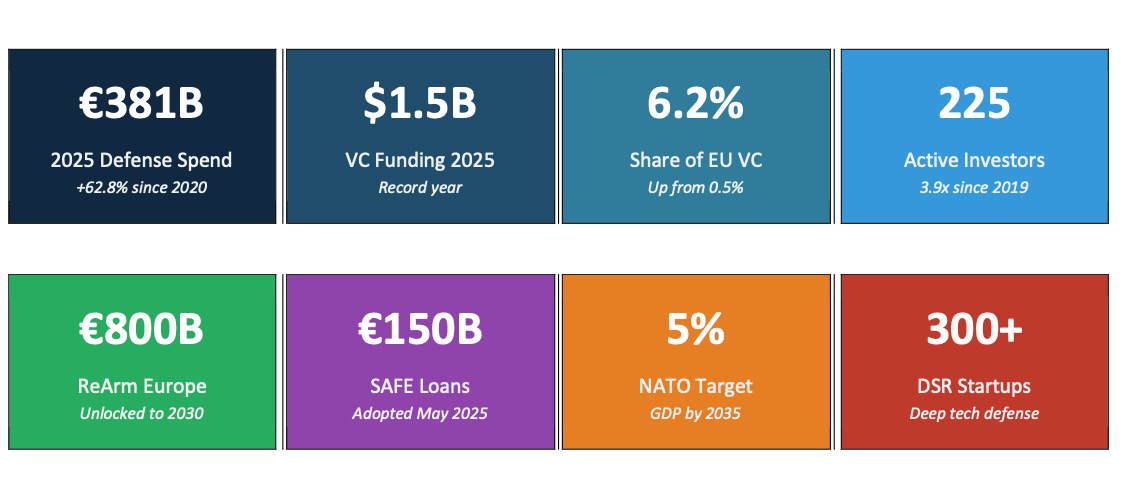
European Union defense expenditure has increased 62.8% in four years.
Germany has committed to more than doubling its defense budget, reaching €153 billion by 2029. Poland now leads NATO at 4.7% of GDP, while at the 2025 NATO Summit in The Hague, allies agreed to a new target of 5% of GDP by 2035.
That commitment matters - not because all states will hit it immediately, but because it formalizes a new baseline. The era of underfunded deterrence is over.
Venture Capital Enters the Battlefield
According to Dealroom data, venture capital investment in European defense startups reached $1.5 billion through September 2025 - representing continued growth in the sector. Since 2019, investment has increased dramatically, with 2024 reaching a record $5.2 billion.
This is opportunistic capital responding to demand, urgency, and state-backed buyers.
Europe’s New Defense Unicorns
That capital has produced a new generation of defense companies.
Helsing, the Munich-based AI defense firm, reached a €12 billion valuation after raising €600 million in June 2025 - the largest defense funding round in European history. Its AI agent flew a Swedish Gripen E fighter jet in May 2025, and the company is developing the Europa autonomous combat drone for deployment by 2029.
Quantum Systems (≈€3 billion valuation) specializes in reconnaissance drones.
Tekever (£1 billion+ valuation) operates combat-proven UAVs with 10,000+ flight hours in Ukraine.
ICEYE (≈$2.5 billion valuation) operates the world’s largest synthetic aperture radar satellite constellation.
This is Europe’s defense-tech moment - and it is no longer hypothetical.
Legacy Primes Are Moving Faster than Ever Before
Europe’s traditional defense giants are not standing still either.
Rheinmetall’s stock is up roughly 2,000% since February 2022. The company opened Europe’s largest ammunition factory in Unterlüß, Germany - a €500 million investment completed in just 15 months.
KNDS is producing the Leopard 2A8, Germany’s first newly built main battle tank since 1992, with 350+ units ordered by six NATO countries.
Leonardo’s order backlog has reached €44 billion.
BAE Systems secured selection for Norway’s £10 billion+ Type 26 frigate program.
Policy Has Finally Caught Up
Industrial momentum is now matched by policy.
The ReArm Europe Plan, launched in March 2025, unlocks up to €800 billion in additional defense spending through 2030.
The €150 billion Security Action for Europe (SAFE) instrument — adopted in May 2025 - provides loans for joint procurement, with 19 member states already requesting funding.
The European Investment Bank has expanded eligibility to include military equipment and tripled financing for defense SMEs. This would have been politically unthinkable five years ago.
The Hard Problems Remain
The report does not pretend Europe has solved everything. Not by a long shot - there’s still a long way to go, challenges to face and bottlenecks to resolve.
Industrial fragmentation persists. Europe still fields six to eight frigate classes and multiple competing tank programs.
The Future Combat Air System (FCAS) - a €100 billion+ Franco-German-Spanish fighter program - remains stuck in workshare disputes that threaten its survival.
And despite all progress, 64% of European NATO procurement still comes from the United States.
Rearmament is real - but coherence is not guaranteed. Arguably, Europe’s biggest weakness - lack of unified foreign and defense policy. Something which I have argued in the past, needs to be federalized on an EU level. The war in Ukraine is not just a threat to Ukraine, but the rest of Europe as well.
Why This Report Exists
The State of European Defense 2025 is designed to provide some actionable intelligence on how the European defense ecosystem has evovled and what it’s current state in 2025.
It covers:
Legacy manufacturers
Emerging startups
Ammunition and production capacity
Air and missile defense
Naval shipbuilding
Aerospace and fighter programs
Space and satellite infrastructure
The evolving EU and NATO policy framework
The question is no longer whether Europe will rearm.
The question is whether it can do so fast enough, efficiently enough, and cooperatively enough to meet the threats already forming on its horizon.
The full strategic report is available for download and includes detailed analysis of over 50 companies, major defense programs, investment trends, and policy frameworks shaping the European defense industry.
Good post and overview - thank you.
Two comments:
As 'the last one to modernise ends up with the latest technology', it will be fascinating to see how Ukraine's innovations will reshape Europe's defence profile, notably; relying on drone swarms for asymmetric attacks on legacy military hardware, and depopulation of the front line in battle, and automated future remote borders protected by drone surveillance systems.
Secondly, the E.U. partnership with Canada, and finding shared solutions to the Russian threat to Europe and the U.S. threat to Canada and Greenland, holds out the possibility of a new version of NATO without the U.S. with a combined population of 487 million people (U.S. 347 million) and standing armies of 1.85 million servicemen (U.S. 1.35m). The combined resources hold the potential to wield considerable defensive power when fully armed with the latest technology.
Obviously the real issues are in the big question - How fast?
Bianka apologies for my naivety here, but industrial policies is something I am still catching up.
How feasible do you think the emerge of an ECSC 2.0 ? Would that help solve the division accross states ? Obviously we’re not in a post-war context so maybe incentives are not as obvious as post WW2 … But do you think this is something that could go in the pipe to make European states interested in each other’s coop?