

Waronomics is free to read, but entirely reader-supported - if you find this work valuable, you can support it by becoming a paid subscriber or buy me a coffee.
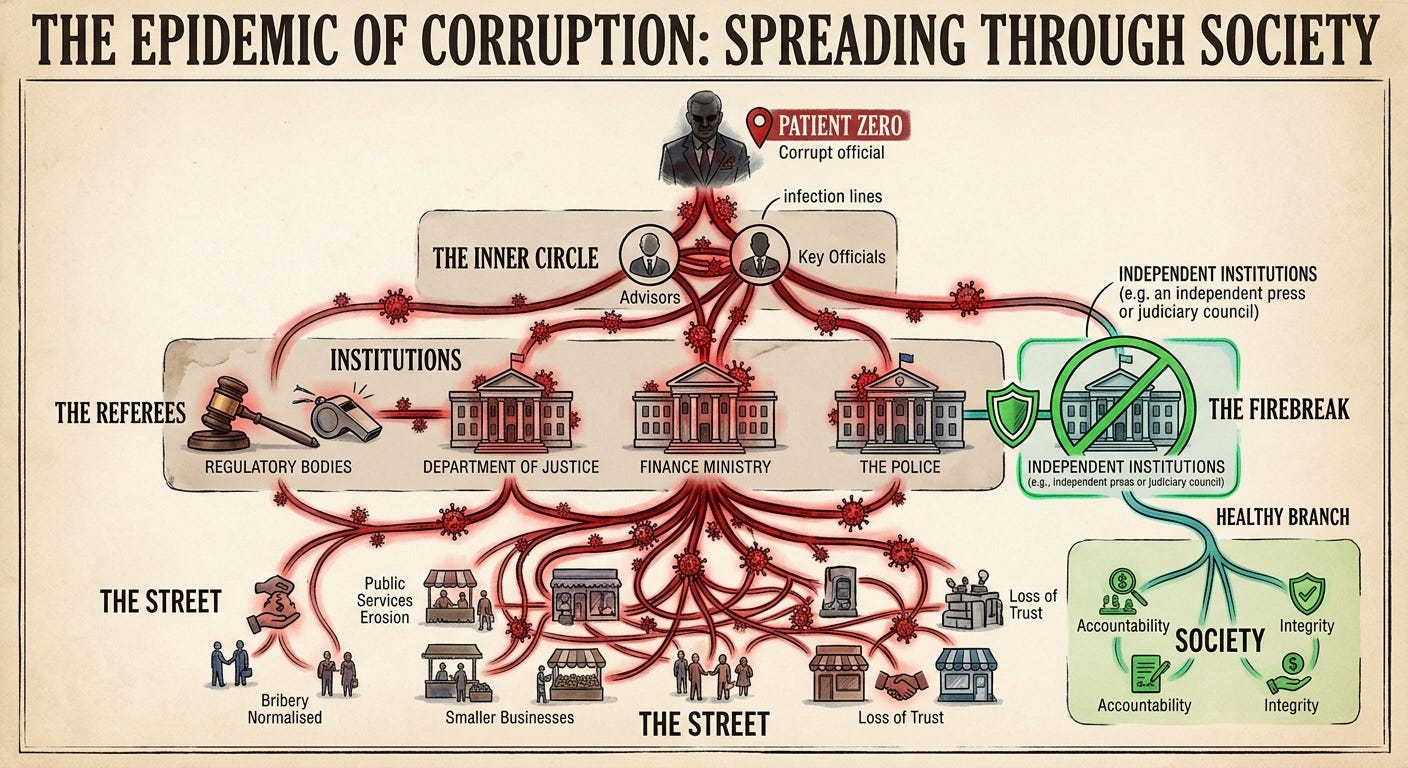
As the scandals around the Trump administration keep piling up like dirty laundry, a joke has started doing the rounds in the Balkans:
“For 30 years we asked: when will we finally catch up with the Americans? In the end, they caught up with us!”
We couldn’t reach your standards of living, but you sure do come close to reaching our standards of corruption. We do enjoy self-deprecating humour in the Balkans, and as a Balkaner, I feel exceptionally qualified to talk about corruption. I grew up in the most corrupt EU member state (we do compete with Romania and exchange the gold and silver medal in that discipline), but also lived in the least corrupt European countries - namely, Denmark and Switzerland - I do have personal experience with both ends of the distribution.
In this article, I will talk about the visible and invisible tax a society pays for corruption, and how its’ gradual normalisation leads to a widespread societal distrust to the point of dysfunction and even - moral decay.
America’s road to Balkanisation, Latin Americanisation or Middle Easternisation?
There’s an ongoing debate of whether the U.S. now resembles a Latin American, Balkan / Eastern European state, or a corrupt oligarchical Middle Eastern one. Truth is - it’s neither. Yet!
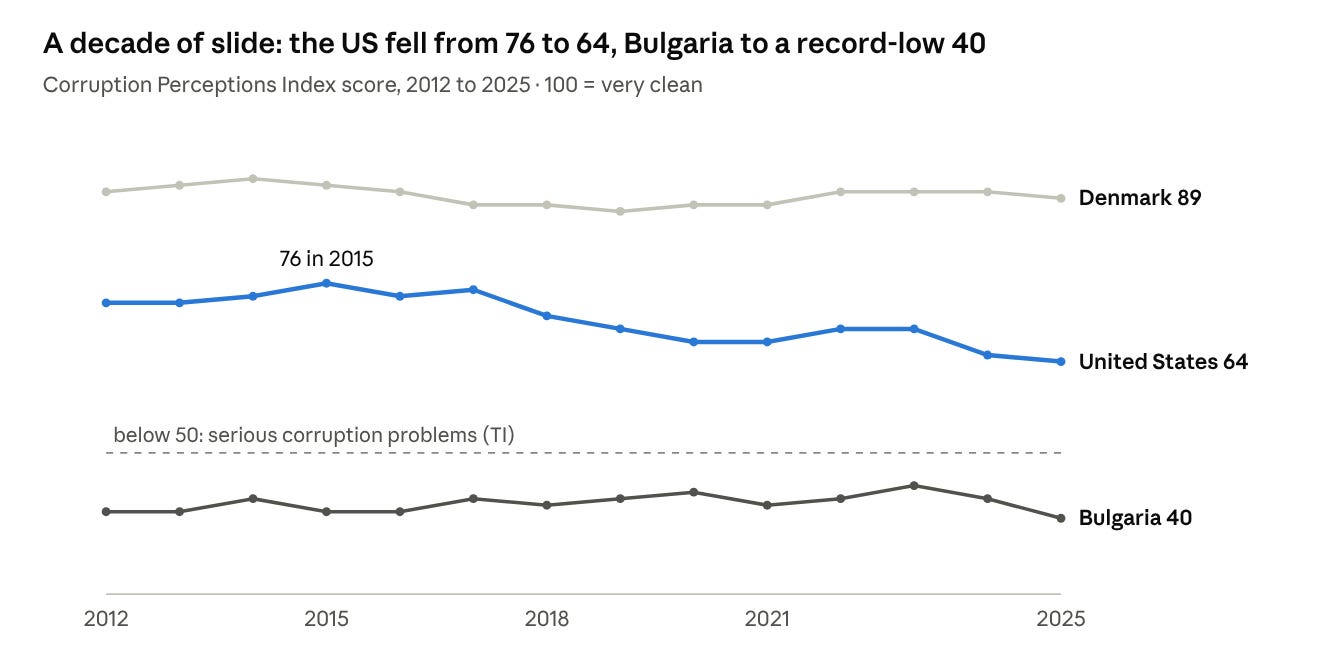
However, the direction of travel is unmistakable. The president’s own 2025 financial disclosure shows roughly $1.2 billion in crypto-related income in his first year back in office. More than 1,600 acts of clemency have been granted this term, including one for the founder of Binance, a company that had worked closely with the president’s family crypto business. And before anyone accuses me of picking sides: the outgoing Democratic president pre-emptively pardoned five members of his own family on his way out of the door. Americans have noticed. 89% of them now say corruption is widespread throughout their government, the highest figure Gallup has ever recorded and higher than any other developed economy.
This is why I have always argued that corruption must be investigated and punished, and punished severely. From where I stand, the United States has two choices:
1) Clean house. Elect a serious, national-security-minded administration in 2028. Then investigate, and prosecute wherever the evidence supports it, anyone suspected of corruption, abuse of office, unlawful conflicts of interest or national-security crimes. Not political revenge, but due process with real consequences. The point is not to settle scores here, but to re-establish a basic guardrail: some red lines still exist, and crossing them still carries a heavy price.
2) Let it slide.
If America chooses the second door, it creates precedent. It tells every future billionaire, political operative and officeholder that public power can be converted into private gain without consequence. That is a dangerous lesson in any country, and it is a lethal in one already living with extreme wealth concentration, a hollowing middle class and collapsing institutional trust.
America’s power does not rest on its’ aircraft carriers not its’ GDP - it rests on trust: in its courts, its contracts, its alliances, its currency, and the idea that the system still broadly works. Lose that, and decline is no longer a risk to mitigate - it becomes structural, and then inevitable.
Corruption lives on a distribution
Every society has corruption, and anyone who tells you otherwise is selling you a scam. The question was never whether there is corruption or not but how much, of what kind, and who gets to benefit from it.
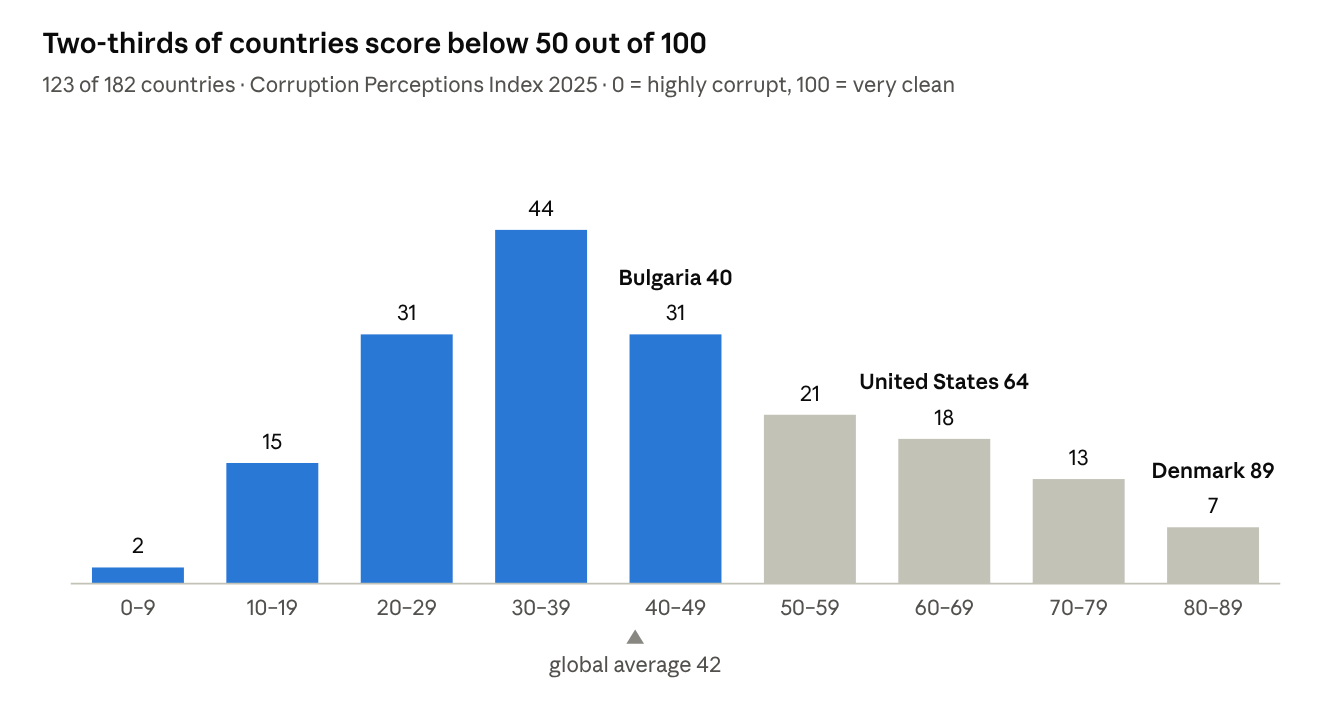
Transparency International scores 182 countries from 0 (rotten) to 100 (spotless). Denmark sits at 89. Somalia and South Sudan sit at 9. And two-thirds of all countries score below 50 (remember when I talked about the real 1%?) which means most of humanity lives in the bad half of the curve.
I find it useful to think of three tiers. I’m sure political scientists have fancier names for them, but since I am not one - these will do.
Tier I: the universalist society. The Nordics. The rules are the same for the minister and the plumber. Corruption exists, but it is episodic, and when caught - becomes a scandal when it surfaces, and people go to prison. Scholars call this an open access order: impersonal rules that apply to everyone.
Tier II: the influencer market. This is where Michael Johnston, in his classic study of corruption syndromes, placed states the US and Germany. Here, wealth buys access to the people who write the rules, and mostly does so legally: lobbying, campaign money, the revolving door, gifts after the fact, etc. Ordinary citizens rarely pay bribes - they just discover, over and over, that the system was built for someone else. Trust in leaders erodes, but daily life still functions relatively well.
Tier III: the particularist society. The Balkan states. Rules bend for insiders at every level, from the minister to the traffic cop to the woman at the hospital reception - it’s a de facto patronage system. What you get depends on who you are and who you know. It’s all about the right connections. Johnston called this syndrome “oligarchs and clans”. Alina Mungiu-Pippidi calls it particularism: the opposite of a state that treats citizens equally.
These are not three different species, but three stages of the same disease, and the progression runs in one direction unless something stops it.
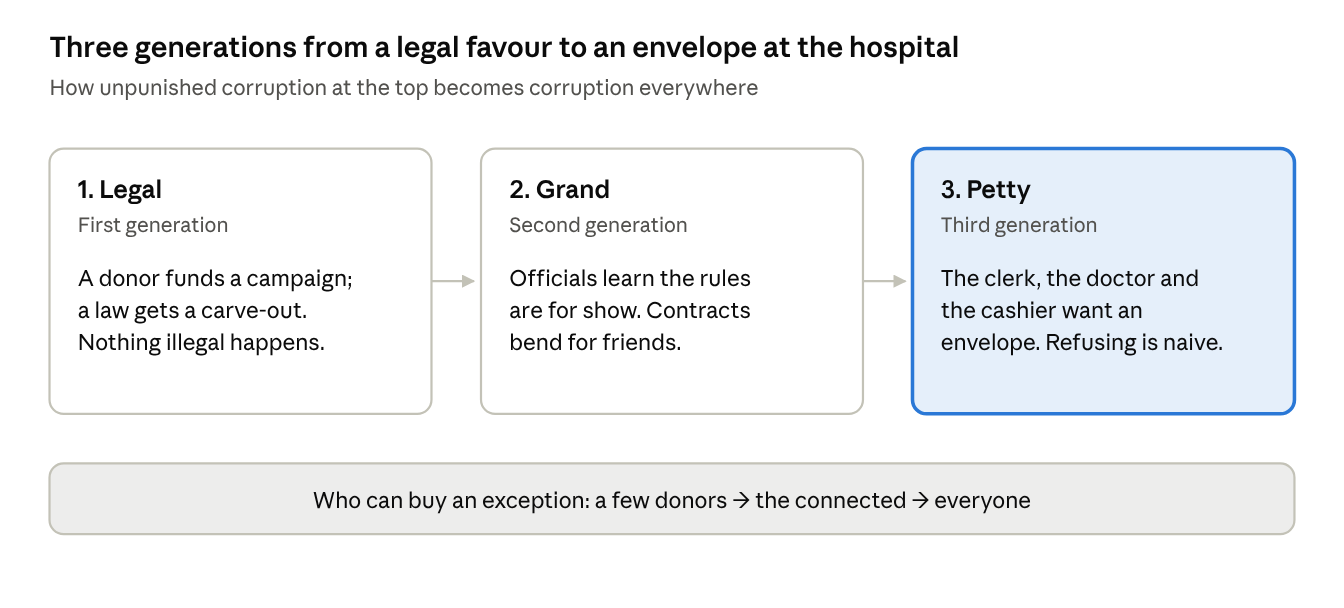
It starts at the top, and it starts legal. A billionaire funds a campaign; a law gets a carve-out. Nobody goes to jail, because nothing illegal happened. The next generation of officials learns the lesson: the rules are for show, and the real game is access. Bending a procurement contract for a donor feels like a small step from bending a law for one. The generation after that grows up watching it, and concludes, correctly, that playing it straight is for suckers. By the third generation - everyone from the government clerk to the doctor - wants an envelope.
Most societies in human history have been limited access orders: a ruling coalition shares out the rents and uses the law as a tool for its friends. Open access, the Nordic model, appeared only about 200 years ago in a handful of countries. It is not the natural state of mankind, and it should be treated as a rare and fragile achievement, and it can be lost.
If you want to see what the end of that road looks like inside a rich Western democracy, go to Sicily.
Sicily: the end of the road
Sicily shatters the comfortable illusion that death by corruption is reserved for the poor, underdeveloped societies with weak laws. Sicily is part of Italy, a G7 democracy and a founding member of the EU, with the same constitution, the same courts and the same euro as Milan. And yet, here we are.
Diego Gambetta spent years studying the Sicilian Mafia and reached a conclusion that should terrify every Westerner who thinks this cannot happen to them. The Mafia is a business, and its product is protection: a guarantee that your deal will go through, your debtor will pay, your shop will not burn. It thrives because trust is scarce. Where you cannot rely on the court to enforce a contract or the police to protect your property, someone will sell you that service. The mafia did not create the distrust, it filled the vacuum. A similar fate reached the Balkans after 1989.
But what happens when that market matures? Look at Palermo - between the late 1950s and the 1980s the city was handed to Mafia-linked builders in what Italians still call the Sacco di Palermo, the Sack of Palermo. Under mayor Salvo Lima and his public works chief Vito Ciancimino, more than 4,000 building licences were signed in five years; about 2,500 of them in the names of three pensioners with no connection whatsoever to construction. The orange groves of the Conca d’Oro disappeared under concrete, and Art Nouveau villas were demolished before they could be protected.
When two magistrates, Giovanni Falcone and Paolo Borsellino, finally put the system on trial, they were both murdered in 1992, within two months of each other. When a group of young Palermitans launched the Addiopizzo movement in 2004, they plastered the city with stickers that read: “An entire people who pays the pizzo is a people without dignity.” Estimates put the share of Sicilian businesses paying protection money at around 80%.
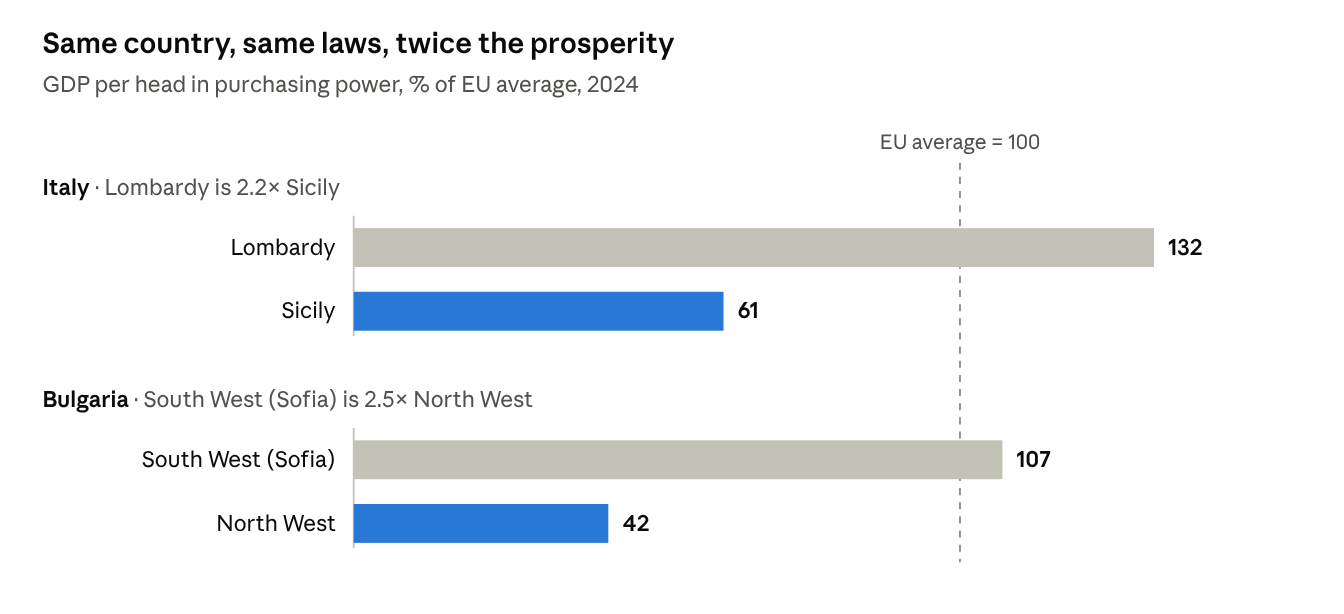
The bill of that corruption is staggering - Sicily’s GDP per head is 61% of the EU average; Lombardy’s is 132%. Same country, same laws, more than double the prosperity. The island has lost 56,000 university graduates in a decade, and the Sicilian diaspora abroad, at 844,000, is the largest of any Italian region. The young and the talented do the only rational thing left to them - they leave.
Robert Putnam traced Italy’s north-south divide back almost a 1000 years: to the free communal republics of the north, where citizens learned to cooperate, versus the feudal kingdom of the south, where everything flowed through patrons. When Italy created regional governments in 1970, the ones in the civic north worked; the ones in the south drowned in patronage. Edward Banfield, studying a southern village in the 1950s, gave the outcome a brutal name: amoral familism. Maximise the material advantage of your own family, assume everyone else will do the same, and never cooperate unless you personally profit.
The (in)visible bill of corruption
Money matter the least when it comes to corruption, but for the sake of presenting a full picture, I’ve made the effort to actually research the monetary loss as well.
The IMF estimates that bribery alone costs $1.5 to 2 trillion a year, about 2% of world GDP, and says the indirect costs are larger. The least corrupt governments collect around 4% of GDP more in tax than equally rich countries at the other end, because people do not pay into a pot they believe is being looted. A study for the European Parliament put the EU’s annual loss at €179 billion to €990 billion.
Then count the people. Bulgaria had about 9 million people when communism fell. The 2021 census found 6.52 million. Nearly half of the last decade’s decline was emigration. Corruption is not the only reason people leave, but it is the reason so many of them never come back.
Then comes the bodycount. 83% of all deaths from building collapse in earthquakes over three decades occurred in countries more corrupt than their income would predict: the missing steel, the watered-down concrete, the inspector who signed without looking. One study links around 140,000 child deaths a year to corruption in health systems.
But the real cost, invisible cost is trust, and the lack of it spreads like a virus.
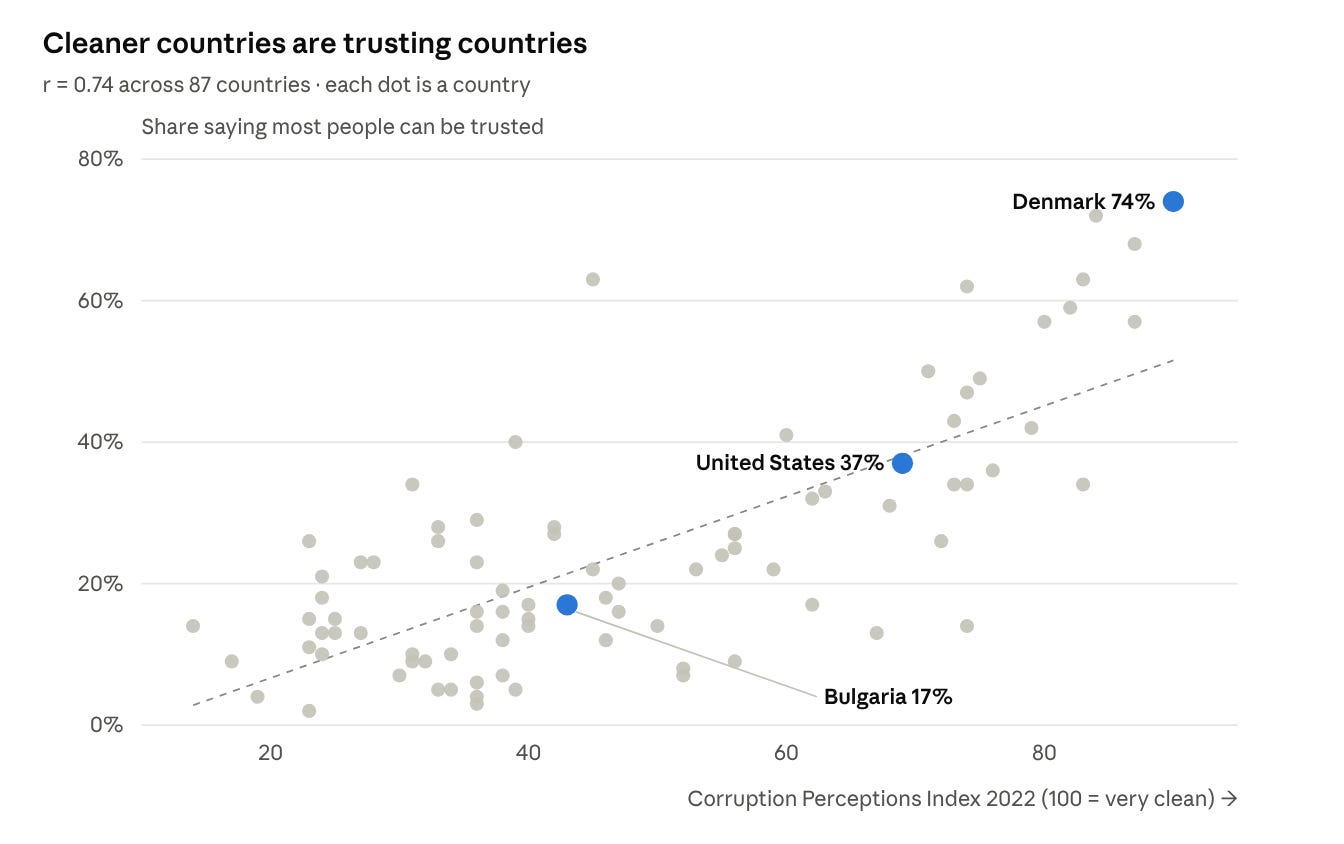
Ask people in Denmark whether most people can be trusted, and 74% say yes. In Norway, 72%. In the United States, 37%. In Bulgaria, 17%. Line those numbers up against corruption scores across 87 countries and they move almost in lockstep; inside the EU the correlation is stronger still. Cleaner countries are trusting countries. Corrupt ones are not.
Such an infection spreads gradually, over time. First people stop trusting politicians - that is survivable; most democracies run on healthy dose of skepticism about politicians. Then they stop trusting the institutions that are meant to restrain politicians: the courts, the police, the prosecutors. Then, because the referees are bought, they stop trusting each other. The mechanic, the landlord, the cashier who might be short-changing you. Every transaction carries a suspicion tax.
Eric Uslaner, who has spent a career on this, finds that it is grand corruption at the top, more than petty bribery, that destroys people’s trust in strangers. Which is exactly why Americans should be worried. Today 89% of Americans say corruption is widespread in their government, and only 17% trust Washington to do the right thing, down from 73% in 1958.
What is worse - when the White House changes hands, trust among the winners rises and among the losers collapses. Today 26% of Republicans trust the federal government and just 9% of Democrats; a year earlier it was roughly the reverse. Trust that depends on whether your guy is in charge is not trust in institutions, but the first stage of a clan-based society.
Legal corruption
There is a mistake Westerners make that those of us from the East never would. We spent our lives resenting our oligarchs, but too many Westerners do not even realise they have them. They call them businessmen.
The Western oligarch does not need a thug with a baseball bat, but a very legitimate and very legal lobbying firm. In 2025, organisations spent a record $5.08 billion lobbying the US federal government, an 11% real-terms jump in a single year. The firm that earned the most, $88.1 million, was the one closest to the White House. In Bulgaria we would at least have the decency to call this corruption.
But before my fellow Europeans get way too comfortable: we have our own version, and it is quietly strangling the continent. I wrote about it at length in my open letter to European capitalists.
Europe is the wealthiest concentration of human capital on the planet - we have the brains, the capital, even the regulatory leverage. What’s the problem then? Why are we stagnating?
Because every time talented people builds something genuinely exceptional, they either get bought by the fact chequebooks of the Americans or the Chinese or end up getting cannibalised at home by a domestic incumbent with no intention of innovating and every intention of holding its market position by any means necessary. Customer intimidation, predatory pricing, regulatory weaponisation, procurement rigging: the full menu of legal and quasi-legal sabotage.
Mario Draghi’s report on European competitiveness found that nearly 30% of Europe’s unicorns moved their headquarters abroad between 2008 and 2021, overwhelmingly to the United States.
Why is this corruption and not just bad luck? Because the incumbents do not win on merit, they win because competition enforcement moves at a pre-global warming glacial pace, with antitrust investigations that take 4-7 years; because the officials who should police them rotate into their boardrooms, and because when fines finally land, they land on the company and never on the executive who made the call. No skin in the game. The system is not broken, but it is captured.
Balkan candor
A friend who’s familiar with my life story once said it’s incredible that I was able to remain kind despite all the hardships life served me. Given my experience with corruption, it got me thinking that it is even more remarkable that I was able to remain principled.
I will tell you two stories about corruption, which affected me personally.
Years ago, my entrepreneurial mother bought a plot of land in an industrial part of our town through an insolvency trustee. Her plan was to develop an industrial business in collaboration with EU funding (those were the early days when Bulgarians still thought that EU funds were for the citizens, and not the oligarchs and their lackeys).
Apparently, the previous owners had been in prison for corruption and embezzlement charged. When they came out (they were let out, because unlike us - they had the right connections), they reclaimed the property. Neither the judges nor the police protected my mother’s legal investment - she lost the land, and she never recovered her money.
My very Balkan mother (a widow at the time too), however, didn’t give up without a fight. She spent years fighting tooth and nail until one evening her phone rang from an unknown number. The voice on the other end asked whether she would like to see her children grow up.
I was one of those children, and I was still in high-school. Now, to this day I didn’t know whether they were threatening to kill her or us, but that is irrelevant. As a family, we reached the point when we decided it is time to stop fighting for justice, because the price of continuing had been made intolerable.
The second story is even more harsh.
A few years ago my beloved older brother died suddenly while traveling across Southeast Asia. A dead white foreigner in a poor country where corruption is the operating system led to his body being collected by a funeral agency that cremated him and kept his remains hostage, demanding of us vast sums of money to return them.
I spent almost a year clawing back his remains from a corrupt funeral home, in a corrupt country, during the height of the Covid lockdowns. Mind you, the Bulgarian state whose passport my brother carried, did nothing meaningful to help. It was as i
Holding a dead man’s body for ransom is the bottom of the pit, especially when the local officials just shrug and tell you there’s nothing they can do about the situation. I loathe corruption with every fibre of my being, because I have personally witnessed its’ destructive force. You start out with a few corrupt politicians and end up with funeral homes extorting grieving families for money.
I will never tolerate corruption in any shape or form, and I believe it is the moral duty of every citizen, in every country, to refuse to tolerate it too. Because every corrupt society I know of started out believing it was the exception, that the rot would never spread, and never reach us. Well, one day, it will reach us. It will reach you. So make sure you don’t allow it to happen.
Outstanding. Clearest explanation of the state of play on societal corruption that I have ever read. Thank you.
@waronomics Thank you for this outstanding essay and case study on corruption. I was wondering whether you would hazard a brief assessment of Germany's place and significance in the European Unicorn problem? An outside view which is closer than someone from the "new world" would be helpful.