

I admit, I struggled with where to begin this essay. One of the curses of the multidisciplinary approach to analysing the world is that while the dots between seemingly unrelated domains click perfectly inside one’s own head, articulating them without wandering off into the bottomless abyss of over-explanation and losing the reader sometimes feels like a Sisyphean task. Bringing order and structure into randomness is not as easy as I anticipated with this particular topic, so have patience and bear with me.
Prologue: How it all started
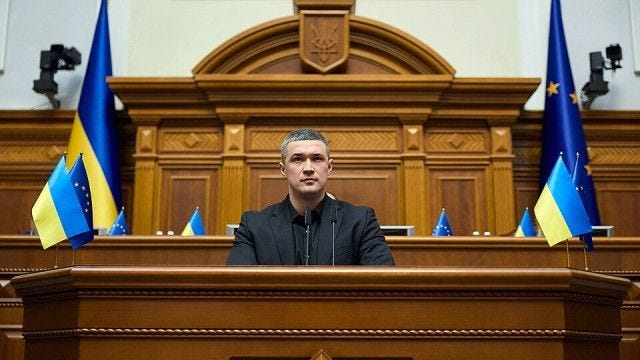
After a week of rumours about a new ministerial reshuffling of the Ukrainian government, the fears of many people - Ukrainians and foreign supporters alike - came true. In a highly unpopular decision by President Zelenskyy, the Defence Minister - Fedorov, a 35-year-old software entrepreneur who has been one of the non-establishment appointments in the government - was relieved of his duties, to be replaced by an establishment political figure from the Interior Ministry.
And this wasn’t some underperformer being rotated out - for the short time of his tenure (6 months) he provided a list of 22 outcomes. Yes, outcomes, not a wish list, but actual deliverables. Anyone from the tech sector recognises this form of retrospective after a sprint, and it is something no politician usually does.
In his six months in office, Fedorov’s ministry cut off Russian forces’ access to Starlink, scaled up the drone programme, turned Crimea into a de facto island, overhauled the procurement system, and began an overdue structural reform of how the ministry itself operates - which, in practice, meant stepping on the toes of the comfortable political class and people whose commercial interests depend on the ministry NOT operating well. He also, predictably, ended up in conflict with the top brass (namely, the Commander of the armed forces - Gen. Syrskyi) over how the war should be run. Draw your own conclusions about which of these things actually got him fired.
Western analysts and Ukraine supporters immediately jumped into analysing the situation, applying the Western lens of logic. Examples were given with WWII Britain and the U.S. to prove the point that for all his virtues, maybe Fedorov was not the right guy for that particular job, and we don’t know what’s happening behind closed doors, and there must be some real good and even benevolent reason why Zelenskyy, in the middle of an existential war, would go through with such an unpopular decision.
Until the Eastern Europeans entered the chat. With all the nihilistic pessimism you’ve come to associate that region and its people with, and without much decorum, we declared that this is just typical infighting between political factions.
The aggressive reformers who would enter a ministry with an axe, versus the Soviet-coded political establishment that is still suffocating those countries 36 years after the fall of communism. The clash, and the subsequent casualties, are inevitable. At the end of the day, it’s all done on the backs of ordinary citizens, who oftentimes feel demoralised and discouraged by these developments - because it does feel like a tango: one step forward, two steps back. Of course, you are kindly asked to sacrifice your life for it.
That’s where the biggest risk lies: demoralisation. And it is particularly high-risk for Ukraine, given that it is fighting a war of survival. Fedorov was the example that it is possible for a young, competent leader to emerge based on his merits, and not political connections. He was the archetype of a new, possible future for the Ukrainian (and wider Eastern European) political class, where the old guard is gradually replaced by people who didn’t spend their formative years in the Soviet system.
There’s a flawed belief among many people that once the Soviet Union and its evil ideology collapsed, the Soviet-coded institutions and thinking went away with it. That’s not how any of this works. It takes the churn of several generations to get there, which is why there’s a huge difference between people (and therefore - leaders) born circa 1991 and those born in 1968. The 1968 leader spent his formative years learning how the system actually worked: which favours to trade, which questions not to ask, whose nephew gets the job. The 1991 leader never had to learn any of that. This is not just a gap between two age groups, but a fundamental difference between two operating systems.
Moses embarked on a 40-year journey that should have taken two weeks of casual walking, tops. Why? Because the last person born into slavery needed to die out before a free people could enter the promised land. Eastern European states are on a similar desert crossing, and we are 36 years in.
This situation is particularly unpleasant for younger people - those under the age of 40, who were lucky enough to be born or raised in the immediate aftermath of the collapse of this system - because we want to see more radical change and accelerated reforms. And Fedorov - being 35, coming from the private sector of software engineering and drone development - did what any of us, literally every single one of us, would have done if we ever got anywhere close to power: he went guns blazing, axe in hand, and obviously disrupted the status quo, making certain generals and politicians very uncomfortable.
There’s a reason reformers don’t last long in Eastern Europe, and that is going to be the case for the foreseeable future. Let me give you an example from my home country. The democratic reformers of 1997-2001 inherited a bankrupt country on the brink of civil war, crippled by hyperinflation and decades of decay after more than 40 years of communist rule. And “bankrupt” is not a metaphor here: the winter of 1996-97 meant savings evaporating overnight, prices changing between morning and evening, bread queues in the snow. The reformers stabilised the economy by pegging the currency to the Deutsche Mark, privatised bankrupt state factories, and set Bulgaria on the path towards NATO and the EU.
The system fought back HARD. It turned them into scapegoats and punished them by removing them from office. They survived only ONE term.
The same happened in recent years: competent leaders who implemented difficult policies and reforms were sabotaged and removed within months. The mechanism is wide-spread and easy to recognise for anyone with half decent pattern recognition skills: a reformer arrives, starts cutting into somebody’s revenue stream or cushy government job with zero output, and the system - the courts, the media it owns, the parties it funds, the “concerned citizens” it mobilises - closes around him like an immune response, except this immune system protects the disease, not the patient.
Eastern European states are reforming and evolving, yes. But they are doing so while tied to a large, heavy boulder, because a system that persisted for decades - and shaped generations of citizens and leaders - does not disappear overnight.
The unfortunate reality is that 36 years after the fall of communism, we are still paying the price. Corruption, nepotism, appointing incompetent officials, robbing the country even when the country is under threat. That ideology did not only hold us back and humiliate us for decades, it left our societies dysfunctional and morally compromised, and even - gradually, over the course of decades - destroyed the morale to fight back. Because when you spend your entire life being betrayed every time you try to do the right thing, at some point you either give up and deal with reality as is, or you pack up and leave.
These, I thought for a long time, were all inheritances from our communist past. I was wrong. It’s the inheritance of human nature.
The real 1%
It is one of those things which I thought I kind of knew, but didn’t really know, and once I fully realised it - with every fibre of my being - I felt so incredibly stupid for not truly seeing it earlier.
It was a long pattern, really. Over the years, whenever I would talk politics and societal absurdities - like corruption, nepotism, the political circus - all my fellow Eastern European friends would get it and chime in with their stories. But so would my Latin American friends. And the Africans, the Indians, the Central Asians, the Middle Easterners, the Chinese. We’d laugh over our shared plight, while all striving and hoping that we would improve our societies so they could resemble something closer to the Netherlands or Denmark, and not whatever we have been served by the lottery of birth.
It wasn’t until I spent a few hours last night battling my way through stubborn Western thinking that I realised - wait a second. WE are the rule, while you are the exception!
In reality, corruption and nepotism are the way of the world, and have been for thousands of years. Take any century you like and just run with it. Roman governors squeezed their provinces to recoup the bribes that had bought them the post. The Ottoman Empire and pre-revolutionary France openly sold state offices. Even imperial China’s civil service examinations, the most celebrated meritocratic system of the pre-modern world, were routinely bypassed by the well-connected. Patronage, clientelism, the family before the law, the strongman above it - this is not a Balkan invention or a post-Soviet defect, it is the oldest political technology humanity has, and for most of history it was the only one on offer.
It’s only in recent times that a few societies have learned a better way - and even they struggle to remember it. Countries like Bulgaria, Romania, and Ukraine are struggling not only against a communist past, but against human nature itself. But because we always focused on and strived towards entering the club of the exceptional, we didn’t realise that 99% of the world runs a software somewhat similar to what we have in our home countries.
Constitutional democracies, reputable and functional institutions, high-trust societies, established processes, overall consensus between the government and its citizens, equality of citizens before the law - this is ALL new. Very, very new. Do the rough maths: out of eight billion people alive today, those living in genuinely high-trust, functional constitutional democracies are a modest minority. Stretch the count across all of human history - every person who ever lived under any arrangement of power - and the share who experienced accountable, meritocratic government shrinks to a rounding error. That’s the real 1%, and it has nothing to do with wealth.
While in some nations this experiment has taken strong roots (like in the Nordic countries), in others it is going through a crisis (the United States, France, etc.), it has still produced visible very outcomes. And here is the uncomfortable part: membership in this club is not permanent. The exception is not a permanent feature of the Western order - it is a practice, a muscle that needs to be trained consistently, otherwise it atrophies.
Institutions stay clean only for as long as somebody keeps them clean: enforces the rules on the powerful, punishes their own political side when it steals, shows up to the boring civic work. Let that slip for a generation, and human nature quietly reinstalls itself in the background.
But on average, the social contract of the club of the exceptional produced several generations of people who benefited from this radical experiment, and it is understandable why they find it difficult to grasp why the rest of us - basically, the whole world - is lagging behind, trying to catch up with the program. A program that, while it doesn’t work perfectly, works pretty darn well for everyone. Our version works perfectly for a selected few.
I’ve always said this to my Western friends, who sometimes take it as an insult when I become too fiery about this - they feel like I am being condescending, as if they are somehow not bright enough to understand this concept. No, not at all. I always tell them: thank God and your lucky stars that you struggle to understand this political reality. It means you grew up in a healthier society than we did.
The problem with us easterners is that we are not exactly known for our patience either. Many gave up after our societies didn’t become Luxembourg after one term of a new government. It’s futile to try to explain to them that it takes generations to get where the exceptions are - because of a multitude of factors, not necessarily our own fault either. Sometimes, you have to appreciate the small wins.
Even the Armenian PM said it recently: even if we don’t become part of the EU, we will reform our state in the image of a successful European one. That’s the right way to think about it - the destination was never the membership card, it’s the kind of state you become while earning it.
That’s also one of the reasons why I argue with my Ukrainian friends regarding joining the EU: don’t hope for, and don’t push for, a quick path to the EU. Do it properly. Cover the Maastricht criteria - trust me, you and your society will be better for it in the long run. And I say this as a citizen of a country that spent a decade and a half under a special monitoring mechanism.
Reforms are painful, and the reformers are not remembered well.
Balkan Candor
Which brings me back to Fedorov.
The system devoured another reformer, yes - the system has been doing that for 36 years, and it will do it again. But notice what else happened: people protested. Commentators pushed back, loudly and by name. Engaged citizens reacted to the removal of a competent minister as a loss - in the middle of a war, when it would be so much easier to shrug and focus on surviving.
Demoralisation is not just an unfortunate side effect of stories like this one - it is a weapon, and there is an entire state apparatus dedicated to wielding it. “Everyone is corrupt, everything is theatre, nothing will ever change, why fight, why donate, why care” - that is not a conclusion honest people reach on their own. It is a product, manufactured and distributed at scale, and stories like Fedorov’s are its raw material.
“If everybody always lies to you, the consequence is not that you believe the lies, but rather that nobody believes anything any longer.” - Hannah Arendt
Remember, too, that the exceptional 1% were not born exceptional. The Nordics we all point to as the finish line were themselves patronage-ridden states two centuries ago. They reformed their way out - slowly, painfully, over decades, against a system that fought back exactly the way ours does. Human nature is the default setting everywhere, and as we can see - it was overwritten somewhere. That means it can be overwritten again.
And on a generational clock, it is being overwritten. This January, Bulgaria adopted the euro and finally closed the loop of its European integration (NATO, EU, Schengen, Eurozone) - 29 years after those one-term reformers pegged a collapsing lev to the Deutsche Mark while the country queued for bread. Nobody remembered them well at the time. The currency board they built outlived every single government that came after them. That is what a small win looks like when you finally zoom out far enough to see it.
So the next time you catch yourself despairing that your country still isn’t Denmark - ask yourself a better question: how did Denmark manage to stop being like your country and how long did it take?
Patience is a virtue. Be virtuous.
Yes, thank you for zooming all the way out, this was very instructive. In Germany, you can see both mindsets at the same time. Interestingly, there are also some positive traits I detect in the former East Germany, like more solidarity among the neighbors and such. I am living in Spain now, and that is a country that went from a very backward dictatorship to one of the most modern societies in a generation and a half. I think the lesson is that it can be done with a lot of support from the countries that already succeeded, but that progress is hard. I do agree with you that the process of joining the EU in itself is a very valuable exercise. The former East Germany never had to go through this and it might be one of the reasons it feels so dejected.
You describe the exception, but not the machinery. Let me supply that from the inside.
Denmark doesn't have one safeguard, it has several that overlap. A citizen can bring a case against the state and win. Parliament can bring down a government in a single vote. The press is free in practice, not only on paper. And most importantly: school teaches us to be critical of our own government, not just the neighbouring one. That last part is the real infrastructure. Institutions can be written down in a morning. A population that expects to be listened to takes generations.
Which is why your warning lands on us, not on you. We have been allowed to believe this is a condition. It is a habit. None of those mechanisms works by itself — they work because somebody shows up for the boring part, year after year. We have started talking about our institutions the way we talk about the weather.
So it isn't you who should learn from us. It is we who need to remember how we got here - while you still remember what it costs to work for it.