


Waronomics is free to read, but entirely reader-supported - if you find this work valuable, you can support it by becoming a paid subscriber or buy me a coffee.
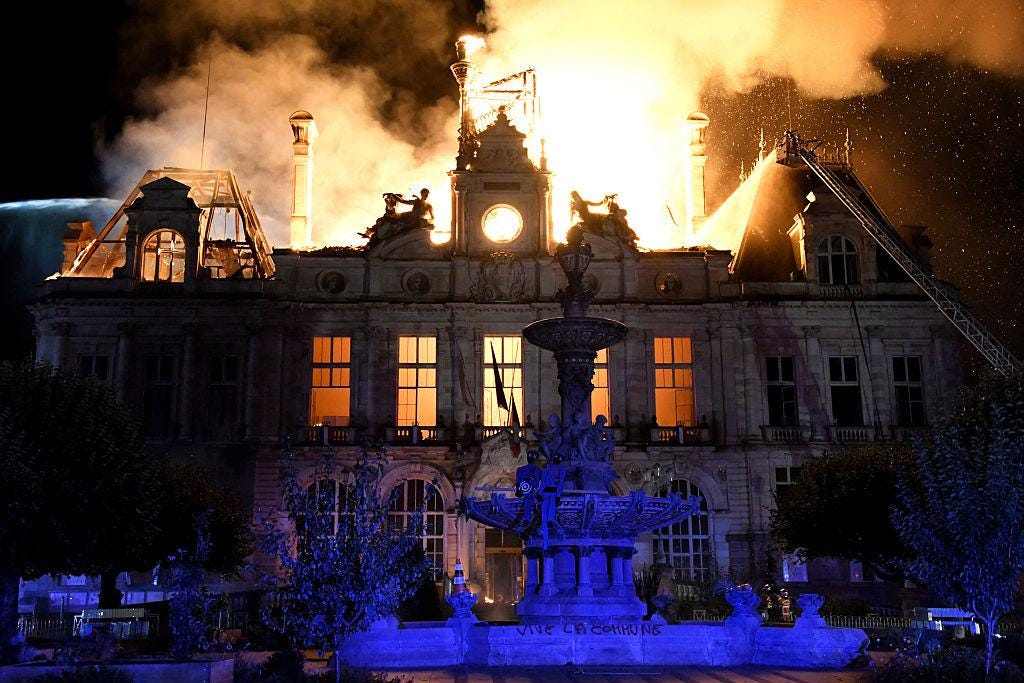
On Saturday evening, 17 October, a group of masked men torched a police car outside the Hôtel de Ville in Limoges, smashed its windows and set the building on fire. By morning, the roof of a 143-year-old listed monument - inaugurated on 14 July 1883 - had collapsed onto the floors below. The prefect called it a catastrophe for heritage, and the mayor asked for a “Notre-Dame plan” to rebuild it.
The images travelled as fast as the explanations and speculations. Depending on which corner of the internet you inhabit, France had either been overrun by immigrants from the banlieues, is a subject of Russian large-scale sabotage, has risen against the betrayal of Emmanuel Macron, or is on the road to a far-left revolution in rehearsal. Each contains a grain of something true, yet each, on its own, is wrong. Complex events require nuance of interpretation.
What is burning in France is not one thing. It is the point where a war-driven energy shock meets a state that has run out of money, a school system that has run out of teachers, and a political movement that has concluded disorder can be leveraged as an electoral asset. The better question is not who started it, but who profits from it - at home and abroad.
The actual scale of the protests
The numbers are the first casualty of every riot video we see on social media today, so let’s start with them and put them into an actual perspective.
The Interior Ministry counted 550,000 people at 110 marches across France, including 110,000 in Paris. The CGT claimed 800,000. Even the higher figure is little more than 1% of a country of nearly 70 million. Around 2,400 people were arrested - roughly one for every 230 marchers. The authorities themselves say the vast majority demonstrated peacefully.
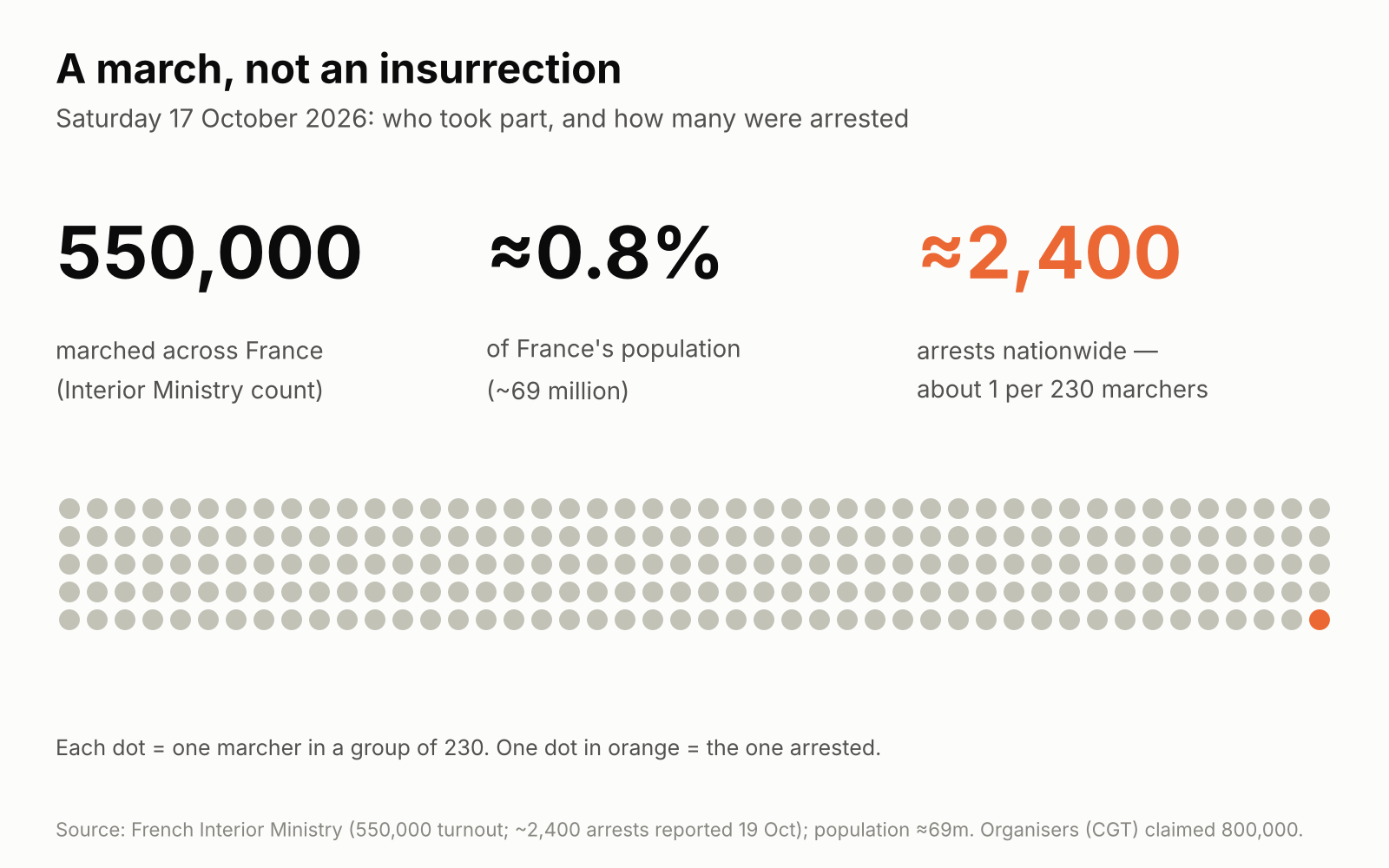
In reality, not the carefully curated version of it, people on the streets were overwhelmingly students, teachers, parents, pensioners and workers with grievances that are real: prices, wages, decline of the quality of public services such as schools. Lumping them together with the people who burned Limoges is precisely what the people who burned Limoges want - a Republic that cannot tell a citizen from an arsonist will inevitably descent into chaos, and that chaos will be fertile ground for opportunistic populists to take hold.
The cost of wars
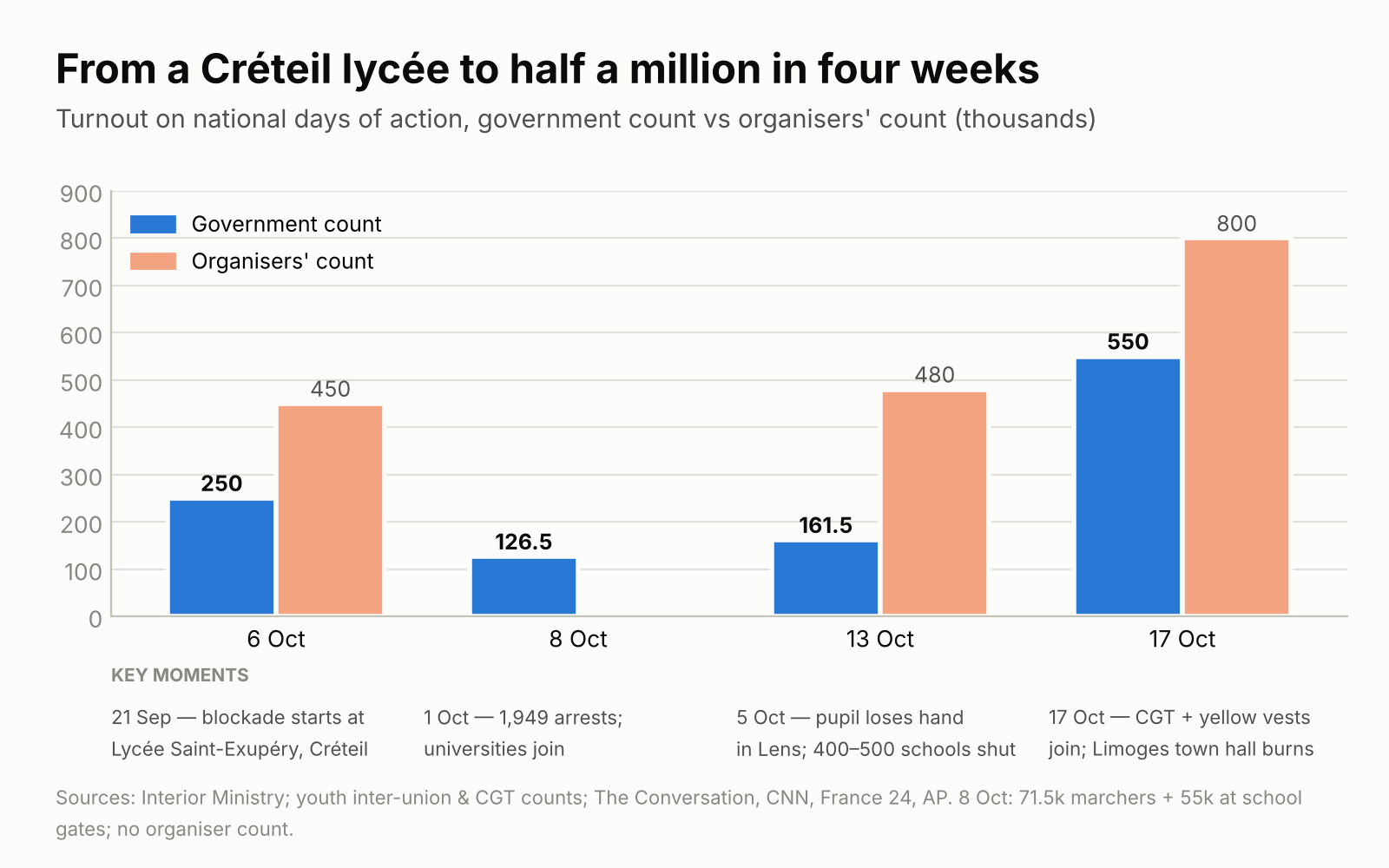
This did not begin as a cost-of-living revolt. It began on 21 September at a lycée in Créteil, in the Paris suburbs, over very ordinary things: unfilled teaching posts, classes of 32 to 36 pupils, rooms without enough tables, classrooms that are cold in winter and reach 40°C in summer. Hardly an outrageous set of revolutionary demands, right?
Within weeks, the movement spread across France. By 1 October, universities had joined, schools were set alight in Nantes, Rouen and Marseille, and the Interior Ministry recorded 1,949 arrests in a single day — around nine in ten of those held were minors. By then - teachers and parents joined. Then trade unions, disgruntled workers, and veterans of the late Yellow Vest movement. Ultimately, a revolt about schools became a referendum on the quality of life in the French Republic.
The deeper frustration is generational. According to the OECD, 18% of French 18–24-year-olds were neither in work nor in education or training in 2025, against an OECD average of 13%. A young person who leaves a crumbling school for a difficult labour market and unaffordable housing - while expecting a less generous pension than their parents - has rational grounds to doubt that the intergenerational bargain still works.
Two things are true at once - the demands are legitimate: 62% of the French told pollsters the movement was justified. And the movement, similar to the Yellow Vests protests from the past, was captured early by people with very different aims: 78% in the same poll said LFI was exploiting it for political gain. Hold both, or you understand neither.
A second-order crisis
France’s unrest is not the product of one absurdity, but of several piling on top of one another.
COVID left Europe with a debt overhang. Russia’s war against Ukraine broke the continent’s energy model, supply chains, and handed it an urgent and expensive rearmament bill. Trump’s second term blew up much of the trade consensus that Europe’s export economies relied on, and since late February 2026, the Iran war has closed the Strait of Hormuz, cutting off roughly a fifth of the world’s oil supply.
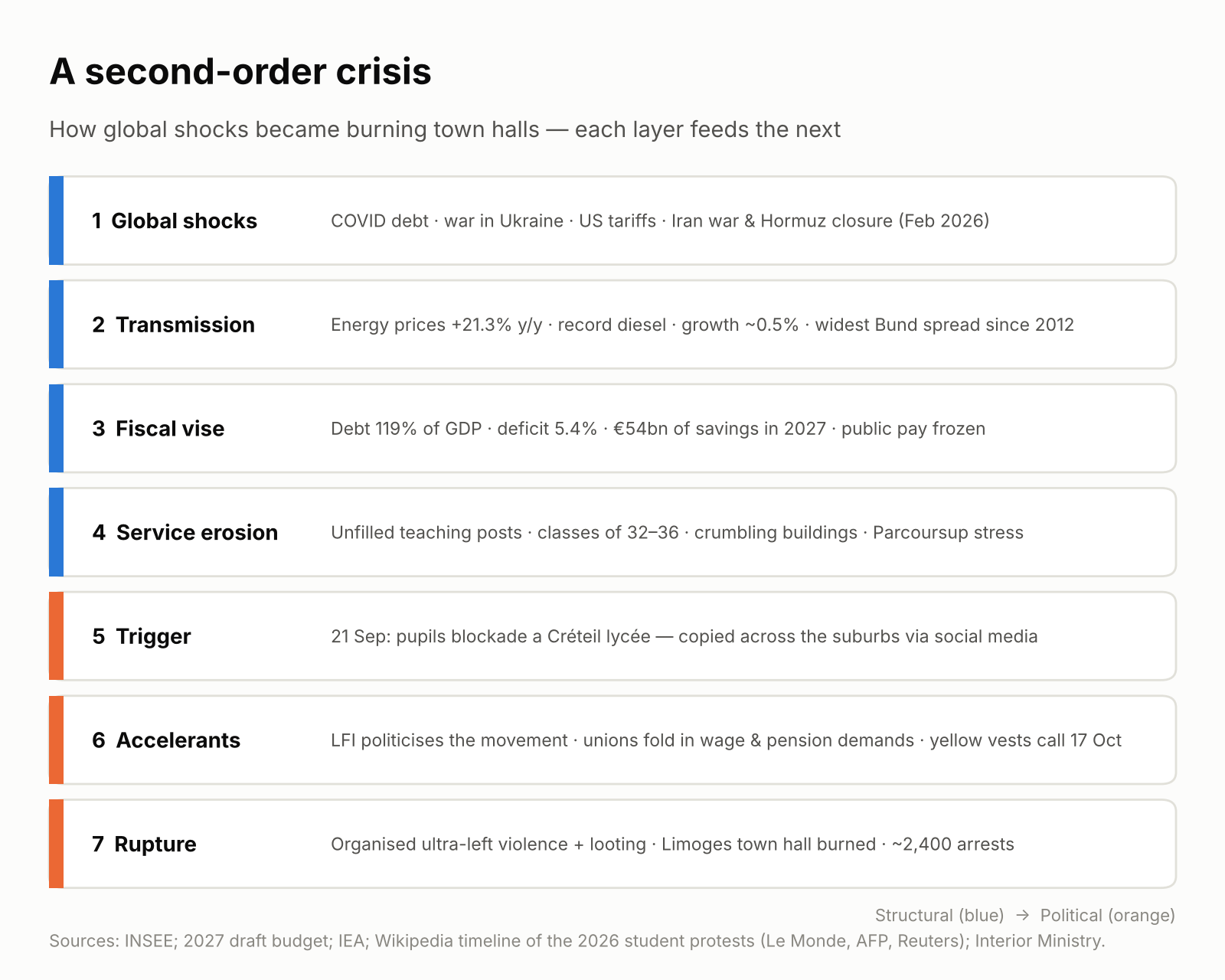
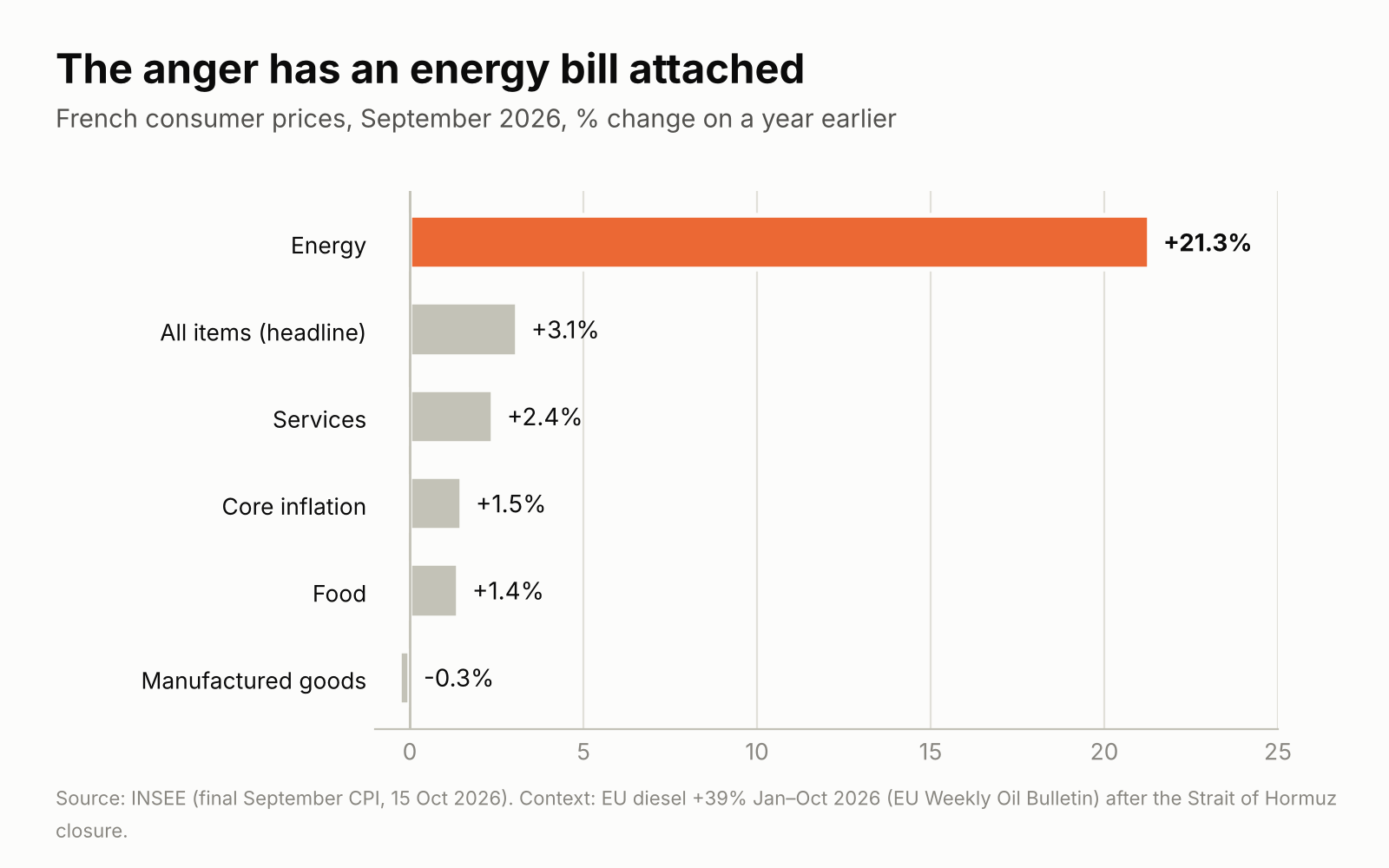
That last energy shock reached French households at the pump. In September, consumer prices were up 3.1% on a year. Energy was up 21.3%; core inflation only 1.5%. EU diesel prices rose about 39% between January and October and set records. For a lorry driver, a farmer or a nurse commuting from the periphery, this is not a just a number on an economics report, but a genuine grievance.
Back in 2022, Paris answered an energy shock with a bouclier tarifaire - an energy shield financed with borrowed money. This time there is no shield, because there is no money. Public debt reached 119% of GDP in mid-2026, a post-war record. The deficit is expected at 5.4% this year, nearly twice the EU limit. Interest payments will cost roughly €79bn this year and about €91bn in 2027, and France’s borrowing premium over Germany has touched its widest level since 2012. The truth is: France can no longer buy its social peace. The math is no longer mathing.
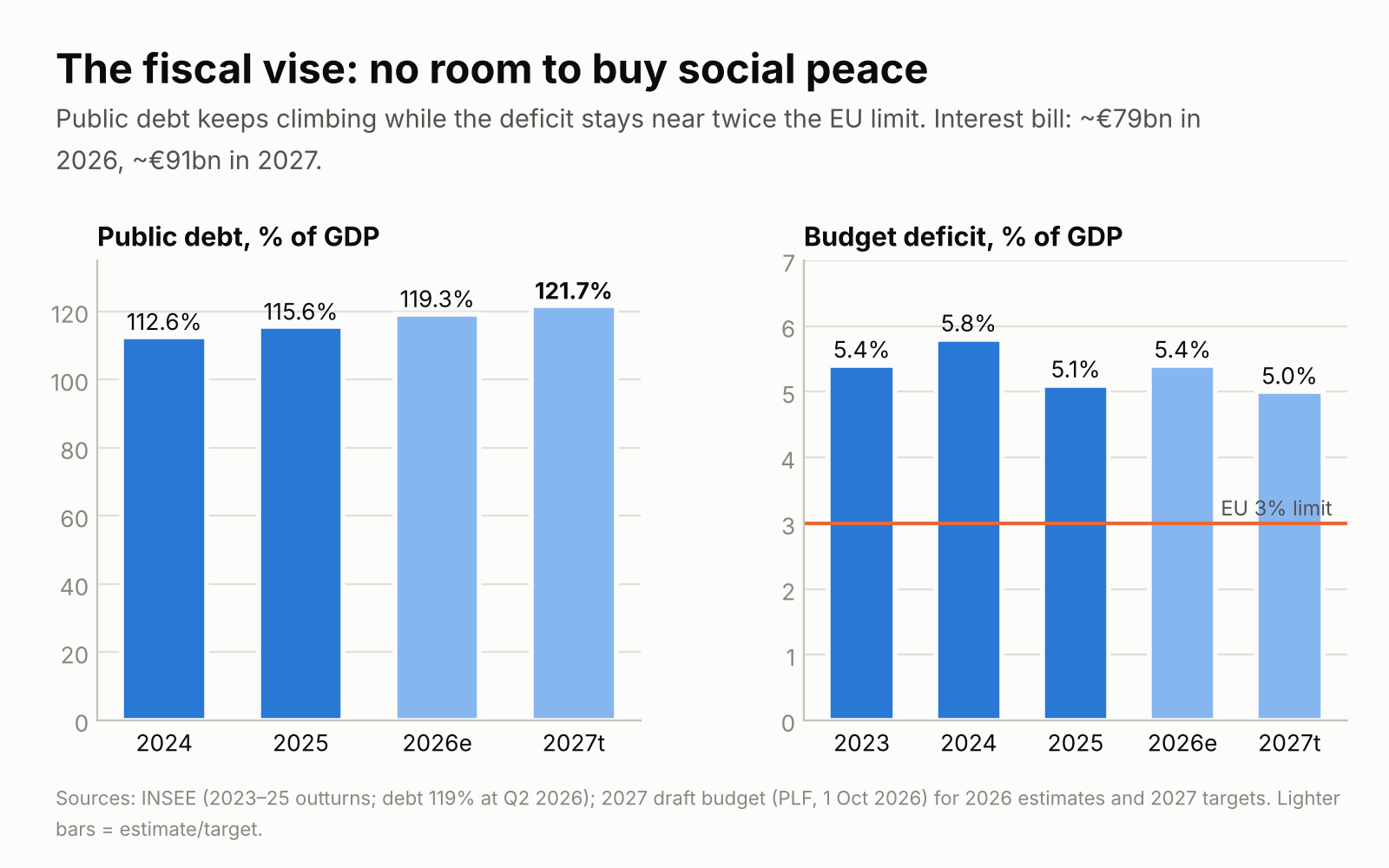
So the 2027 budget does what budgets freezes public-sector pay and seeks €54bn in savings - and debt still rises to 121.7% of GDP. France’s own fiscal watchdog calls the government’s 1% growth assumption optimistic, while private forecasters expect anywhrre between 0.3–0.6%.
Follow the chain and you arrive at a classroom in Créteil with 35 pupils and no French teacher. Our globalised, international system supplies the shocks, but it is domestic institutions that decide how well they are absorbed. Unfortunately for France, their absorbers are worn out. Wars abroad now set the price of social peace at home - and France can no longer afford it, hence the public unrest.
The Mother State
There is even a deeper layer t explore here, and it is an uncomfortable one for the French elite - both past and present.
After the Liberation, France built an unusually ambitious state. The social-security system of 1945–46 came out of the Resistance’s programme and a coalition that ran from Gaullists to Communists. Industries were nationalised - Renault was seized in 1945 over its owner’s collaboration. The Fifth Republic then made the bargain permanent: with a Communist Party still winning around a fifth of the vote, the Gaullist state delivered much of what communism promised, without the actual communist revolution. Mitterrand widened it in 1981, before reality forced the U-turn of 1983.
The bargain worked for several decades in a row. By every metric, France became one of the richest and most socially just societies in the world. Only two presidents of the Fifth Republic - Mitterrand and Hollande - were genuinely of the left. Yet the Republic institutionalised social protection so successfully that the state became the default guarantor of everyone’s security, from cradle to grave. Generations were raised to see it as a mother who always pays. While plenty of French people are entrepreneurial and never asked the state for anything, the political culture assumes the opposite.
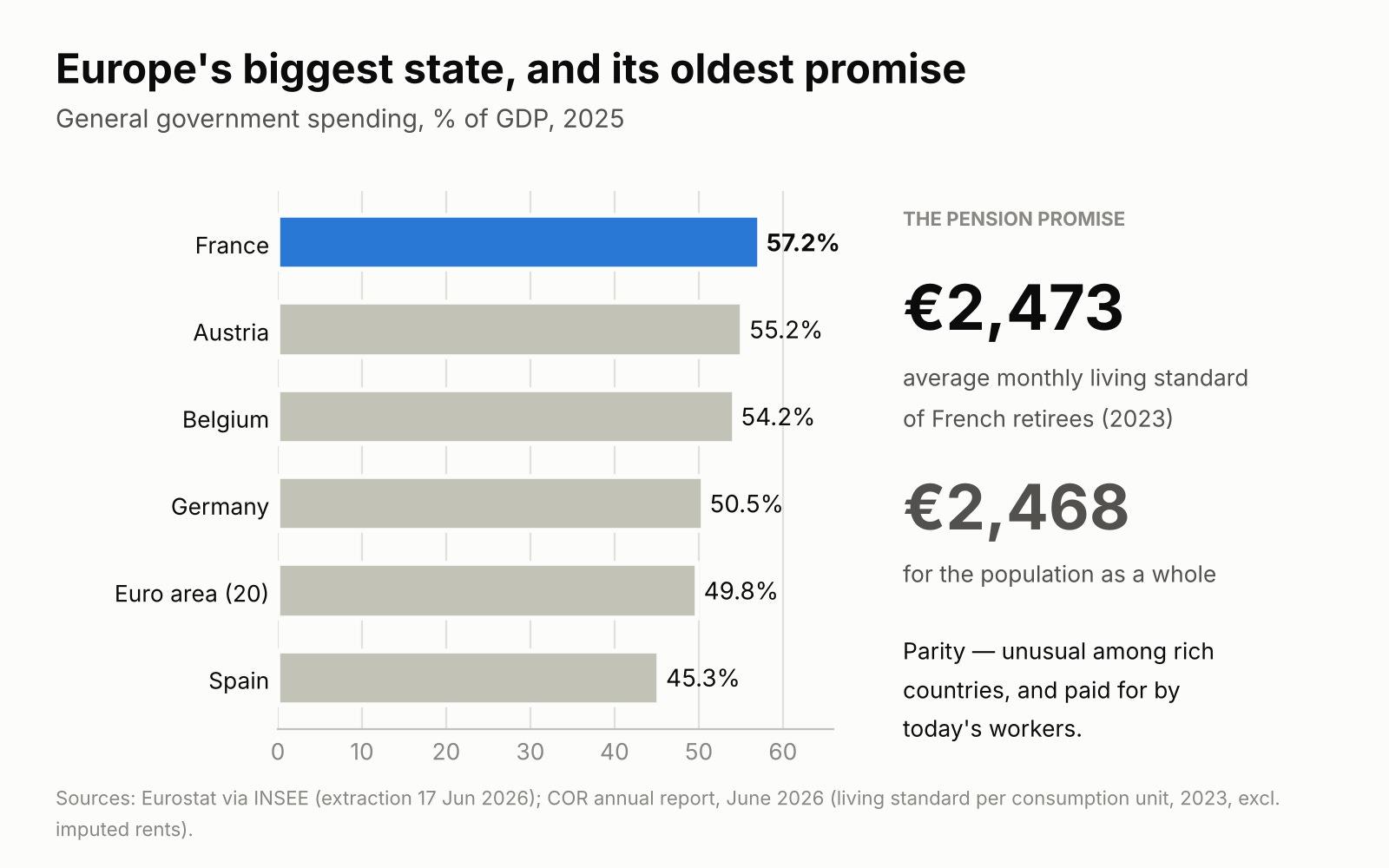
The numbers show where this leads. French public spending reached 57.2% of GDP in 2025, against 49.8% in the euro area and 50.5% in Germany. That figure covers everything - schools, defence, hospitals, interest - not just bureaucracy and welfare. But social protection alone absorbs about 32% of GDP, five points above the euro-area average. And the average French retiree now enjoys the same or higher living standard as the population as a whole: €2,473 a month against €2,468 in 2023. That parity is rare among rich countries, and it is financed by today’s workers.
To be clear - I am not arguing for or against the welfare state - my views on it are irrelevant here. It is an argument about arithmetic. The stubborn unions defend arrangements the state can no longer finance, an refuse to move even an inch in compromise. Much of the left feels betrayed by Macron, who promised to transcend left and right and ended up governing from the centre-right on economics - as the numbers required him to do so. To them, he has become the new Sarkozy.
That is the catch-22 the people of France find themselves in - the French state is too expensive to fund and too sacred to reform. Each interest is understandable; together they are unaffordable. And the young, looking at their schools, conclude that the bargain has been kept for their grandparents and broken for them.
A story of three crowds and a match
Now let’s proceed to the violence, because this wouldn’t be a genuine analysis without examining the images we’ve all witnessed in the past few days. The mistake almost everyone makes is to treat 17 October as one crowd, when in fact we gave at least three.
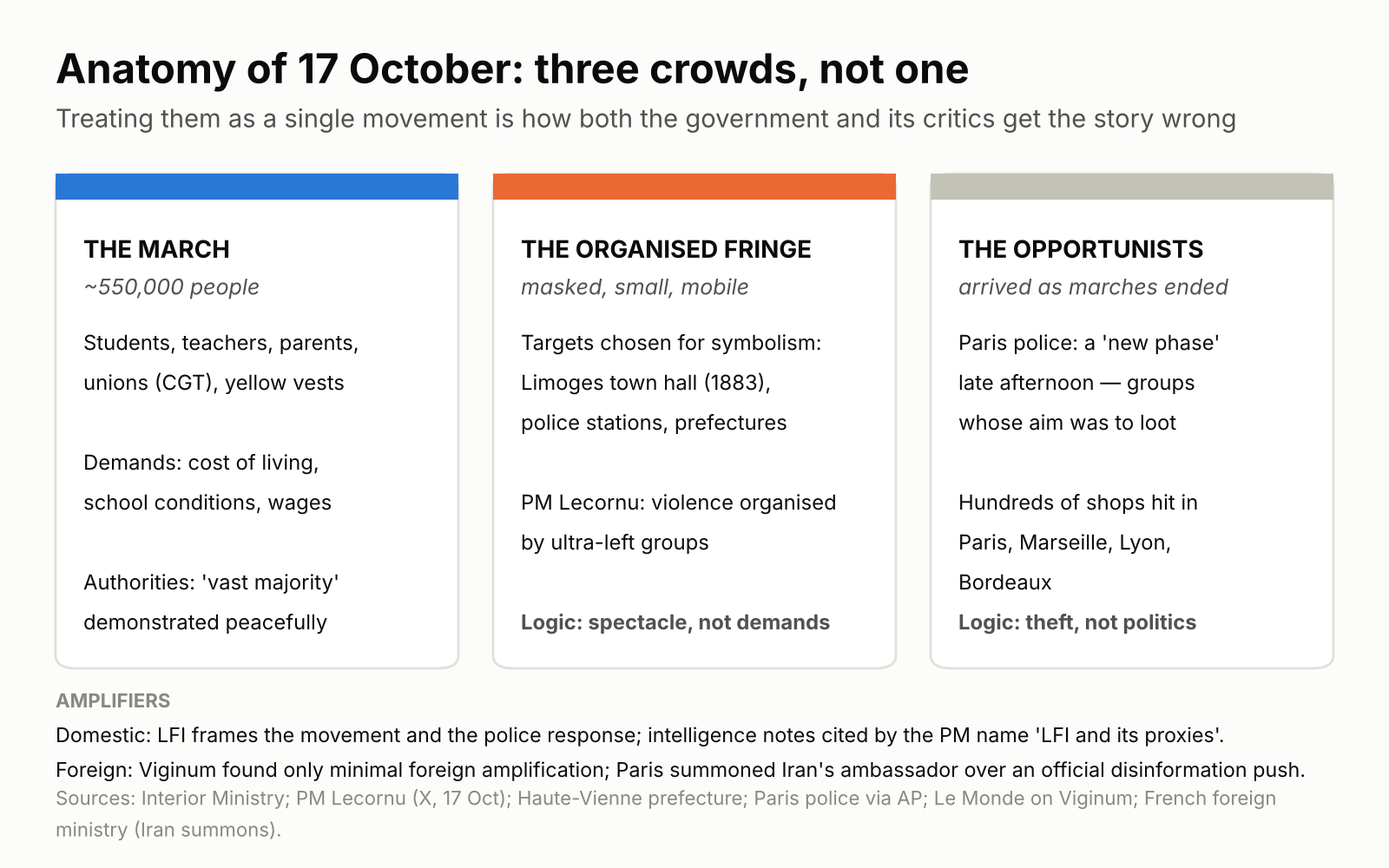
The first crowd is the march itself: hundreds of thousands of people, peaceful, with demands about wages, prices and schools.
The second is the organised fringe - masked, mobile and small. It picked targets for their symbolism. In Limoges, witnesses saw it torch a police car, break into the town hall and set it alight. Prime Minister Sébastien Lecornu said ultra-left groups had organised violence in several cities. Statues of Joan of Arc were defaced in Paris and Toulouse, the latter draped in a yellow vest and a Palestinian flag. These spectacles - similar to the latter days of the Yellow Vests protests - are not demands, but an attack on the symbols of the French Republic itself. Its likely effects - humiliating France abroad, unsettling investors, frightening the middle class - are exactly the effects such a spectacle produces. So far it has produced something else: anger at the rioters.
The third crowd arrived as the marches ended. Paris police described a new phase in the late afternoon, with groups whose only aim was to loot. Hundreds of shops were hit in Paris, Marseille, Lyon and Bordeaux. True opportunists, similar to the ones we’ve seen in the United States in the past.
What about immigration?
Given some of the demographics involved in these protests - especially their more violent parts, immigration was inevitably going to enter the debate. Much of the viral footage shows young men from the banlieues, and the movement itself started in Seine-Saint-Denis and Val-de-Marne. But since France keeps no ethnic statistics, and there is no official breakdown of who was arrested, viral footage is now treated as a sample: the most shocking clips travel furthest, and Le Monde has documented how images - some of them AI-generated - were selectively amplified to fit competing narratives.
People ought to remember that France was an empire with a lot of (current and) former colonies, and its’ immigration policy has been largely colonial for decades. Yes, France does have a serious integration problem - segregated suburbs, failing schools, distrust of the police - and it deserves its’ own genuine analysis. But neither populist slogans, nor AI-generated amplified rage-bait posts on social media is going to solve a complex, multi-generational integration problem.
The match
Which brings us to LFI. While Jean-Luc Mélenchon’s party did not create the anger., it did everything it possibly could to set it alight.
By 1 October, the Prime Minister’s office was citing intelligence that described the movement as an operation organised by LFI and its far-left proxies. Mélenchon called the pupils harmless, described the crackdown as racist in tone, and urged activists to place themselves between pupils and police. LFI’s mayor of Saint-Denis said violence could, at a given moment, be legitimate, and was referred to prosecutors. A former LFI parliamentary assistant was filmed promising barricades and a burning Élysée. After 17 October, Mélenchon blamed the Prime Minister for the chaos - then offered to end it in exchange for a price freeze, €10bn for youth and the abolition of Parcoursup.
This is Yellow Vests 2.0. In 2018, a provincial revolt against a fuel tax and an the arrogance of French bureaucracy when it came to business - a movement that crossed left and right - was hijacked by radicals from both extremes who ransacked the Arc de Triomphe. In 2026, a school revolt has been hijacked by a radical left that openly wants to replace the Fifth Republic with a Sixth. Mélenchon, a Trotskyist activist who served as a Socialist minister in the very institutions he now wants to tear up, is its political embodiment. We spend a great deal of energy - rightly - watching Le Pen. We spend far too little watching him, and the damage he is capable of inflicting on the Fifth Repubic.
Ironically, just like one of his heroes - Lenin - he too comes from a very wealthy family, and has access to vast resources to have the political and social impact he does. As someone that had to claw myself out of the ruins of communism, I do share a specific loathing for divorced-from-reality wealthy Marxist-Leninists that would lit up a revolution from the comfort of their protected penthouses.
Who profits abroad
Was Moscow behind it? On the evidence available: no. However, they can and will benefit from it either way.
France is one of the few European countries that invests seriously in fighting information warfare. Its agency Viginum has exposed Russian networks such as Storm-1516 and Matryoshka, and the EU ranked France the second most targeted country for Russian information manipulation, after Ukraine. Yet Viginum, examining the mobilisation before 17 October, found only minimal foreign amplification. No official or judicial finding links Russia to organising the unrest.
Ironically, the state caught in the act was Iran. Paris summoned the Iranian ambassador over a disinformation campaign run by official Iranian foreign-ministry accounts accusing France of flagrant human-rights abuses. A country at war is exploiting a crisis made worse by that very war.
As for Russia - truth is, it does not need to organise French chaos. It needs only to amplify it, and wait. An authentic grievance, combined with domestic unrest can be very easily exploited by the Kremlin.
And the domestic picture is pretty dire. Marine Le Pen has escaped her father’s anti-republican shadow and distanced herself from the Kremlin enough to be electable: she condemned the 2022 invasion, and the RN now insists Russia cannot dictate French policy. But in September she said France could no longer afford to finance Ukraine, called for a peace conference, and wants France out of NATO’s integrated command once the war ends. Mélenchon, for his part, suggested in September that Ukraine’s long-range strikes might be feeding the Russian threat. Both extremes, from opposite directions, arrive at the same place: a France that does less for Ukraine.
That is the real geopolitical stake. France is a nuclear power, a permanent member of the UN Security Council, the backbone of European defence industry and one of Kyiv’s most important backers. A government consumed by riots, censure motions, union demands and nervous bond markets has little capacity left for grand strategy. A weekend of disorder does not weaken France’s deterrent per se, but years of paralysis, eroding fiscal credibility and a change of course in 2027 could. Moscow does not need to light the fire, it only needs France to keep burning.
The 2027 endgame
Next year the street will meet the ballot box.
In Elabe’s poll of 14–16 October - taken before the riots - Le Pen leads the first round with 32.5%. Behind her, Édouard Philippe (16.5%), Raphaël Glucksmann (15.5%) and Mélenchon (15%) are in a statistical tie for second place. In the run-off, Le Pen beats Philippe 52.5 to 47.5 and Glucksmann 53.5 to 46.5. Against Mélenchon, she wins 69 to 31. Many centrist and moderate-left voters say they would rather abstain than vote for him.
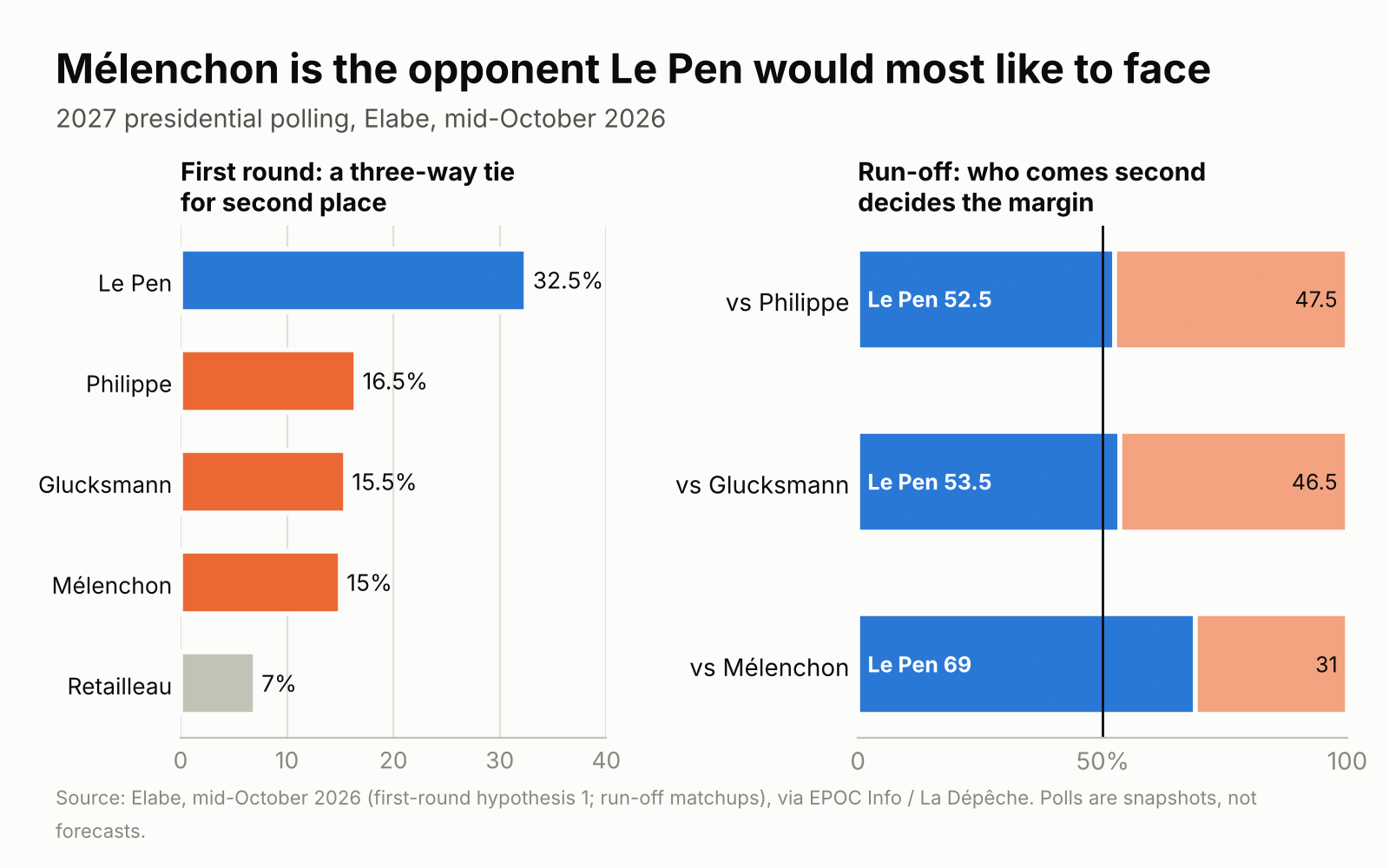
The current numbers indicate that Mélenchon cannot win the presidency. But he can play a role in deciding it. To reach the second round, he must radicalise and mobilise his base - the young, the banlieues, the angry. The very intensity that gets him there makes him unelectable once he arrives. His success in the first round would be the mechanism of his defeat in the second.
Le Pen understands this perfectly. Every burning town hall feeds the RN’s promise of order; she no longer has to persuade voters that her programme is attractive, only that the alternatives are unacceptable. Tellingly, after 17 October she blamed Macron, not Mélenchon.
No secret pact is needed here - in parliament, RN and LFI deputies have repeatedly voted together to try to bring down the government. Their incentives are aligned: each needs the other as the enemy. It is not Molotov–Ribbentrop on paper, but it is an objective alliance in practice - and history shows that when the extremes feed each other, it is the democracies between them that pay.
Whether Mélenchon dreams of a French October Revolution or simply bets that young voters will carry him into the run-off, the outcome is the same: a Le Pen–Mélenchon second round would be a catastrophe for France, and a gift to every adversary watching from Moscow to Tehran.
The Republic is not the problem
None of this means France is collapsing - half a million people marched, and the overwhelming majority went home peacefully. What happened in Limoges after the fire may matter more than the fire itself: residents in tears, a city furious, and an immediate demand to rebuild.
France’s crisis is not simply a revolt against a government, or inflation or crumbling schools, but a revolt against the growing distance between what the Republic has promised, what its economy can finance, and what its institutions can deliver. Political entrepreneurs are exploiting that distance, violent actors are attacking the institutions themselves, and foreign adversaries stand to profit from the paralysis.
The way out is neither repression alone nor another round of borrowed concessions. It is honesty - about what wars abroad now cost at home, about what the French state can reasonably afford, and about who is exploiting the gap.
Vive la République. Vive la France.
Welcome back! It's nice to see you posting again. I hope you resolved your situation satisfactorily.
As a French millennial who chose to leave the country a few years ago, I have some additional detail.
1. I think Macron is very aware he's sitting on a pressure cooker that's getting ready to explode. He doesn't choose to address the issues since his constituency is more or less in the center/center right, including retirees, e.g. the ones with the most to lose if the deal is renegotiated. (Not sure it would be possible without a major crisis even if he wanted to, if I'm being honest). So when the cooker starts letting off steam, he deploys the state's coercive powers to tighten the lid and discourage demonstrations. We've seen this time and again since covid. It's bad enough on its own, but what worries me most is that it's a buffet of delicious precedents that whatever extreme comes to power can point to when they start cracking down too.
2. You're right on the "mother state". I think a social safety net and generally a state strong enough to regulate society and make generational investments is desirable, but France has taken it too far. Now the mindset is that any problem requires state intervention, which compounds the problems.
3. On the broken social contract: it was predicated on growth from postwar babyboom, rebuilding, transition to consumer economy and cheap, abundant energy. It was already crumbling for my generation (millenials). My parents rose from lower working class to upper middle class on their own work. Even with Master's degrees and hard work, my wife and I would never have been able to buy a home in any reasonable timeframe without very significant help from our parents. (Which BTW is an important nuance... the boomer retirees everyone loves to hate are often the same people who help subsequent generations survive the current times). I don't expect to receive anything like my parents retirement-wise.
The sad truth is that post-boomer middle class generations were raised in the expectation that studying and working hard would pay off like it did for their parents.
But unfortunately it was more the exception than the historical norm. Broken expectations are much worse than no expectations. These days you have to be rich to be middle class. The generations after mine are even worse off. No wonder they're pissed.
4. Agreed, Melenchon is a disaster. He chose to pivot to the far left after a time in the mainstream left, and most worryingly he has chosen to go all in the north African constituency. I suppose he thinks the Muslim underclass would be a nice basis for his revolution. I think he's grossly miscalculating, and will be the first devoured if a revolution based on that group ever comes. There are plenty of historical examples of revolutions devouring their own.
5. It's deeply ironic to see Le Pen wishing for a final round against Melenchon. For decades mainstream candidates wished to be matched against a Le Pen, father or daughter, to ensure election, even going so far as to encourage extremes to get there. We have reached the logical end point. I wish I could find that funny.
6. Because of the euro, France won't be able to print its way out of debt - much like Greece back then. We're in for a bumpy ride when this comes to a crisis point.
Thanks again, I'm glad you're back.
I love reading intelligent and thoughtfull analysis. And considering your text is one of the only texts like this i found to france in the last week I am happy to recommend it.