


Waronomics is free to read, but entirely reader-supported - if you find this work valuable, you can support it by becoming a paid subscriber or buy me a coffee.
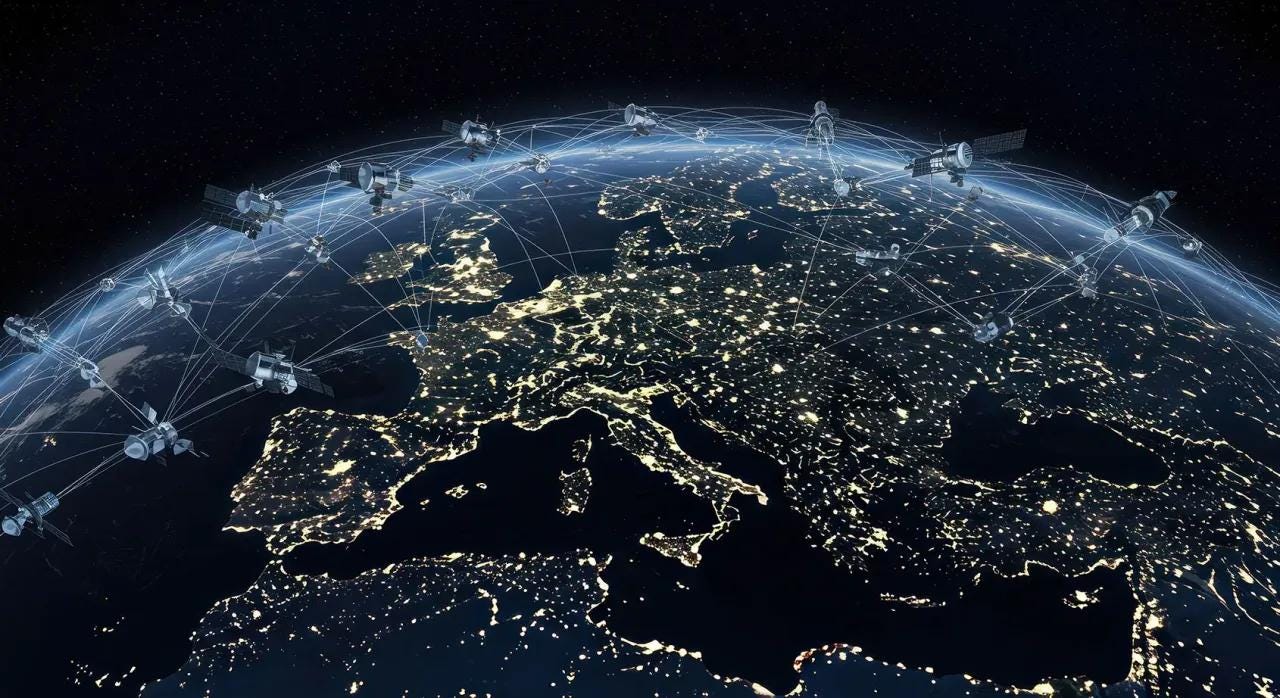
Until very recently, the world believed that economic interdependence would save us from ourselves. After all, why would nations go to war when their economies are so deeply intertwined? Why would political leaders jeopardise the prosperity generated by global trade? And why would global companies, whose very existence and large profit margins depends on selling products and services across borders, would willingly become tools of geopolitical confrontation?
Over the course of several decades, we built an extraordinarily interconnected world around a relatively small number of powerful companies. We entrusted them with our communications, our financial transactions, our information, our data and, eventually, even the technological infrastructure underpinning our national security.
We called them global companies. Their services crossed borders, their customers lived on every continent, and their technologies became so deeply embedded in modern life that we gradually stopped thinking about where these companies came from, who ultimately controlled them, and which governments could exert authority over them.
But global reach doesn’t mean political neutrality, and we are learning that bitter lesson now.
A company like Visa or Mastercard can facilitate transactions across more than 200 countries and territories, yet its ability to operate remains subject to national laws, sanctions, regulatory interventions and corporate decisions. We never thought about the power these companies wield, because they used to affect - and rightfully so - our adversaries. Visa and MasterCard do not operate in Russia and Iran, and while these decisions were a response to military or proxy regional aggression, not an arbitrary political whim, they nevertheless expose the same structural reality: global commercial infrastructure operates within a political order, not above it.
The same applies to cloud computing, semiconductor manufacturing, software platforms, telecommunications and, increasingly, satellite connectivity.
A company can operate everywhere, serve everyone and employ people across dozens of jurisdictions, but when geopolitical interests collide, it does not exist outside politics. It belongs to a jurisdiction, answers to regulators, depends on export licences and remains vulnerable to the preferences of those who control it.
And nowhere is that contradiction more apparent today than in the skies above Ukraine.
The Weaponisation of Starlink
Starlink terminals had become an indispensable element of Ukraine’s wartime communications infrastructure. They helped Ukrainian forces maintain connectivity despite Russia’s systematic destruction of terrestrial networks, supported the coordination of military units and enabled numerous unmanned systems to operate across the battlefield.
The technology, without a shadow of a doubt, had been transformational for Ukraine’s war effort.
However, as the new administration took office last year, the problems began. Elon Musk, who was initially very sympathetic towards the Ukrainian cause, became increasingly radical in his political views and understanding of the conflict. Combine that with an administration that is becoming ever so hostile towards Ukraine, while warming up to Russia, and you have a recipe for disaster.
The most recent escalations regarding the reliability of Starlink began on the night of 13 October 2026, when Ukrainian military units began experiencing disruptions to the satellite communications systems underpinning some of their drone operations.
Musk maintained that decisions concerning Starshield’s operational restrictions belonged to the American military and ultimately the US president, and he distinguished the government-controlled military service from commercial Starlink, which he argued should not be used for offensive military operations anyway.
And while the publicly available evidence does not yet establish a definitive answer to every question of this absurd situation, the markings are on the wall - a sovereign country fighting an existential war found itself dependent on communications infrastructure whose operational restrictions had become the subject of contradictory explanations from a foreign corporation and a foreign government.

And for the record, this is not the first time Starlink has exposed such a dilemma. In 2022, during preparations for a Ukrainian operation against Russia’s Black Sea Fleet near Sevastopol, Musk refused a request to activate Starlink coverage in the relevant area, later explaining that he feared facilitating a major escalation.
So the question remains: at what point does a private communications provider acquire the practical ability to influence a country’s military options?
Of course, no commercial provider is obliged to support every conceivable military operation, and restrictions on offensive use can reflect legitimate legal and contractual considerations. But when a military has built essential capabilities around an external provider, the provider’s rules and decisions acquire geopolitical consequences far beyond an ordinary customer relationship.
The Death of the Global Company
I think it is time for us to accept that the defining assumptions of globalisation is coming apart.
For years, Western countries and their partners operated within an international order in which access to American technology was generally regarded as a commercial decision, even when it involved critical infrastructure.
European governments could purchase American cloud services, deploy American telecommunications technologies, integrate American software into public administration and procure American military systems with relatively little anxiety about the political implications, because the assumption was that the United States and its allies shared sufficiently durable interests to make those dependencies manageable. That assumption is now being stress tested in real-time.
When alliances become transactional, when political commitments fluctuate between administrations, and when corporations are drawn directly into foreign-policy disputes, technological dependence becomes vulnerability.
The most important distinction here is between interdependence and dependence. Interdependence means that two parties benefit from maintaining a relationship and both incur meaningful costs if it breaks down. Dependence becomes dangerous when one party can withdraw a critical service while the other cannot replace it without suffering substantial damage.
The former encourages cooperation, the latter creates opportunities for coercion.
This is why a country operating a fleet of American-made aircraft, relying on American cloud infrastructure, or using American satellite communications must ask a question that would once have seemed unnecessarily paranoid:
What happens if Washington’s interests cease to align with ours?
And equally, what happens if decisions affecting our access are made not through accountable government institutions, but through the commercial terms, discretionary authority or political preferences of a powerful private actor? The answer is not necessarily to eliminate foreign technology. For most countries, complete technological decoupling and self-sufficiency is economically impossible at that point in time.
The answer is to understand where dependence becomes an unacceptable vulnerability. And that realisation is now producing a new space race.
The New Space Race
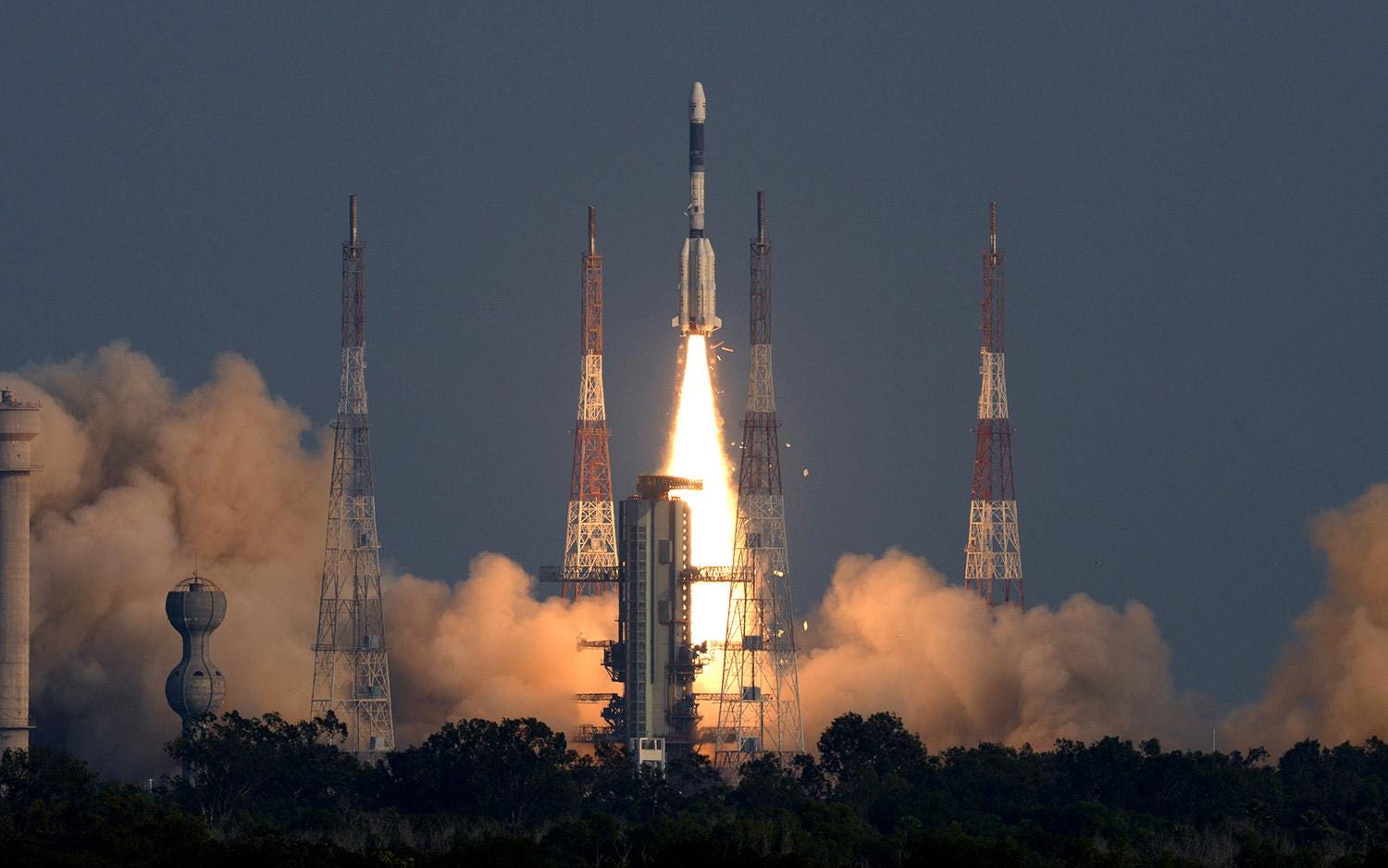
Europe has spent much of the past decade discovering the dire consequences of strategic dependence. Russia’s invasion of Ukraine exposed the continent’s reliance on Russian energy, the inadequacy of its defence-industrial capacity and the extent to which European security still depended on American military capabilities.
The confrontation with China exposed vulnerabilities in critical minerals, manufacturing and strategically important supply chains. The increasingly unpredictable direction of American foreign policy has added another dimension to this problem - its dependence on foreign infrastructure in orbit.
Unlike the original Cold War space race, the objective here is not to plant an EU flag on the Moon, but to make sure European governments, militaries and critical infrastructure can continue communicating even when relations with an external provider - such as Starlink / Starshield - deteriorate.
There are several important developments suggesting that Europe is finally moving beyond declarations of strategic autonomy towards the industrial capacity required to achieve it.
Yes, industrial capacity.
The thing is, to build and sustain a sovereign network, states need control over a chain of capabilities, not just the satellites.
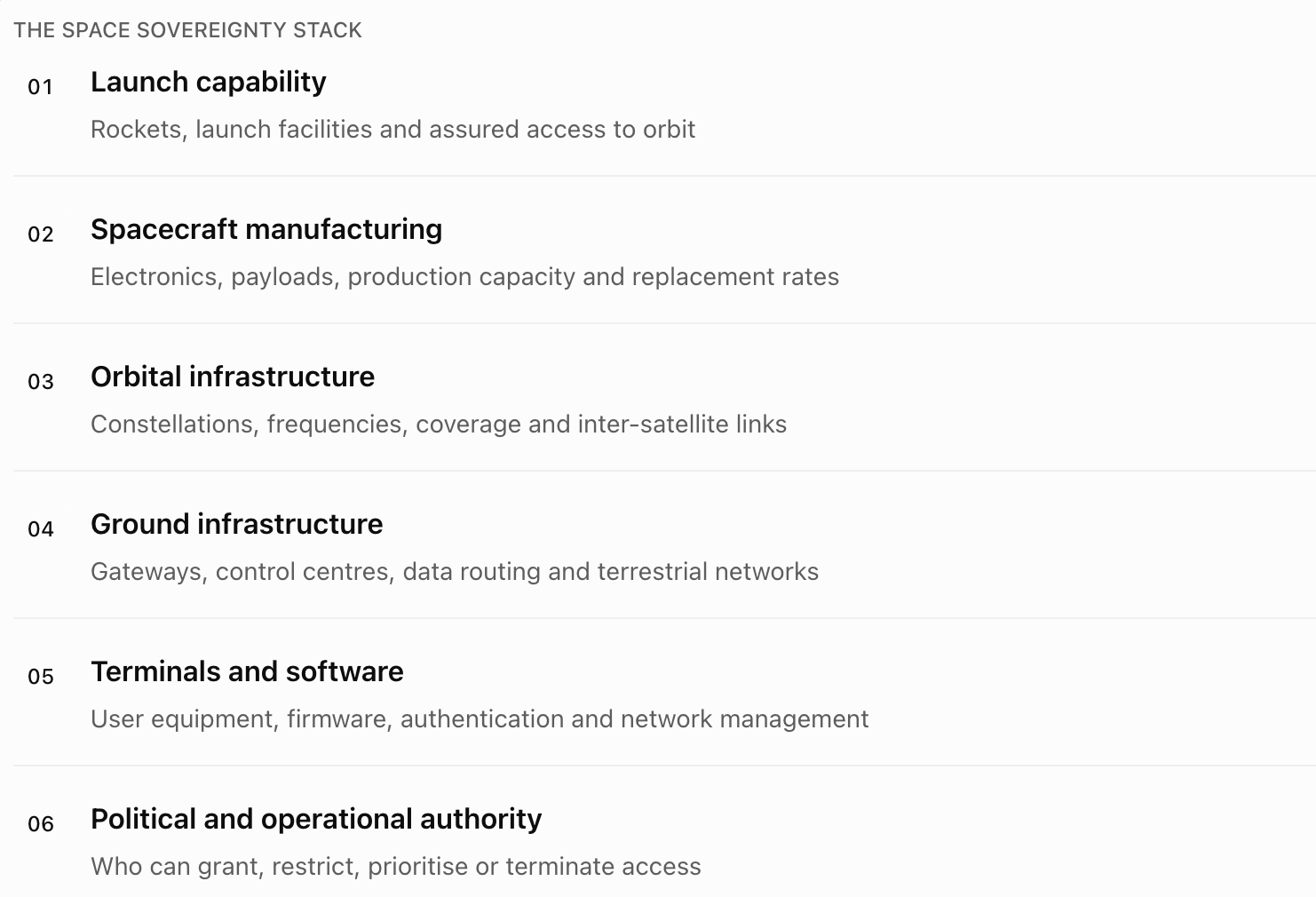
A state can own satellites yet rely on foreign launch vehicles. It can operate a constellation yet depend on foreign semiconductors. It can have national telecommunications companies while leaving software control or essential ground infrastructure abroad.
We have to be real about this - complete autarky is unrealistic. The strategic objective should therefore be to avoid any single foreign dependency becoming an unacceptable point of failure, not necessarily to manufacture every component domestically.
The current owners of the sky
Low Earth orbit has turned into a strategic infrastructure, and it has exactly three serious owners: one American company, one French-British constellation and two Chinese state-backed networks. Everyone else is a customer, a latecomer, or both.
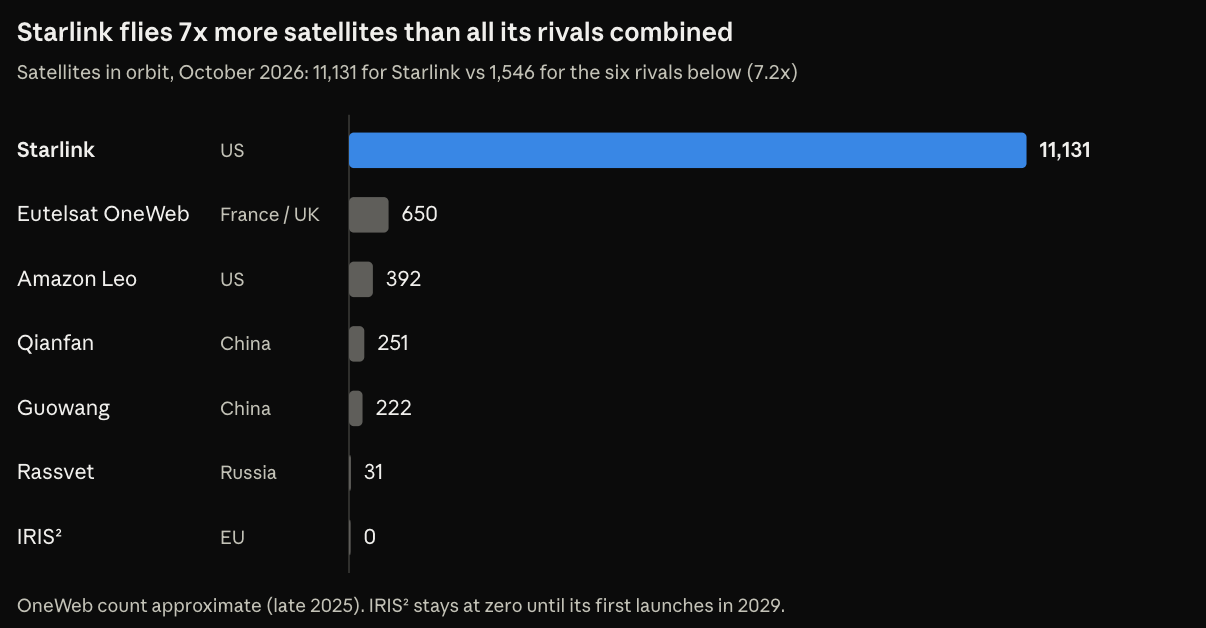
The West’s “competition” to Starlink is Amazon Leo, with 392 satellites in orbit, about a quarter of what its own FCC licence demanded by July 2026. Yet, it’s worth remembering that this is the same country, same jurisdiction, and above all - the same White House. That’s not exactly diversification, but a second seat at the same table.
China, meanwhile, is doing what China always does: building at state speed. Guowang and Qianfan are only a couple of hundred satellites each today, but the combined plan is around 27,000. Guowang’s own ramp calls for 3,600 satellites a year from 2028.
And Russia? Rassvet had 31 production satellites up by mid-October against a plan of 156 by year-end. And, according to Zelensky, it’s getting help from Beijing. Because of course it is. We don’t call them an Axis for no reason.
Europe Looks Up
Credit where it’s due: Europe has finally started doing, not just talking about doing. The problem is that almost nothing will be in orbit before 2029.
Starlink is still the best network on the planet, and a sovereign network that shows up in 2030 does nothing for a frontline soldier in 2026. Plenty of planners argue for a portfolio, not a replacement: keep buying Starlink, add OneWeb, national systems and multi-orbit terminals, so no single switch is decisive. Even Kyiv, after October, is asking for more Starlink, not less.
Eutelsat OneWeb: Europe’s existing alternative
For Europe, the obvious starting point is Eutelsat OneWeb. The French-headquartered satellite operator, formed through the combination of Eutelsat and the British-origin OneWeb constellation, already operates more than 600 satellites in low Earth orbit.
Unlike IRIS², which remains under development, OneWeb is an operational commercial network providing connectivity to governments, enterprises, aviation and maritime customers. This makes it Europe’s most immediate “alternative” to Starlink, so to speak.
But the difference in scale is enormous! SpaceX operates more than 11,000 Starlink satellites. OneWeb operates a little over 600.
Those numbers do not translate directly into a comparison of network effectiveness. OneWeb’s satellites occupy different orbits and support a different commercial architecture. Latency, bandwidth, terminal availability, geographic coverage and military suitability matter at least as much as the raw satellite count.
Nevertheless, the industrial disparity is much more difficult to ignore. SpaceX has developed a vertically integrated system combining satellite manufacturing, launch vehicles, ground infrastructure, software and terminals. Its reusable rockets have allowed it to deploy and replenish satellites at a pace that competitors are struggling to match.
Europe, meanwhile, is attempting to strengthen the capabilities it already possesses.In September, Eutelsat expanded its satellite procurement arrangements with Airbus, bringing its planned programme of new OneWeb spacecraft to 669 satellites. On 2 October, Airbus announced that it had completed the first 32 next-generation OneWeb satellites at its Toulouse facility.
This is significant for two reasons.
the manufacturing of these satellites in France demonstrates that Europe possesses substantial aerospace engineering expertise and the capacity to organise industrial production of advanced communications infrastructure.
the programme is not merely expanding the constellation - much of the investment is required to replace ageing satellites and maintain existing services.
A sovereign space infrastructure cannot simply be launched once and forgotten. Satellites degrade, reach the end of their operational lives and must be replaced continuously. It is an ongoing industrial commitment.
And here comes the irony - the first 32 new Airbus-built OneWeb satellites are being prepared for launch by SpaceX. Europe is building an alternative to American-controlled satellite communications while relying on an American company to put part of that alternative into orbit.
To be fair - not necessarily an unreasonable commercial decision. SpaceX has highly competitive launch capabilities, but it is a perfect illustration of the difference between owning a technology and controlling the industrial ecosystem required to sustain it.
Sovereignty - whether in space or any other realm - is not a product you purchase once, but a capability you must be able to reproduce and sustain. Europeans that spent a lifetime laughing at Americans for their sky-high defence budgets are about to find out why those budgets existed in a first place. Sovereignty is expensive, and a continent that outsourced its energy sovereignty to russia, its industrial sovereignty to China, and its defence sovereignty to the United States is in for a rude awakening.
IRIS²: Europe’s Long Game
The European Union’s most ambitious response to its dependence on foreign satellite infrastructure is IRIS² - Infrastructure for Resilience, Interconnectivity and Security by Satellite. Rather than merely creating another commercial internet provider, the programme aims to give Europe control over secure communications for governments, militaries, emergency services and critical infrastructure.
In August 2026, the European Commission and the SpaceRISE consortium - led by Eutelsat, SES and Hispasat - agreed to expand the planned constellation to 348 satellites, including 330 in low Earth orbit and 18 in medium Earth orbit, with first launches targeted for 2029. The programme, originally valued at approximately €10.6 billion, brings together some of Europe’s largest aerospace and telecommunications companies.
One particularly significant development came from Belgium - on 10 September 2026, Aerospacelab secured a €2.4 billion contract to manufacture 264 satellites for IRIS². For a company founded in 2018, this is an extraordinary achievement, but it also signals something bigger: Europe is moving towards industrial-scale satellite manufacturing, creating opportunities for a new generation of aerospace companies and their wider supply chains.
And this is how technological sovereignty becomes industrial policy - owning satellites is one thing, but possessing the manufacturing capacity, launch infrastructure, secure software and supply chains necessary to sustain them is another thing entirely.
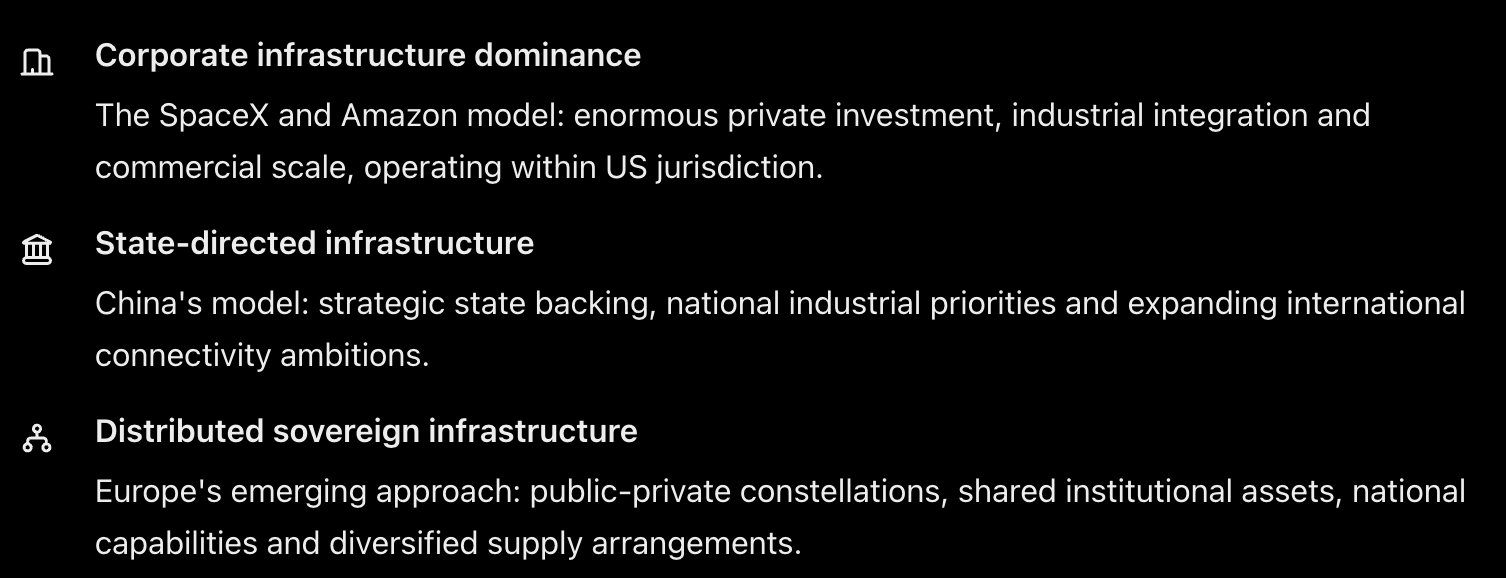
Europe is pursuing a layered strategy here: OneWeb already provides commercial satellite connectivity, GOVSATCOM began pooling governmental satellite capacity in January 2026, and IRIS² aims to establish a comprehensive sovereign system over the coming years / decade(s).
None is yet a complete substitute for Starlink, and procurement contracts are not operational capability, yes. But together, they represent a fundamental shift in European thinking, which is a lot more than we could’ve said just a few years ago.
For years, strategic autonomy was largely a political aspiration. IRIS² will test whether Europe can turn it into an industrial and operational reality. Watch this space, it will only get more interesting in the upcoming years.
India: the middle way
If Europe is the cautionary tale, then India - being India - will remain a leader in hard-headed hedging. Now, I admit I know very little about India and Indian politics, which is why I am cautious to speak about something I don’t know, but from what I’ve seen so far - they’ve been champions in hedging between big players. Be it commercial (e.g. Starlink) or geopolitical (China, Russia, the U.S., the EU).
Starlink, Jio-SES and Eutelsat OneWeb all hold the same licence in India. As of October 2026, all three are still waiting on security clearance and spectrum. When Musk complained about delays and Jio’s clout, New Delhi’s answer was basically: everyone waits in the same line. In May it added 29 more regulations for satellite operators, on top of interception and localisation requirements. Translation: you want 1.4 billion customers? Fine, but you play by our rules.
Meanwhile, India is developing its domestic constallation too. In July the space regulator IN-SPACe cleared Reliance Jio’s plan for about 1,600 satellites as technically sound, opening the way to India’s first home-grown constellation. Ambani says Jio will lease global capacity while it builds its own. Oh, and Jio also sells Starlink. Hypocrisy? Nah, it’s just hedging, and it’s exactly what everyone else should be doing.
On the military side, India plans 52 surveillance satellites, half built by private firms. Even there, dependence sneaks in: a 2026 national-security payload flew on a private American rocket, an ISRO first.
Everyone else is hedging
Outside Europe and India, the middle powers have reached the same conclusion: own something. Even something small.
Canada. Telesat is betting about C$7 billion on Lightspeed, now 225 satellites after a defence order that Ottawa says gets its forces sovereign connectivity years earlier. First satellites at the end of 2026, commercial service in early 2028.
Ukraine. The country that needs an alternative most is building one. Stetman and Denmark’s GomSpace plan 360 satellites for about $1.1 billion, deploying from 2027. The first test satellite, UASAT-NANO, reached orbit on 1 October.
Taiwan. Taipei went with OneWeb after its Starlink talks fell apart. Eutelsat’s CEO says plenty of customers want an alternative to Starlink. Yeah, no shit.
Balkan Candor
Folks, sovereignty is expensive. If we are serious about achieving it, we need to let go of our cushy welfare states and our precious work-life balance. Satellites, rockets, factories and terminals don’t build themselves.
We need to work hard, because the building blocks of future prosperity don’t rest on 35-hour workweeks and 6-week summer vacations. They rest on hard, deliberate and meaningful productive work.
Buckle your seatbelts, the age of peace and prosperity is gone.
Consider recent experiences with Multinationals such as GM,VW, Daimler etc. We were warned against the transfer of wealth by the 1970's W. German counter culture. Financialization and its globalized search for lowest labor costs is the failed mechanism.
Great post. This will be a helpful perspective for updating this study next month.
https://thethirdattractor.org/studies/keys-to-orbit/tour