


Waronomics is free to read, but entirely reader-supported - if you find this work valuable, you can support it by becoming a paid subscriber or buy me a coffee.
The following analysis is a merge of two articles I’ve had in draft, but decided to create as a single piece to connect the dots. It is therefore the longest piece I have (yet) produced.
If you ask the average European whether we live in an age of war, you will get a shrug. There is no Verdun on the evening news, no Stalingrad, nor Okinawa. The world wars are now remembered as a black-and-white footage, which feel like something that happened to another species.
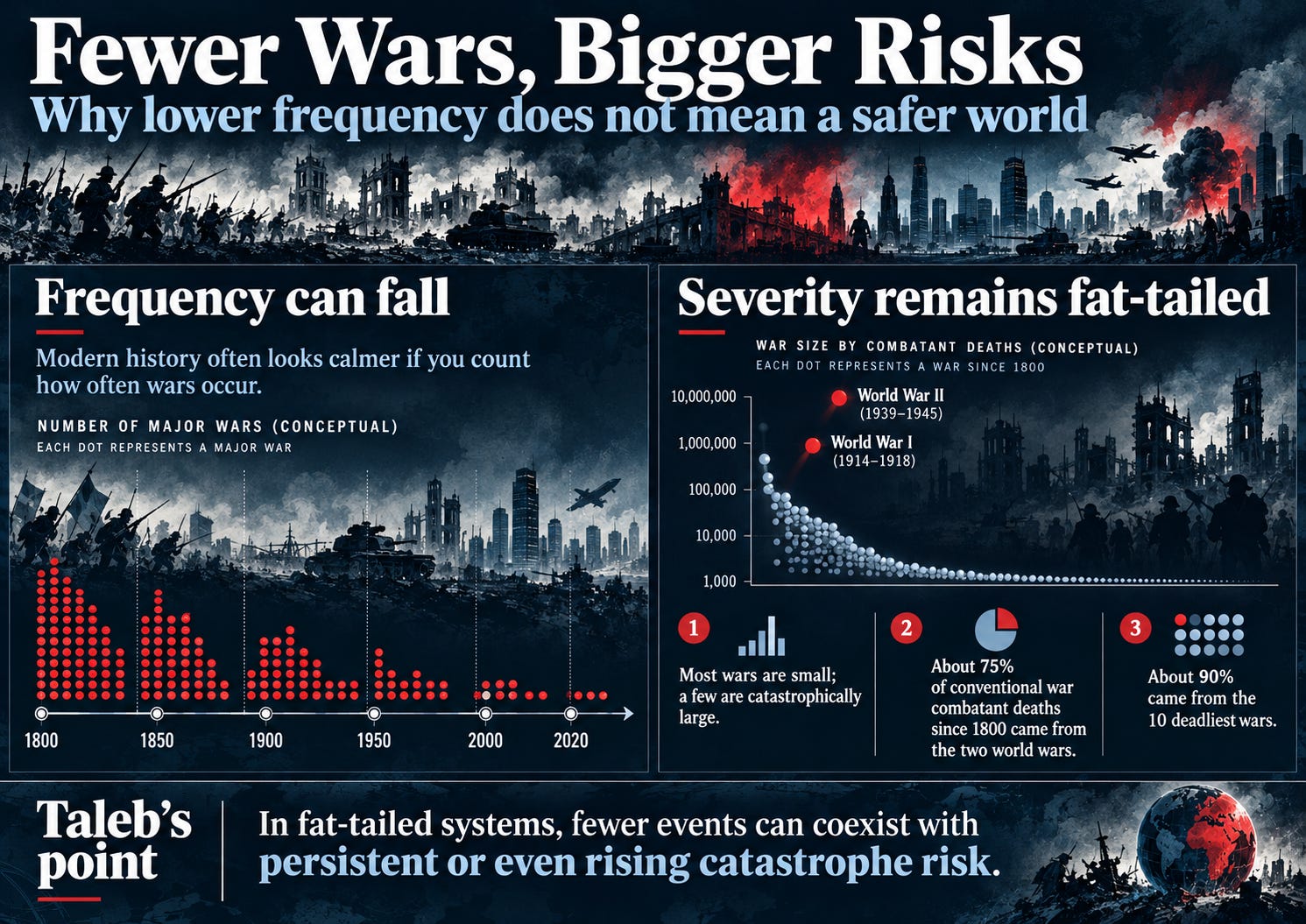
Humanity has developed increasingly powerful means of inflicting destruction on a grand scale without demonstrating that it has eliminated its propensity for war. Our ability to avoid the next World War is therefore to be treated as a political achievement requiring constant maintenance - not as a permanent feature of modern civilisation. Because war carries a fat-tailed risk.
The fat tails of war: frequency ≠ severity
In 2016, Taleb and Pasquale Cirillo published a study of violent conflict across 2000-years of history, and found that war deaths follow a fat-tailed distribution: for most of history, wars were frequent but small and contained. It wasn’t until the industrial age when wars became…monstrous.
The Great War killed somewhere around 15 to 20 million people. The Second World War killed between 70-85 million - the numbers are incomprehensible on paper, which is why Neil Halloran’s short film The Fallen of World War II is worth 18 minutes of your life.
Why great-power war went cold
When direct war between nuclear powers becomes suicidal, rivalry flows into channels where the costs are bearable: proxy wars, sanctions, sabotage, espionage, propaganda, trade embargoes, supply-chain disruption, and so on and so on (please, read this in the voice of Slavoj Žižek, it will make you chuckle).
Cold wars still kill - ask Korea, Vietnam, Afghanistan. But they do not turn entire continents into battlefields the way Europe and the Indo-Pacific were between 1939 and 1945. A cold war is, in a grim sense, the mitigated version of the alternative. We are, once again, living inside such a war.
Welcome to Cold War 2.0 (as per Velina Tchakarova definition).
WWI: The war that keeps on giving
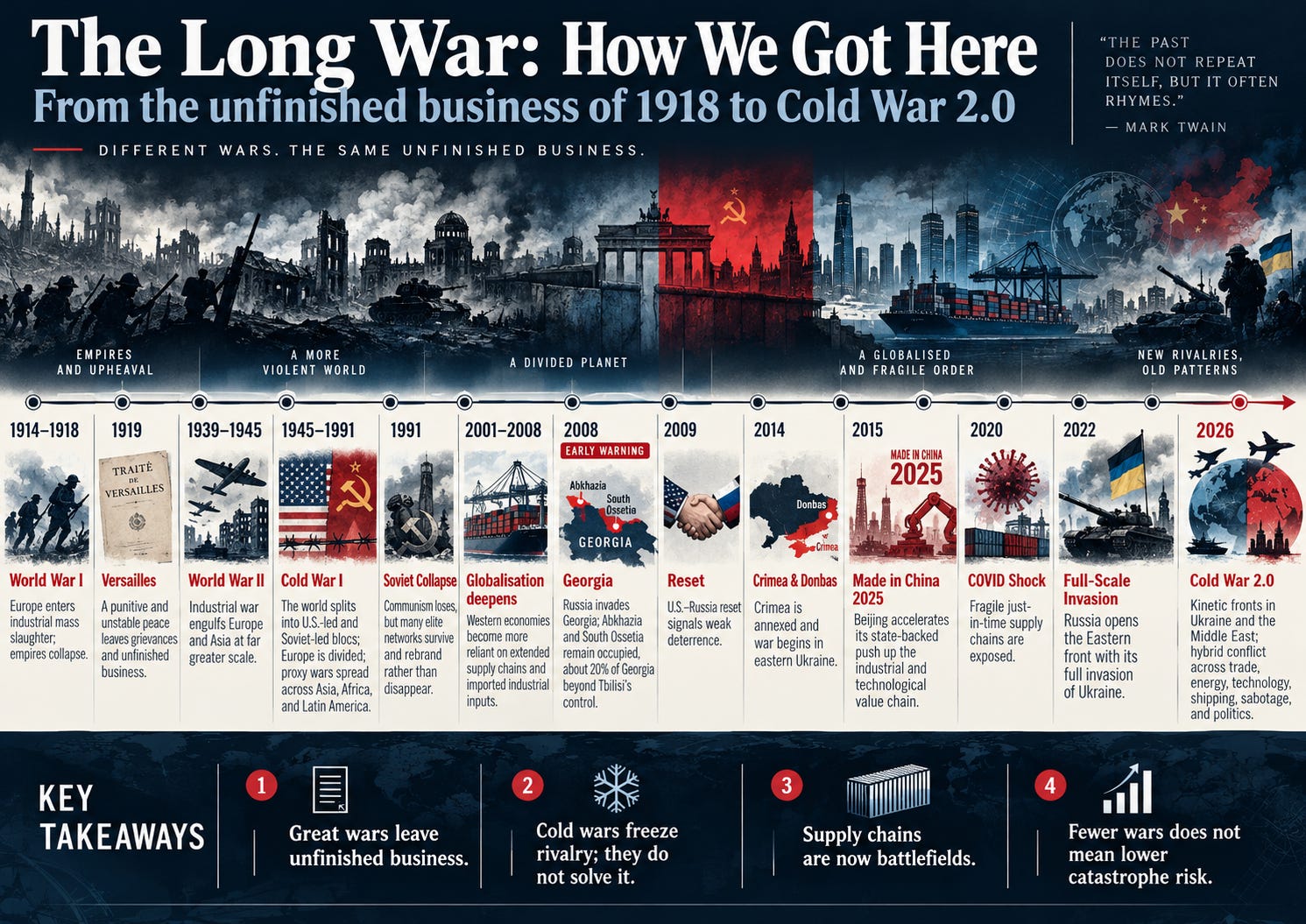
They called it the Great War, because nobody was expecting a sequel. H.G. Wells, in 1914, sold it as “the war that will end war.” Well, it didn’t end all wars, but it ended four empires: the German, the Austro-Hungarian, the Ottoman and the Russian. However, it never ended the argument that started it to begin with.
1918–1939: Victory without a peace
The treaties of 1919 managed a rare historical double failure - Versailles was harsh enough to humiliate Germany and too weak to contain it, and no power was willing to enforce it once enforcement became inconvenient. Of course, none of this made the Second World War inevitable per se - at the end of the day, it took deliberate choices by aggressive regimes, and a collective failure of nerve by those who could have stopped them. How much of these circumstances sound familiar to you nowadays? A lot, doesn’t it?
1945–1991: The war didn’t end the struggle
The Second World War ended with the destruction of Nazi Germany and Imperial Japan, but it allowed for the Red Army to take over the eastern half of Europe.
Millions of people east of Berlin swapped one occupier for another. Call it Soviet if you like; the decisions were made in Moscow, so I will forever call it with its real name - russian. Budapest in 1956 and Prague in 1968 learned what happens when you forget that - the tanks roll into your city square. Literally.
Meanwhile communism spread across Asia and into Latin America, and the world split into two competing political systems, resulting in the first Cold War: four decades of nuclear standoff and proxy wars from Korea to Angola.
How the first Cold War was actually won
One side ran out of the ability to produce. That’s it. That’s how almost all wars essentially end.
On 16 September 1989, Boris Yeltsin finished a tour of NASA’s Johnson Space Center in Houston and asked to see an ordinary American supermarket. His entourage pulled into a Randalls in Clear Lake. The Houston Chronicle’s reporter watched him walk the aisles shaking his head.
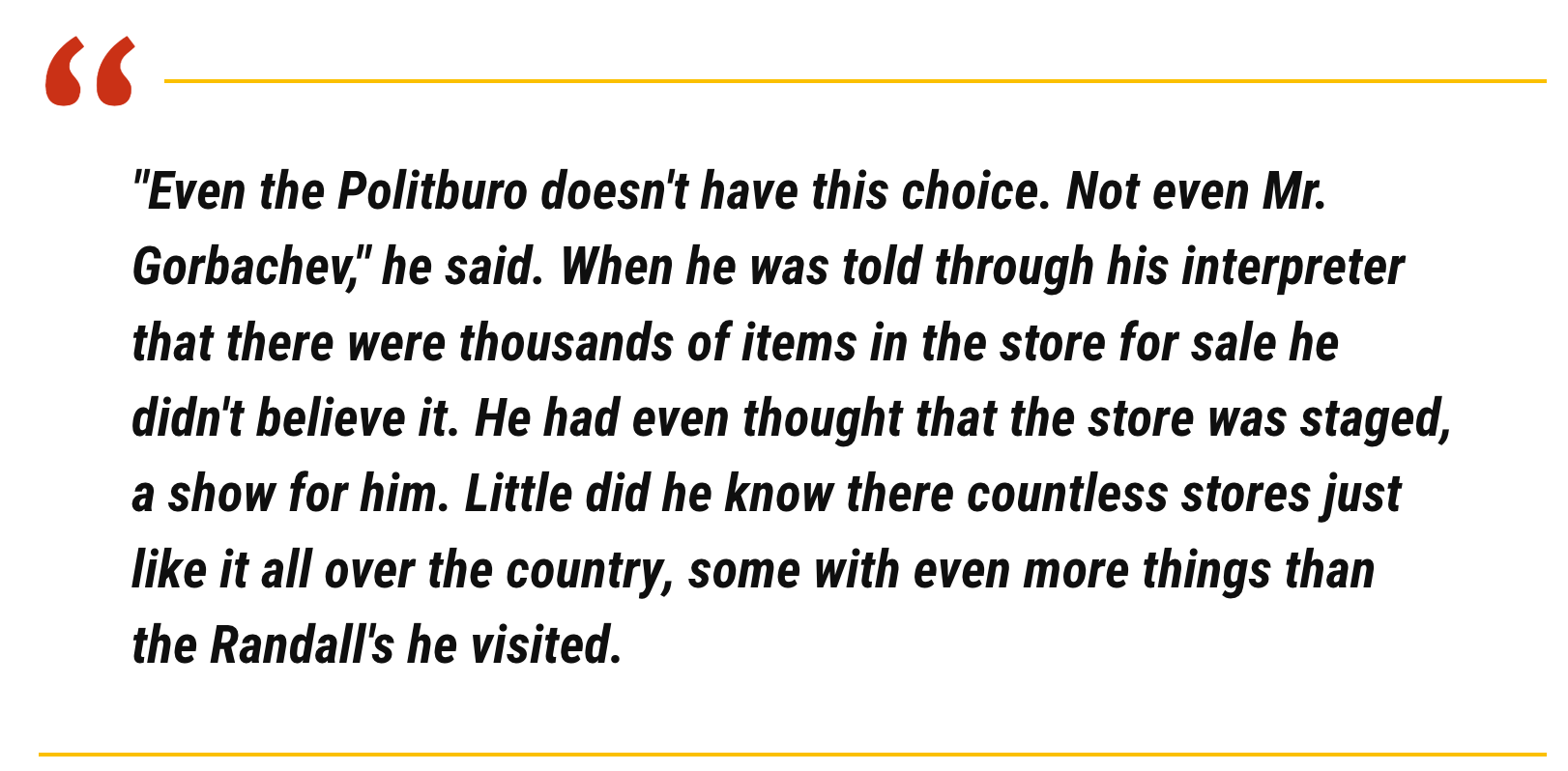
At the end, the Soviet elites realised that a single mother on food stamps in Texas had more purchasing power than the ruling communist elites of a nuclear superpower. The war, supposedly, “ended”.
1991: The controlled demolition
And this the point in history where the West made its most pivotal, expensive error: it assumed that the defeat of a system meant the defeat of the people running it.
(An amusing, yet historically accurate 16-year old video of the history of the Soviet Union - the last part is especially telling, and almost prescient)
In Russia (and elsewhere), the nomenklatura did not disappear, it rebranded. Sociologists Olga Kryshtanovskaya and Stephen White documented how much of Russia’s new business elite grew straight out of the old Soviet establishment. The loans-for-shares auctions of 1995–96 handed the crown jewels of Soviet industry to a small circle of insiders. By 2000, a former KGB officer was running the country, and the old elites rebranded themselves as free-market capitalists, told the West they were reformers, and the West - eager for a peace dividend - chose to believe them. Blindly.
China’s path was different, and in their defence - more honest. The Communist Party never fell at all. It started market reforms in 1978, sent the tanks into Tiananmen Square in 1989, and joined the WTO in December 2001. While russia’s elites rebranded, the Chinese ones never had to.
Ultimately, russia and China drew the same conclusion from 1991: you can enter the West’s markets, take the technology and capital without taking its politics or liberal democratic values. They used the open door to enter, and in China’s case to capture, Western markets. Three decades later they came back to collect, and now we are stuck with the exuberant bill of our own naiveté and complacency.
The illusion of the peace dividend
If you want a date for when Cold War 2.0 began, people will offer you several. Putin’s Munich speech in February 2007, where he told a hall full of Western defence ministers that the post-1991 order was finished (nobody believed him). Crimea in 2014 (nobody cared). The US–China tariff war of 2018 (nobody noticed). The full-scale invasion of Ukraine in 2022. Take your pick, either and all would work.
My pick has always been August 2008. Munich was a speech, but Georgia was the first time since 1991 that Russia changed the borders of a sovereign European state by force and got away with it.
Georgia was the green light which enabled the domino effect of Crimea and then the full-scale invasion of 2022. The war happened on George W. Bush’s watch, and Washington’s response was humanitarian aid and harsh words. Then, within weeks of taking office, the Obama administration launched the “reset.” In March 2009 Hillary Clinton handed Sergey Lavrov the infamous red button.
The reset was framed as hard-headed engagement on shared interests, and it did produce agreements. But the message received in Moscow was much simpler: you can carve up a neighbour and within 6 months Washington will want to talk about new beginnings, initiate a reset and offer you any off-ramp. International law, it turned out, could be broken at no lasting cost.
2014: Crimea, and the first rehearsal
The Kremlin took the Georgian lesson and scaled it up. In March 2014, Russia annexed Crimea. In April, its proxies and “volunteers” started the war in Donbas. In July, a Russian missile shot down Malaysia Airlines flight MH17, killing all 298 people on board.
The West responded with strongly worded letters of condemnation and sanctions designed to hurt a little bit, but not too much. Germany, in particular, doubled down most: Nord Stream 2 went ahead anyway, and Europe’s dependence on Russian gas grew rather than shrank. In Moscow this read exactly as it should have: the Europeans will complain, then they will keep paying. Everything that followed - the 8-year war in Eastern Ukraine, the troop build-ups, the propaganda - was preparation for the next phase. In February 2022, Russia opened the Eastern Front in full.
2015: Beijing publishes its non-kinetic battle plan
While Europe was buying Russian gas, China was quietly doing something far more consequential. Taking control of industrial supply chains.
In May 2015, under Xi Jinping - the most nationalist leader the Communist Party had produced since Mao - the State Council launched Made in China 2025. The plan named 10 strategic sectors and set domestic market-share targets for robotics, aerospace, EVs, power equipment, shipbuilding, advanced materials and more. The goal was to move up the value chain, capture the upstream links of global supply chains, and make the West dependent on China.
It largely succeeded. Estimates of targets met run to around 86% (Northern Trust, citing SCMP). The US–China Economic and Security Review Commission concluded in November 2025 that Beijing met or exceeded many of its goals, with misses mainly in aviation and advanced semiconductors (USCC). The Rhodium Group found that China had built what it called “reverse dependencies” - sectors where the world now depends on China rather than the other way round (Rhodium Group).
Western finance ministers seem to have slept through this entire episode, because Beijing published its plan in 2015, the West read it, commissioned think-tank papers about it, and went back to buying cheap. Serious Western industrial policy - America’s CHIPS Act, Europe’s own chips and defence-industrial programmes - only arrived from 2022 onwards. In industrial terms, that is a catastrophe: factories take years to build and decades to master. China is a decade ahead of the game, and the West is now playing catch-up against a very prepared opponent.
In 2018, tariffs started flying between Washington and Beijing, and the commercial relationship stopped pretending to be anything other than a rivalry.
2020: The Chinese Chernobyl
Then came COVID - or, as one Bulgarian political analyst memorably called it, the Chinese Chernobyl.
The CCP’s first instinct was very Sovieteqsue: hide it and deny. Doctors who raised the alarm in Wuhan in late 2019 were reprimanded by police for “spreading rumours.”
What followed exposed the Western economic model to the bone. Just-in-time supply chains, optimised for cost and nothing else, simply snapped. Masks, medicines, chips, car parts, shipping containers - suddenly the West discovered how much of its daily life depended on factories it did not control and ships it could not schedule.
Governments papered over the crisis with borrowed money, and that bill is now due. Global public debt rose to just under 94% of world GDP in 2025, and the IMF projects it will hit 100% by 2029 (IMF Fiscal Monitor, April 2026). It is arriving at the worst possible moment: energy markets squeezed by Russia’s war on Ukraine, a new war in the Middle East, interest rates at multi-decade highs.
The generation that was promised the end of history
And underneath all of it sits the hardest problem of all - the social one, where a decades long social contract has been now broken. At least two generations of Westerners have grown up with peace, prosperity and a generous welfare state as the default setting of the universe. They were told history had ended, and they planned careers, pensions and lives around that promise. I can’t blame them for that.
However, we need to realise that those days are over. Please, understand this - It. Is. Over. And these days will not come back until this Cold War reaches its end - and above all, until it is won by the Western alliance. Most people have not yet come to terms with that, and their political elite, for the most part, have not dared to tell them (apart from Friedrich Merz).
The industrial battlefield
Wars don’t always start as supply chains wars, but they end as such. In 1945 the Allies out-built the Axis, and as the old saying goes: not bullets, but logistics win wars.
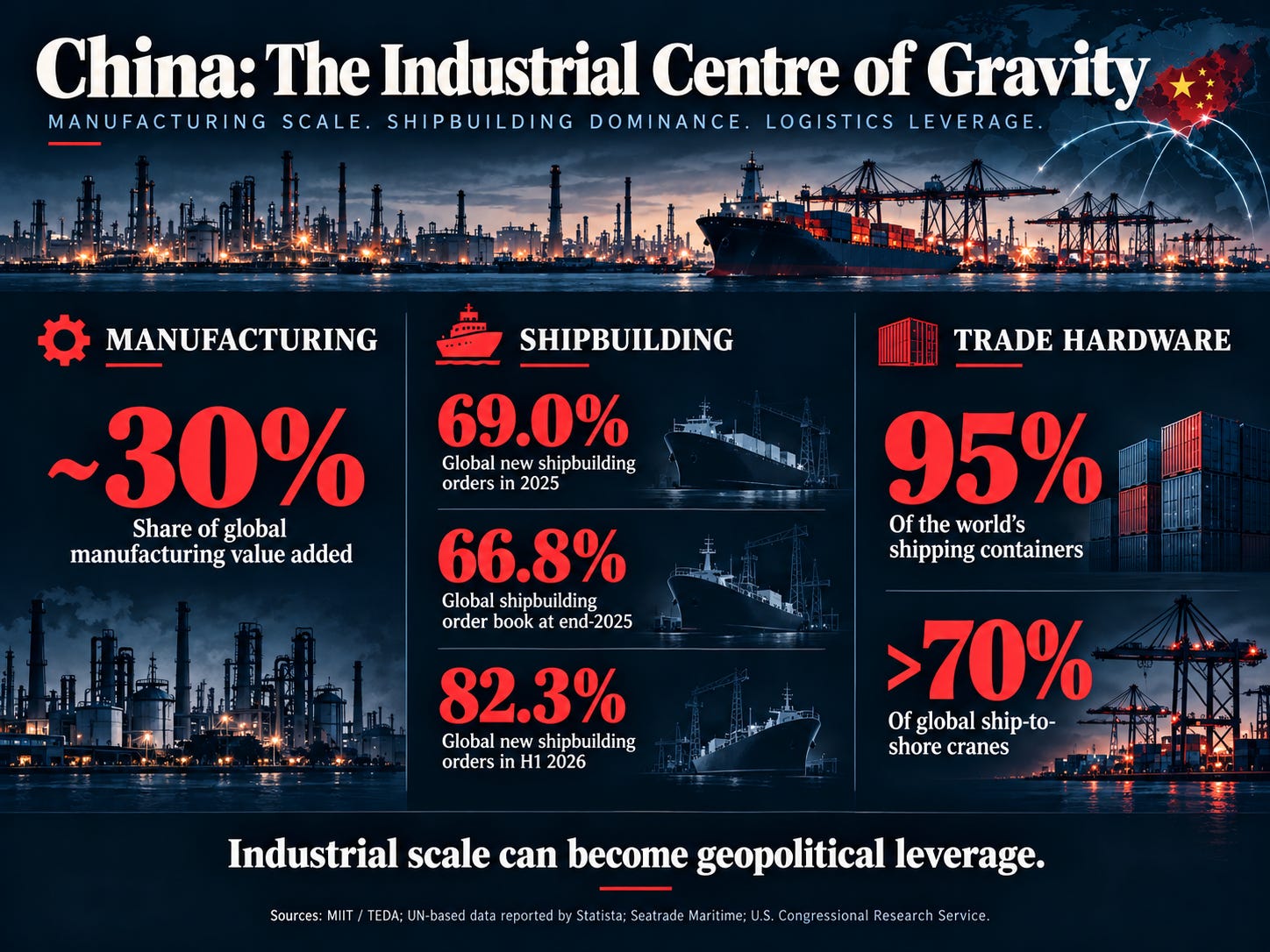
China now produces close to a third of the world’s manufacturing value added - around 30% by Beijing’s own count, and 29% in 2023 by UN data (TEDA, citing MIIT; Statista). That alone would make it the industrial centre of gravity, but the truly scary numbers are the shipbuilding capacity.
In 2025, Chinese yards won 69% of all new shipbuilding orders on the planet and held 66.8% of the global order book (Asia News Network, citing MIIT). In the first half of 2026, that share of new orders rose to 82% (Seatrade Maritime). A 2026 Congressional Research Service assessment adds that China makes roughly 95% of the world’s shipping containers and more than 70% of ship-to-shore cranes.
In the context of a new Cold War, how does that sound to you? Even if we disregard the fact that according to Chinese law, every commercial vessel needs to be military compliant, the ecosystem - dry docks, steel, welders, marine engineers, financing - is what a country needs to replace lost ships faster than its enemy. The United States won the Battle of the Atlantic partly by launching Liberty ships faster than U-boats could sink them. Today, that capacity sits with China, not us.
And it goes further upstream. The International Energy Agency’s 2026 critical-minerals assessment describes how Chinese export controls on rare earths and battery technologies exposed dependencies running through the car, defence and energy industries of the entire West. The principle is almost Sun Tzuian in its simplicity: control the chokepoint, and you control everything downstream of it.
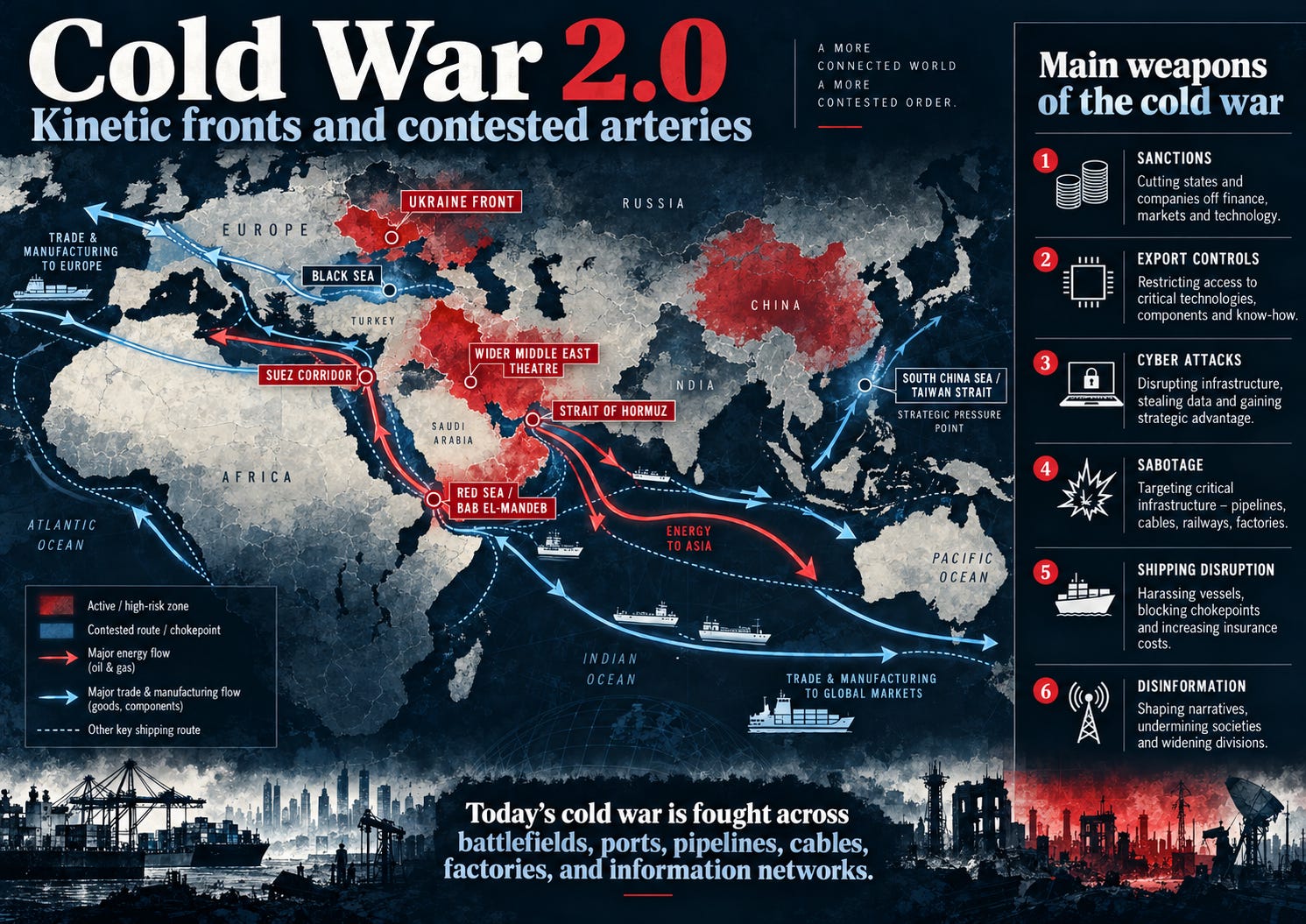
Front I: Ukraine, the war of factories
Ukraine is where the new Cold War stopped being cold and turned kinetic. It is also the clearest demonstration of what industrial war means in the 21st century: WWI trench warfare meets drones by the hundreds of thousands, shells by the millions, and an endless contest over who can manufacture, repair and replace faster.
The economic front matters as much (if not more) as the line of contact. Ukraine’s drones keep hitting Russian refineries. Moscow, squeezed by falling oil and gas revenue, is buying foreign currency and gold to plug the gap (ISW, 6 October). Russia, in turn, is hitting civilian ships in the Black Sea, effectively trying to close it for trade and cause famine by barring Ukrainian grain from being exported.
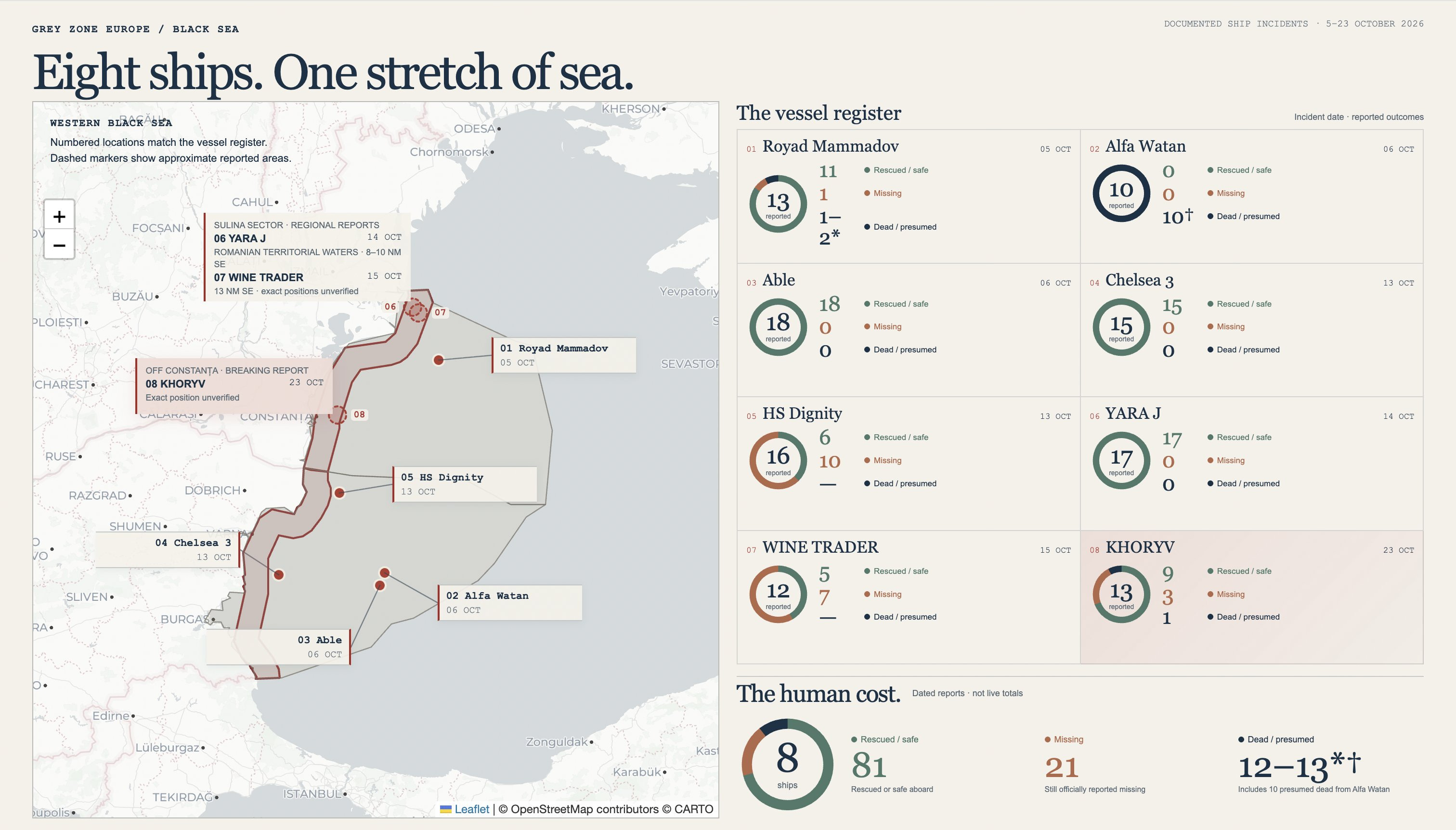
And Russia is not fighting alone. North Korean troops fought in Kursk, Iranian-designed drones fill Ukrainian skies, Chinese components flow into Russian weapons. This cooperation runs mostly through bilateral and trilateral channels rather than a formal four-way alliance, anchored by China and Russia (CSIS).
Front II: Iran, and the closing of the arteries
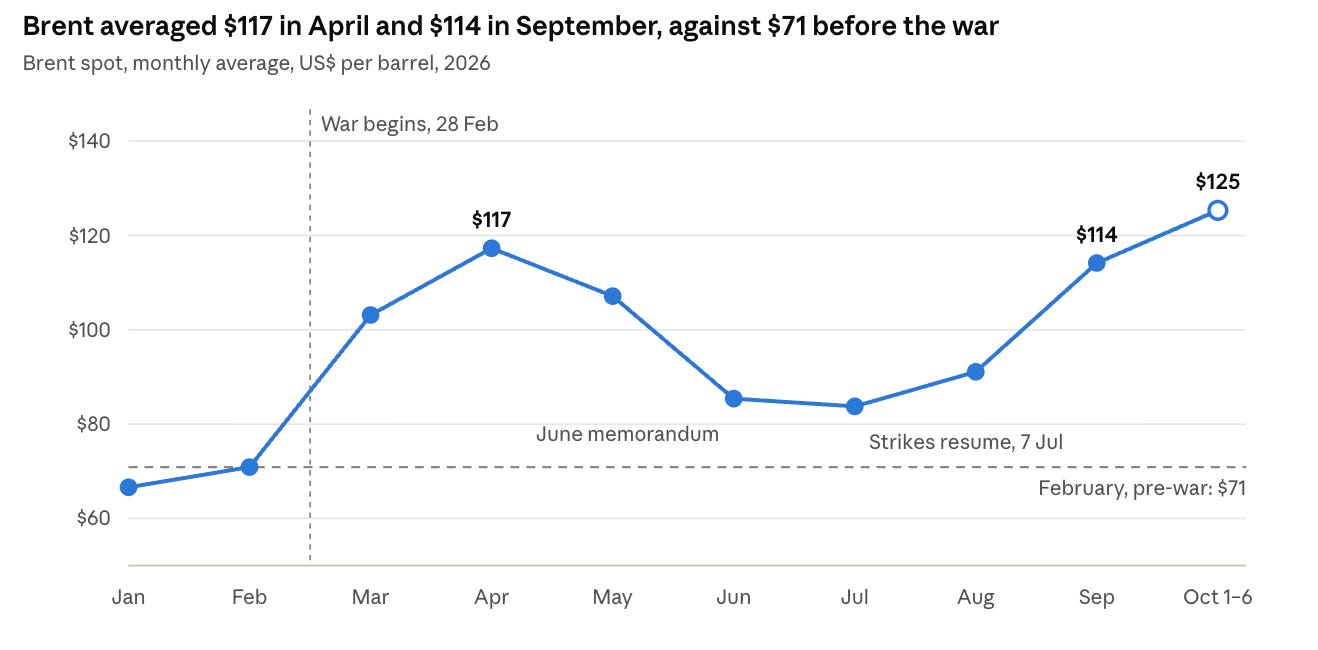
The second kinetic front opened on 28 February 2026, when US and Israeli strikes on Iran killed Ali Khamenei. On 2 March the Revolutionary Guard declared the Strait of Hormuz closed to “unfriendly” ships. Before the war, about 20 million barrels of oil a day - roughly a fifth of world supply, and a similar share of LNG - passed through it (Al Jazeera).
Unfortunately, you cannot start and win a war with arguably the most incompetent (and corrupt) administration in your 250-year-old history. And certainly no war can be won with just air power - you need boots on the ground, and Iran (sitting at around 90M people) is no Iraq.
A ceasefire on 8 April, followed by a US naval blockade of Iranian ports from 13 April. The Islamabad Memorandum, signed on 17 June, which collapse on 8 July, after Iran started attacking ships that refused its routes (Congressional Research Service). Then, on 11 September, Iran’s Houthi allies seized Perim Island and with it control of the Bab el-Mandeb, the southern gate of the Red Sea (Euronews). That same month, drones hit Saudi Arabia’s East–West pipeline, the main route around Hormuz. Both exits of the Arabian Peninsula’s oil system are now in the hands of the Axis or its proxies.
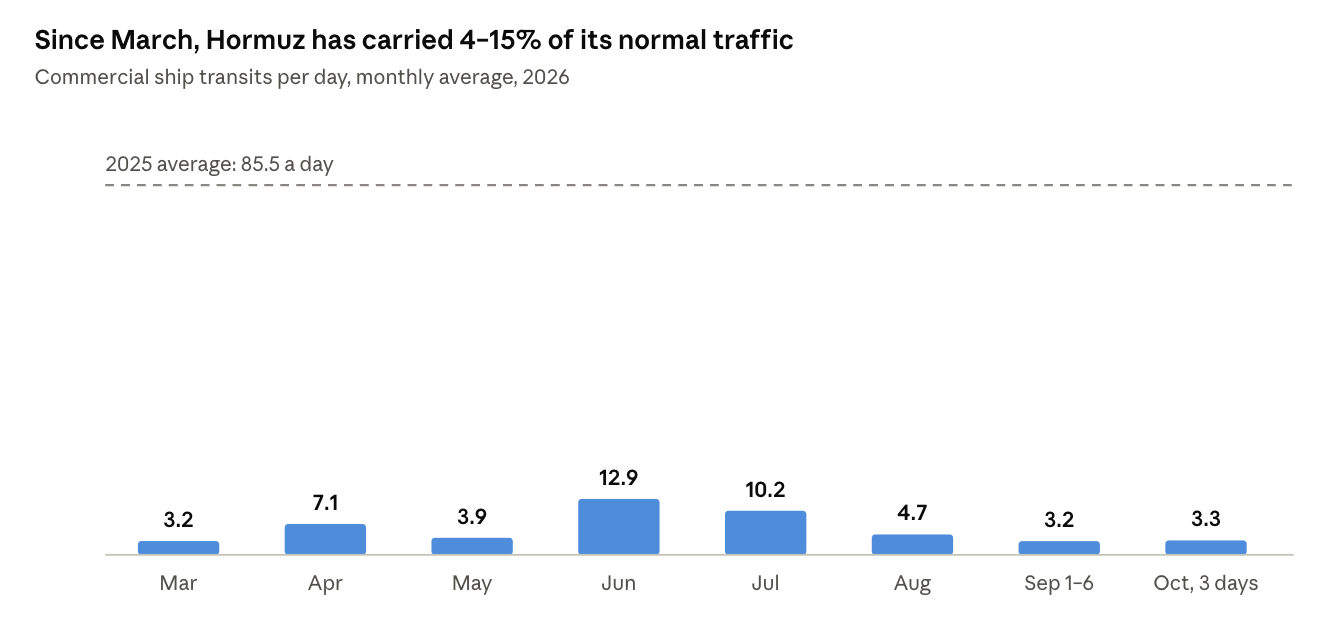
A chokepoint does not need to be physically shut to strangle the world economy. Some oil still moves by pipeline and through ship-to-ship transfers in the Gulf of Oman (straits.live), but the price of moving it has exploded. War-risk insurance for a Gulf transit was about 0.25% of a ship’s hull value before the war; it has run between 3% and 10% since. On a $150 million tanker, that is a $15 million bill for a single voyage (Insurance Business).
How Hormuz harms China too
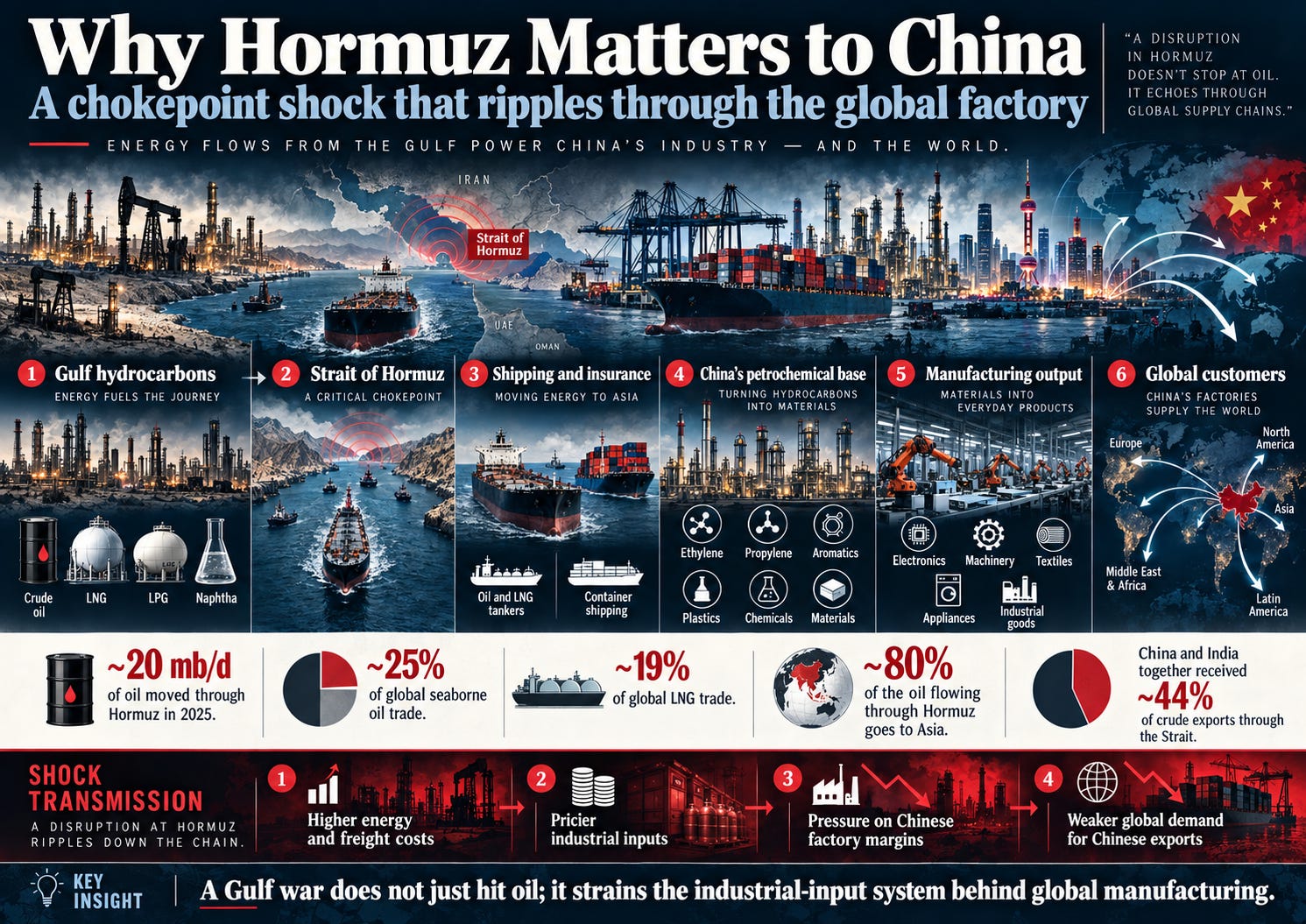
The bigger part of the Hormuz story is that the war disrupted the Gulf’s entire industrial-input system feeding the Chinese manufacturing machine: crude, LNG, LPG, naphtha, petrochemical feedstocks and the shipping capacity to move them. Here’s how the chain works:
Gulf hydrocarbons → LPG and naphtha → ethylene, propylene, aromatics → plastics, chemicals, materials → Chinese factories → global manufactured goods.
In 2025, China took roughly half of its crude, a third of its LNG, 40% of its naphtha imports and 45% of its LPG imports from the Middle East. Gulf LPG alone covered 18% of China’s total LPG consumption (OIES).
The damage is visible - China’s crude imports fell 21.5% year on year in September, output of sulfuric acid, a key input for phosphate fertiliser, fell 12.4% (CREA). Producer prices rose 5% while consumer prices rose just 0.9% (Okaz, citing customs and statistics data).
Translation: input costs are rising and Chinese manufacturers cannot pass them on to customers. China’s manufacturing model runs on wafer-thin margins and brutal price wars, which makes it acutely sensitive to small upstream cost changes. And this was not a small change.
The war also hits China’s customers. The EU alone absorbs roughly 15% of Chinese exports (China Briefing). Iran war → global energy inflation → weaker consumption and investment in Europe and beyond → lower demand for Chinese goods.
The long squeeze
Now, Beijing’s tells a different story (of course it does) - exports up 36.3% in September, and a trade surplus of $938 billion in nine months (ING via FXStreet).
Forgive me if I do not take that at face value. This is the same government that stopped publishing youth unemployment in August 2023, after it hit a record 21.3%, and brought it back months later with a new method that happened to produce a smaller number. Piece of advice: read every and all data that comes out of Beijing and Moscow as you’d read your horoscope.
And even on Beijing’s own numbers, the decline cannot be hidden - GDP growth slowed to 4.3% in the second quarter, the weakest since the pandemic. Fixed-asset investment shrank 7.2% in the first eight months of 2026; real-estate investment collapsed by 19.2%. Youth unemployment sits around 15% (BBVA Research). Housing holds about 70% of Chinese household wealth, and it is deflating (The Globe and Mail).
What you are looking at is a two-speed economy: the factories boom while households retreat. An economy that survives by exporting its overcapacity is not strong, but dependent - on other people’s energy coming in, and other people’s money buying what goes out. That dependence is our leverage.
Officially, this war is about Iran’s nuclear programme, its missiles and its navy. Fine, I will pretend to believe this is what it’s all about and somehow harming China was not part of the wargaming. Yet, I cannot help but look at the strategic effect: a squeeze on China’s industrial model from both ends at once - the inputs coming in and the demand going out. No, I do not view this as a coincidence. And no, I do not think this was the plan of the Trump administration and his incompetent loyalists, but America extends beyond its executive branch of power. Their incompetence, however, are making achieving the above mentioned objectives far more difficult (but not impossible).
If you think about it, back in 2001 the Chinese were offered a very good deal - follow the rules, trade, cooperate, and we all get rich. They screwed it up by allowing a (former) cave-dwelling Maoist to take control of the Party, and now that deal is over - either go back to the pre-Xi days and give us access to the intermediate goods we need to rebuild our own supply chains and take back control of our industrial capacity - or this gets more expensive for everyone.
Yes, it hurts us too, it’s impossible not to. South Korea’s and Japan’s petrochemical plants were hit harder than China’s in the spring. Europeans are paying more for everything. We have less disposable income, and the economy in decline. I am not pretending otherwise over here - we are hurting too, and hurting badly. But if we burn, they burn with us. You - the CCP and Kremlin - wanted a new Cold War? Here you have it - wars are a net destroyer of wealth. Your and ours. Let’s see who runs out of it first.
IV. The invisible war
The kinetic fronts tend to overwhelm the headlines, but it is the hybrid fronts that do the the real damage. Those hybrid fronts run along three dimensions:
political
social
economic
And all three are wrapped in a thick web of narratives and propaganda that makes them nearly invisible to the untrained eye. Nobody declares a hybrid war, you notice it the way you notice damp in a wall: when the plaster is already coming off.
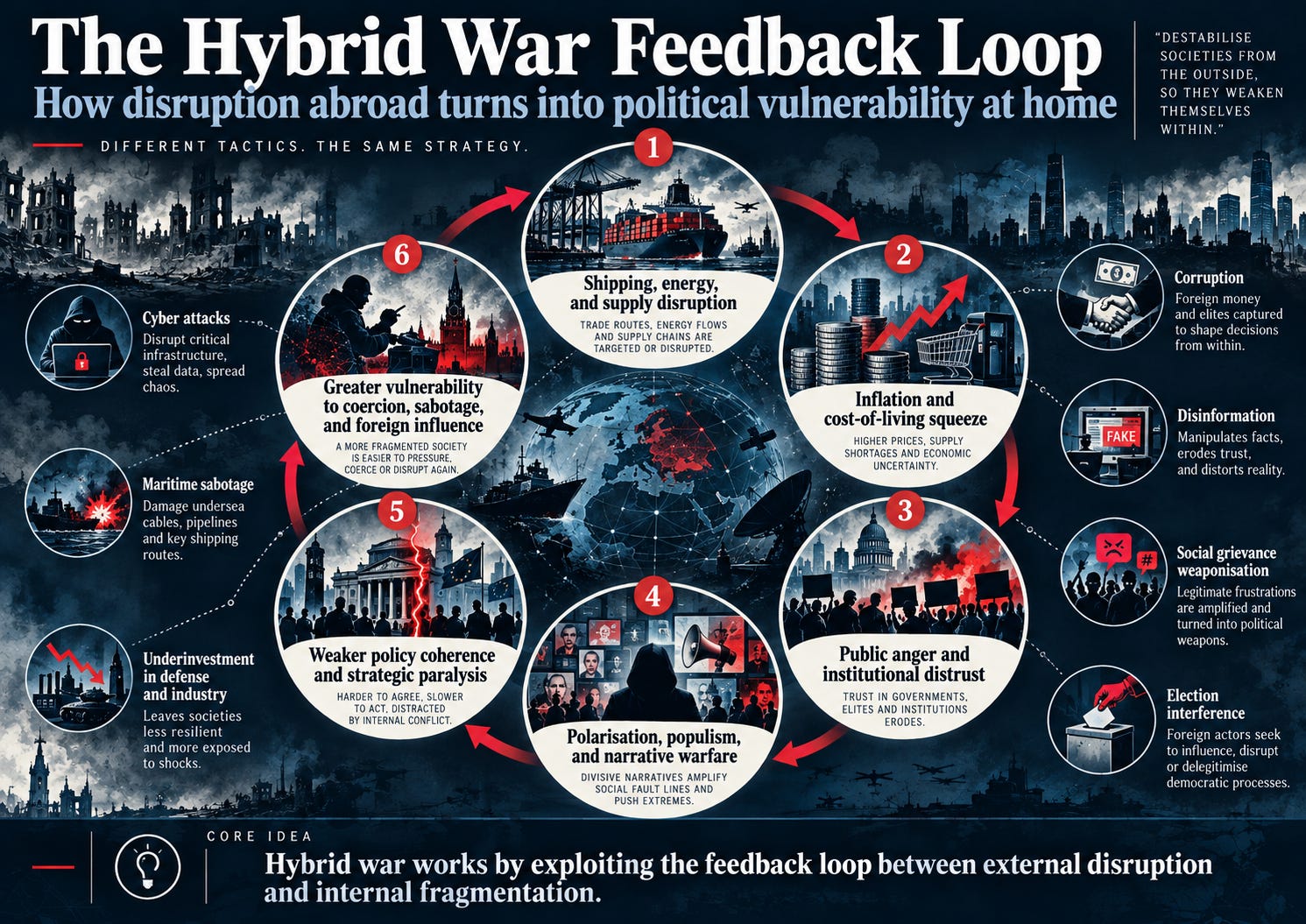
The key to understanding it is that the three dimensions are not separate. They feed each other in a loop.
Link one: sabotage
Start with the economic front, because it is the easiest to measure. Since October 2023, ships from Russia’s sanctions-dodging “shadow fleet” have damaged 11 undersea cables and pipelines in the Baltic Sea (PISM, via Hvylya). On Christmas Day 2024, the Estlink 2 power cable between Finland and Estonia was cut, allegedly by a shadow-fleet tanker dragging its anchor; repairs took seven months (Ukrainska Pravda). In the Black Sea, Russia now strikes merchant ships directly. In the Red Sea, traffic through the Bab el-Mandeb halved after the Houthis took Perim (The National). And in Hormuz, as we have seen, the insurance bill alone can run into eight figures per voyage.
Every one of these is cheap for the attacker and expensive for the defender. A severed cable, a doubled insurance premium, a rerouted fleet costs billions - and those billions end up in the price of everything you buy. This is why inflation has been rising steadily for years now.
Link two: grievance
Higher shipping costs mean inflation, inflation means squeezed incomes, and squeezed incomes mean angry voters. And angry, divided, distrustful societies are the soil the Axis farms via AI-enhanced and algorithmically-controlled rage.
The EU’s diplomatic service analysed 540 foreign information manipulation incidents from 2025 in its March 2026 threat report, documenting Russian and Chinese operations that amplify existing grievances - economic insecurity, migration, distrust of institutions - and use AI-generated content to do it at scale (EUvsDisinfo). The mechanism is pretty straightforward - they don’t need to create the anger, it’s already there, all they need to do is find it, feed it and amplify it.
And the menu of choices can rival the breakfast board of a large cruise ship. Class wars, gender wars, culture wars, left vs right - take your pick from the never ending menu of social grievances and radical political movements. The slogans may be different slogans, but the strategic outcome is the same: a weakened and paralysed West that can’t rearm and gives up sooner.
Energy policy belongs here too. The problem is not green energy as such - a solar panel on a roof is one fewer cubic metre of someone else’s gas. The problem is policy that swaps one dependency for another. Germany shut down its last nuclear plants in April 2023 while still digesting the loss of cheap Russian gas, and Europe’s energy transition now runs heavily on Chinese solar panels, batteries and processed minerals. Strategic stupidity is not green or brown, and what people need to remember is that energy security will always and forever trump energy transition.
The more divided, angry and unstable a society becomes, the less it trusts its own institutions - and the more likely it is to be captured by people with bad intentions who benefit the Axis: Russia, China, Iran and North Korea.
Link three: capture
Which brings us to the political front: infiltration and corruption at the top.
There are three different claims you can make about a politician. One: their policies are aligned with Moscow’s or Beijing’s interests. Two: foreign networks amplify them. Three: they act under foreign direction or money. The first is a matter of public record, the second can be documented, but the third needs evidence a court would accept. You do not need to prove the third to show the damage done by the first. Policies that weaken Western collective action benefit Moscow and Beijing regardless of the motive behind them. A Western political leader needs not to be paid by Moscow or Beijing, or have some KGB/FSB compromats against him to be doing their dirty work for them. Sometimes, all he needs is to be corrupt, incompetent or a populist (or all three).
Take Donald Trump as an example.
First, let’s be clear about one thing - Trump is not the personification of America, nor of its national-security establishment. There are factions inside his own movement, and there is a permanent state of soldiers, diplomats and analysts who still think in alliances and decades. Here, we are inly focusing on Trump.
I never bought into the idea that Trump is a russian asset, and I think I will be vindicated. For one, russian assets tend to be smarter than that. Trump is just corrupt, and thinks in deals and news cycles. He does not view the United States as a superpower embedded in an alliance that must defend long-term geopolitical interests. He views it as a limited company - America Ltd. - a vehicle for (his own) transactions. Judge him by revealed preference.
In my judgment, Trump is far less interested in what Ukraine can offer America than in what Russia and China can offer him, his family and his circle. His envoys to Moscow are a real-estate friend and his own son-in-law, scouting for business, not peace deals.
The AfD, Viktor Orbán, Robert Fico, Le Pen, Rumen Radev , etc. are all some incarnation of that archetype.
The closed loop
Now, if we put the three links together, what do we get? Sabotage raises costs —> Costs feed grievance —> Grievance elects politicians who promise the politics of the impossible: cheap energy, no war, no sacrifice. Those politicians weaken sanctions, block aid and fracture unity. And a weaker response tells the Axis that the next act of sabotage will be just as cheap as the last one.
No single step looks like war, and that is the whole design. On 8 October 2026, the EU Council extended its sanctions against people and entities behind Russia’s destabilising activities, citing continued and intensified hybrid operations. Brussels has noticed, the question is whether European voters have?
V. The cost of remaining free
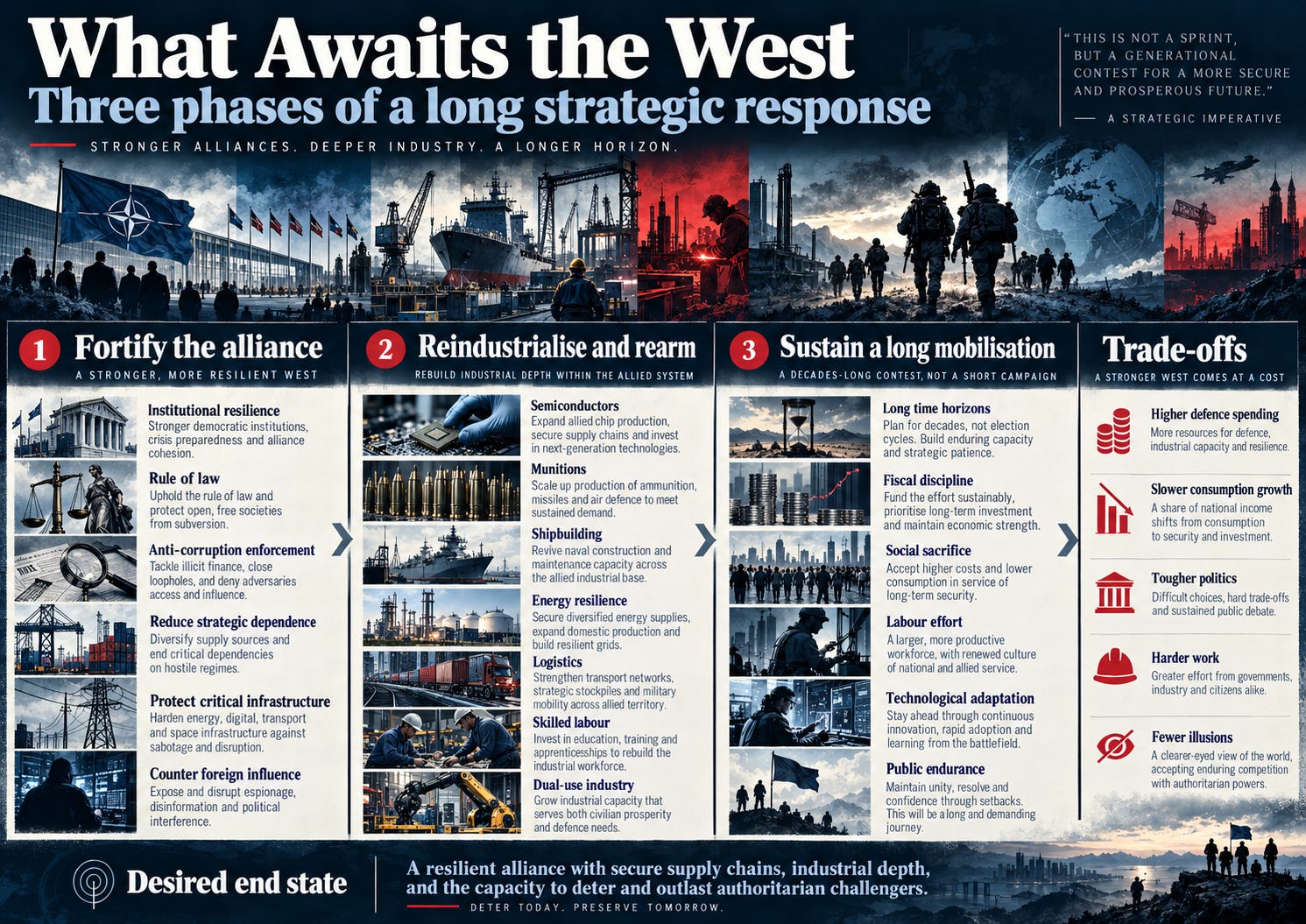
What awaits us are three very difficult tasks. I list them in order of priority, but they cannot wait for one another - they have to move simultaneously.
1. Fortify the alliance
To rebuild industrial supply chains within the Western alliance, the alliance first has to be unified and fortified, the way it was during the first Cold War. That means no Trojan horses inside the walls doing their best to sabotage serious work.
But - and this matters more than anything else in this piece - it has to be done by our own legal standards, and not as a politically/ideologically motivated purge. That will only turn the purged into martyrs, and cause further destabilisation. The moment we start removing opponents because they are inconvenient, we become the thing we are fighting, and Moscow wins without firing a shot by just exploiting this angle.
The good news is that the toolkit already exists, and it works:
Counter-intelligence and prosecution. The Jian Guo conviction shows courts can act on evidence, even inside parliament offices.
Follow the money. Real transparency on foreign funding of parties, media and NGOs; beneficial-ownership registers that are enforced; campaign-finance rules with teeth. In 2024 Czech authorities exposed and sanctioned Voice of Europe, a Moscow-funded outlet that paid European politicians. Do that systematically!
Sanctions on influence networks. The EU’s hybrid-threats sanctions regime, renewed this October, should be used against entire networks, not just a few names.
Constitutional review. Where a party threatens the constitutional order, there are courts for that. Germany’s long legal process over the AfD is slow and frustrating, but it is also legitimate precisely because the courts can rule against the state.
Election integrity. Romania’s constitutional court annulled the first round of its 2024 presidential election over a Russian-linked influence campaign. Election interference should not be tolerated, and subversive actions should be punished in accordance to the law.
Anti-corruption enforcement. Independent prosecutors, including the European Public Prosecutor’s Office, cut the channels through which foreign money buys domestic influence.
Protect the infrastructure. Patrol the cables, inspect the shadow fleet, harden the grids. NATO’s Baltic Sentry mission is a start, not an end.
Expose and pre-bunk. Name the operations publicly and early, before the narrative sets.
Win elections. Hungary just proved it can be done, even against a gerrymandered system and captured media.
Unfortunately, this will take time and vast resources - which, as we are about to see, are scarce. But it needs to be done if we are to protect our democratic institutions so they can survive this war. The post-war world will be rebuild based on the integrity of those institutions.
2. Rebuild the arsenal of democracy
Once the alliance is secured, it has to rebuild its industrial supply chains so it can run a war economy strong enough to deter, and if necessary defeat, the Axis.
We are already seeing that money is starting to move. NATO’s European members and Canada will spend about $634 billion on defence in 2026, or 2.53% of their GDP; the alliance as a whole will spend more than $1.8 trillion (ICDS; Anadolu). The European Defence Agency puts EU defence spending at €418 billion in 2025, projected to reach €454 billion in 2026 (EDA). At The Hague in 2025, allies pledged 5% of GDP by 2035, including 3.5% for core defence.
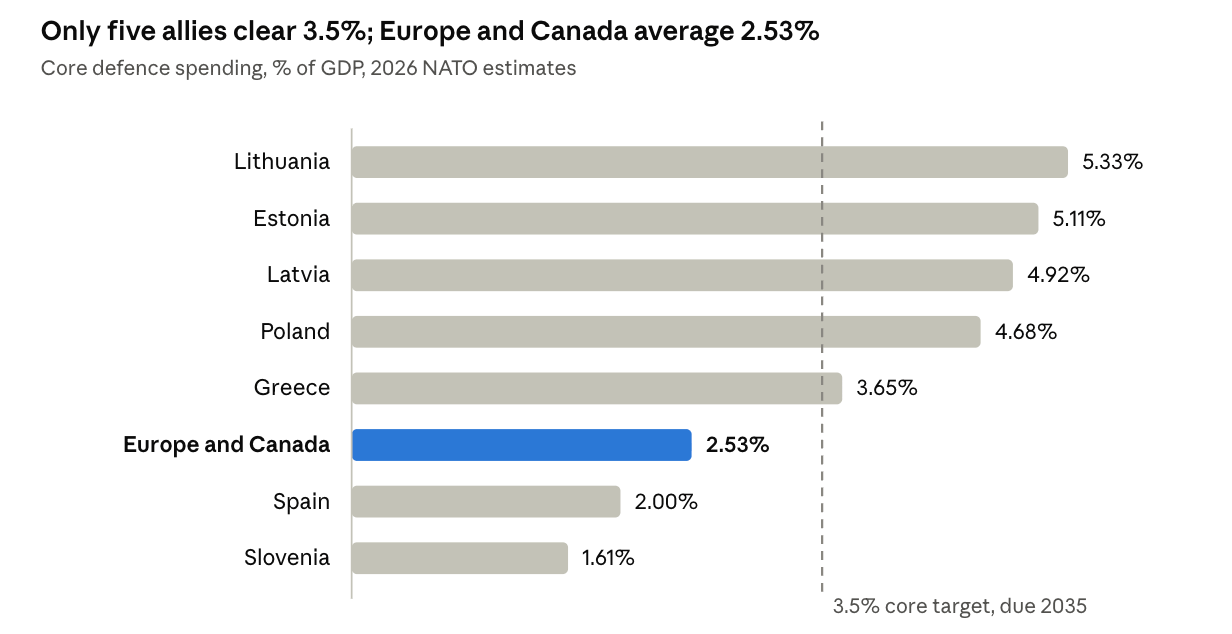
The countries closest to Russia already spend like they mean it. The rest of Europe is roughly a percentage point of GDP short of the core target, and some - Spain openly - have declined to aim for 5% at all (ICDS).
But money does not shoot, money buys only what someone can make, so we need to start making. An alliance can triple its budget and still hit walls in propellant, explosives, precision components, specialist machinery, grid capacity, shipyards and - above all - skilled hands. China won 69% of the world’s shipbuilding orders last year - you cannot buy your way out of that gap, you have to build your way out.
That is why the goal is not rearmament alone, but dual-use reindustrialisation: chips, munitions, ships, energy, logistics and the skilled workforce behind all of them, rebuilt inside the alliance. Beijing announced its plan in 2015, and we are already a decade behind. The only way to close a decade is to start now and never stop.
3. The sacrifice
And now the part nobody, literally nobody,, wants to hear. This will take decades. We will collectively have to give things up to get to victory: comforts, a certain quality of life, the sacred “work-life balance,” the fancy careers we were promised. We will all have to weaponise our skills and our work, and work very hard.
The rearmament budget will not grow on trees. Every euro for a shell factory is a euro that does not go somewhere else, and some of those euros will come out of social programmes and comforts we have grown used to. For perspective: in the early 1950s the United States spent roughly 9-10% of GDP on defence, and it still built the most prosperous society in history.
Which is exactly the point. Remember Yeltsin in that supermarket? The West did not win the first Cold War by becoming poorer than the Soviets, it won by being so much richer that the Soviet elite stopped believing in its own system. So the sacrifice has to build something. Shift spending from consumption to production, cut what does not create capacity (I am looking at you VCs! Gone are the days of investing millions in AI horoscope apps for a quick ROI) and fund what does. And share the burden fairly - because a rearmament paid for only by the people who already feel left behind is the fastest way to hand the doom loop its fuel and the populists their slogan.
Sacrifice, yes. Austerity for its own sake, no. The deal on offer to citizens has to be honest: harder work, higher costs and fewer illusions now - in exchange for a society that is still free, still prosperous and still standing when this is over. And a peaceful and prosperous future for our children.
Conclusion: Is it worth it?
There are, broadly, three ways this ends.
Renewal. The alliance purges its dependencies, rebuilds its industrial base, keeps its institutions legitimate and makes deterrence credible again. China remains a rival, but its leverage shrinks. Russia stays dangerous, but contained. This is not a prediction. It is the outcome worth fighting for.
The long grey middle. Nobody wins. Trade fragments into blocs, defence budgets stay high, regional wars and hybrid attacks become background noise, and governments lurch between confrontation and convenient deals. This is the most likely path, and it could last for decades. Our parents called something very like it “peacetime.”
Fragmentation and escalation. The alliance splinters, the Trojan horses win more elections, industrial investment never catches up, and the Axis learns that every probe pays. Crises link up across theatres — Eastern Europe, the Gulf, the Taiwan Strait — until one of them does not stay cold. This is Taleb’s fat tail. It is not inevitable. It is also not impossible, and the quiet decades behind us are no evidence that it cannot happen.
So: is the sacrifice worth it? Abso-fucking-lutely.
Why? Because, believe me as I say this, you DO NOT want to live in a world shaped by Moscow and Beijing.
The West’s great mistake after 1991 was not that it traded with its adversaries. It was believing that trade had made them stop being adversaries. It let efficiency stand in for security, and it let the factories, the shipyards and the refineries drift to the other side of the board, one cheap invoice at a time.
The Great War never really ended - its uniforms changed, its weapons evolved, its fronts changed. The only question left is whether, this time, we have the patience and the discipline to finish it. Once and for all. For the sake of future generations.
Illuminating and mostly correct.
China views America as intellectually and strategically lazy.
Russia understands that the American bottom line is always set by vulture Capitalism not democratic idealism.
Trump is the excrescence of that national Deal with the devil.
Thank you for the well-reasoned analysis of the pressing issues regarding the crossroads the Free World finds itself at.