



Every empire tells itself a story about the costs it bears. Rome’s senators complained about defending ungrateful provincials. British parliamentarians grumbled about the white man’s burden. And today, American politicians rage about subsidizing European defense while their constituents struggle with healthcare costs and crumbling infrastructure.
The narrative is seductive precisely because it contains a kernel of truth wrapped in layers of motivated reasoning. Yes, the United States maintains the world’s largest military. Yes, some (not all!) European allies spend less on defense than Washington would prefer (and yes, they had every right to push them to up their spending). But the conclusion drawn from these facts - that America generously defends freeloading Europeans - inverts the actual economic and strategic logic of U.S. military spending.
What’s actually happening is that the United States has built a globe-spanning security architecture that serves American economic interests first, generates substantial returns for American defense contractors, and functions as the enforcement mechanism for dollar hegemony. European territory provides the real estate. European purchases provide the customers. And if/when the shooting starts, European soldiers provide the ground soldiers (while the U.S. controls the skies and intelligence).
The “freeloading Europe” myth persists because it serves powerful interests: it justifies continued defense spending to voters, obscures the transparent accounting of the spending, and prevents serious examination of whether American security commitments serve American citizens as opposed to American elites.
The Economic Returns of Primacy
Start with a basic question: if maintaining global military primacy were purely a cost with no return, why would American elites - who are generally quite good at protecting their economic interests (that’s literally how the United States was incepted and earned its independence) - continue supporting it?
The answer is that primacy generates substantial, measurable economic returns, just not ones that flow to ordinary Americans. The U.S. defense budget of $916 billion in 2023 - representing 39% of global military spending according to SIPRI - isn’t charity. It’s the overhead cost of running the global system.
That system delivers concrete benefits to Americans. The dollar’s role as the global reserve currency - approximately 59% of central bank reserves according to the IMF’s COFER data - exists because international transactions occur under the implicit guarantee of American military power. When China needs to import oil from the Persian Gulf, it does so in dollars, on ships traversing sea lanes the U.S. Navy patrols, under a security architecture Washington maintains. The tribute isn’t paid in gold; it’s paid in seigniorage, transaction fees, and the ability to finance deficits that would break other countries.
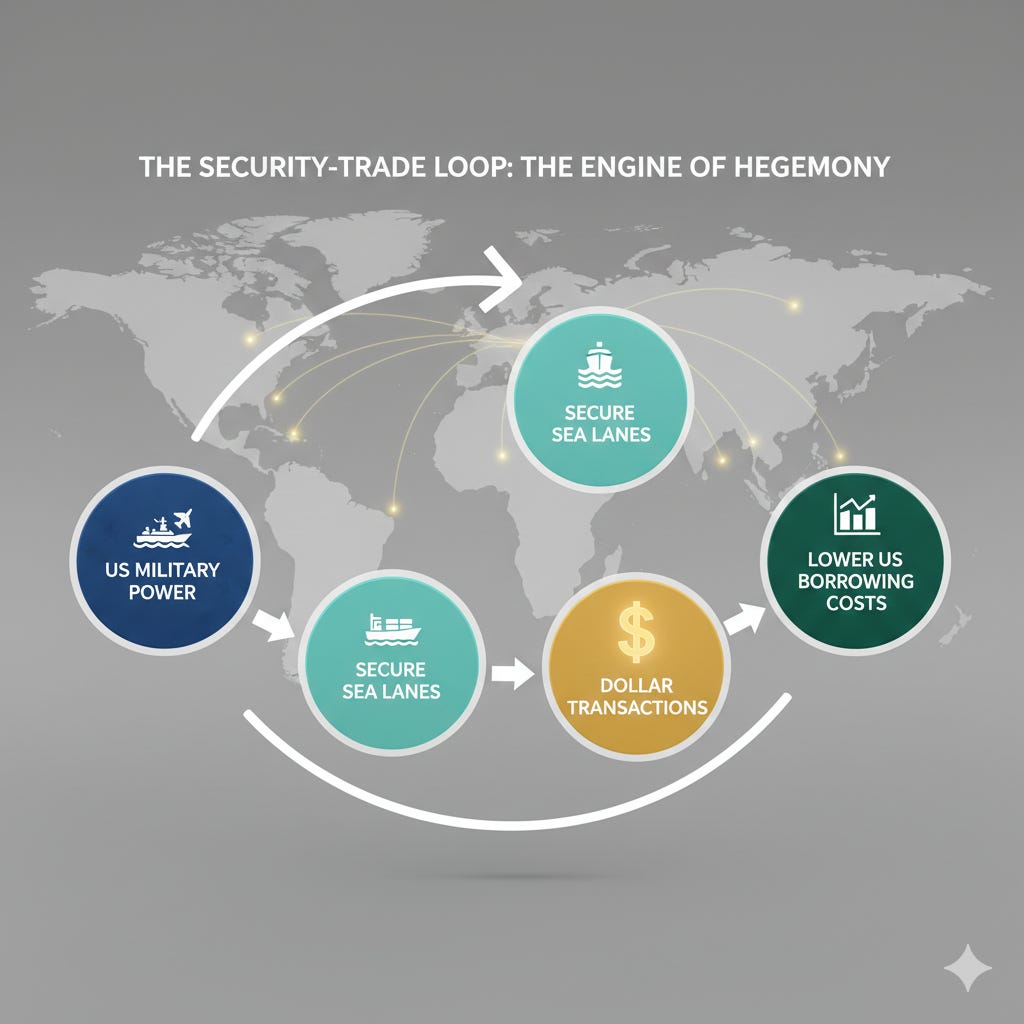
Economists Arvind Subramanian and Martin Kessler have estimated that dollar dominance allows the United States to borrow at interest rates roughly 50-60 basis points lower than would otherwise be possible - a savings of tens of billions annually on the national debt. Barry Eichengreen’s work on Exorbitant Privilege documents how this translates into sustained current account deficits that would be unsustainable for countries without reserve currency status.
Put simply: military primacy enables financial primacy, which enables the United States to consume more than it produces, year after year, with the difference financed by the rest of the world. Don’t be fooled by believing that this is a bug in the system invented by greedy bankers; it’s the core feature.
The Real Estate Transaction: Bases as Commercial Infrastructure
Now examine what Americans actually buy with that $916 billion, particularly the portion devoted to overseas presence.
The conventional framing treats U.S. bases in Europe as defensive installations protecting European territory from threats. This is technically true but analytically backwards. These installations primarily serve as logistical infrastructure for power projection elsewhere. They’re closer to distribution hubs in a commercial supply chain than to medieval fortifications.
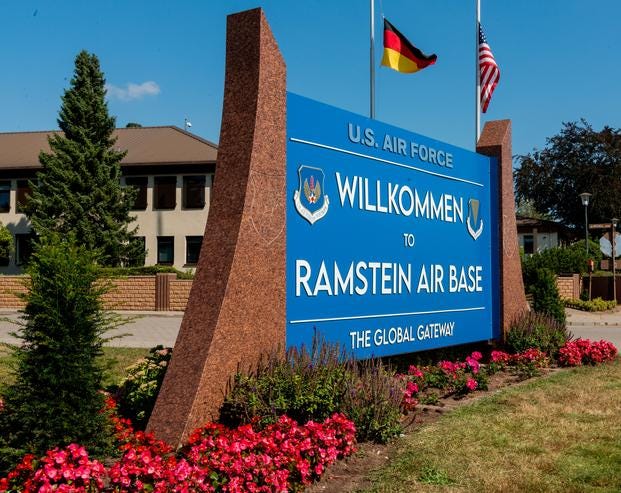
Consider Ramstein Air Base in Germany, which the Pentagon identifies as the largest U.S. Air Force base outside American territory. During the peak of operations in Iraq and Afghanistan, Ramstein served as the primary logistics hub for moving personnel, equipment, and wounded soldiers between the continental United States and multiple Middle Eastern theatres. According to the Defense Health Agency, Landstuhl Regional Medical Center - located near Ramstein - treated more than 75,000 patients from combat zones between 2001 and 2014.
The base’s value to the United States has nothing to do with defending Kaiserslautern from Russian tanks. Its value lies in geography: positioned roughly equidistant from Washington and Baghdad, Ramstein makes it possible to sustain operations in the Middle East, North Africa, and Central Asia without the logistical nightmare of deploying everything from Fort Bragg or Travis Air Force Base.
The same logic applies across the European theatre. U.S. Naval Air Station Sigonella in Sicily provides access to North Africa and the Eastern Mediterranean. RAF Mildenhall in the United Kingdom serves as a forward operating location for reconnaissance and intelligence gathering. The Romania and Poland installations developed after 2014 position U.S. forces closer to the Black Sea and the Baltics - useful for contingencies ranging from Russia to the Middle East.
The Pentagon’s own Base Structure Report for FY 2023 lists over 60,000 U.S. military personnel stationed in Europe, supported by extensive infrastructure including airfields, communications nodes, medical facilities, and ammunition depots. Replicating this infrastructure elsewhere - particularly in politically unstable regions or at greater distance from key theatres - would cost substantially more and deliver worse operational results.
RAND Corporation studies on forward basing have repeatedly found that maintaining rotational forces from CONUS costs significantly more than forward stationing equivalent capabilities, once you account for transportation, temporary facilities, and the operational limitations of not having permanent infrastructure. Forward presence isn’t charity; it’s cost-effective power projection.
The Client State Model: Defense Procurement as Industrial Policy
Here’s where the economics become particularly interesting: NATO functions as a captive market for American defense manufacturers.
Alliance interoperability requirements - technically necessary for combined operations - create de facto procurement preferences for U.S. systems. If your air force needs to integrate with American command and control networks, you’re buying American fighters. If your army needs ammunition compatible with American artillery, you’re buying American shells. If your navy needs to operate alongside U.S. carrier strike groups, you’re buying American data links and weapons systems.
The numbers are remarkable. SIPRI’s arms transfer database shows European NATO members more than doubled their weapons imports between 2014 and 2023, with the United States capturing over 50% of this market. In 2023 alone, U.S. defense exports to Europe exceeded $60 billion - representing a substantial share of total American arms sales globally.
Poland exemplifies this dynamic. Warsaw has committed over $30 billion to U.S. defense purchases in recent years, including M1 Abrams tanks, M142 HIMARS rocket systems, F-35 fighters, and AH-64 Apache helicopters. Germany - despite maintaining a significant domestic defense industry - is purchasing F-35s, precisely because NATO nuclear sharing requires American aircraft. Finland and Sweden, newly integrated into NATO, were also considering buying American F-35s rather than European alternatives up until the Trump administration began its foreign policy of antagonism of allies.
Even France, which jealously guards its defense industrial independence, imports American aerial refuelling aircraft (KC-135), intelligence systems, and increasingly finds itself buying American munitions for sustained operations.
Follow the money. These contracts flow to Lockheed Martin in Texas, Raytheon in Arizona, General Dynamics in Michigan, Northrop Grumman in Virginia - corporations employing tens of thousands of workers in congressional districts across the United States. The political economy is straightforward: defense spending that flows to European NATO forces significantly benefits American manufacturers, while the security guarantees that encourage this procurement cost the U.S. military relatively little in peacetime.
There’s an additional net benefit: the more Europe increases defense spending while relying on American systems, the more dependent it becomes on U.S. supply chains, maintenance contracts, and technology transfers. This dependence is strategic. The moment European states develop truly independent defense industrial capacity - joint European fighter programs, indigenous missile production, sovereign satellite constellations - American leverage, including soft power over an entire continent, diminishes.
The optimal outcome for U.S. defense contractors is precisely what we’re seeing: Europeans spending more on defense, but remaining structurally dependent on American systems. Hence the paradox that American politicians simultaneously demand European allies spend more on defense while American defense lobbyists work to prevent European defense industrial consolidation that might compete with U.S. manufacturers.
Reverse Subsidy: What Host Nations Actually Provide
The “freeloading Europe” narrative systematically ignores substantial European contributions to maintaining U.S. military infrastructure (we all know the benefits for local cities and towns, and had this been an article about how Europe benefits from U.S. security guarantees, you bet I’d be talking about it).
Host nation support encompasses both direct financial transfers and indirect subsidies that reduce the cost of overseas basing for the United States. Germany provides over $1 billion annually in direct support - funding that covers base security, utilities, local employment, and infrastructure maintenance that would otherwise fall on the U.S. military budget.
The indirect subsidies are larger and less visible. European host nations provide:
Land worth billions in commercial real estate markets, provided rent-free under basing agreements
Tax exemptions on fuel, equipment purchases, and contractor services that would add hundreds of millions to annual operating costs
Waived customs duties and import restrictions for military cargo and equipment
Co-funded infrastructure development, including airfield improvements, communication systems, and training facilities
Simplified legal frameworks that exempt U.S. personnel from certain local regulations and taxation
For comparison, Japan contributes approximately $2 billion annually to support roughly 54,000 U.S. military personnel stationed there - covering nearly 75% of the total stationing costs according to the U.S. Forces Japan. South Korea provides over $1 billion per year under its Special Measures Agreement, funding that covers Korean national employee salaries, construction costs, and logistics support.
Congressional Research Service analyses have repeatedly found that when you account for both direct host nation funding and indirect subsidies through land provision and tax exemptions, forward-deployed forces often cost less than equivalent forces stationed in the United States - particularly when you factor in the costs of building comparable facilities on American soil and the operational limitations of not having forward-positioned forces.
This isn’t charity from either direction, but a negotiated arrangement where host nations provide tangible economic support for infrastructure that serves both American strategic interests and - to varying degrees - their own security concerns.
Blood Debts: The Asymmetry of Article 5
NATO’s collective defense provision - Article 5 - has been invoked only once in the Alliance’s 75-year history. Not to defend a European ally from Soviet aggression. To support the United States after the 9/11 attacks.
What followed was a 20-year military campaign in Afghanistan in which allies contributed forces, took casualties, and supported operations that served primarily American security interests.
British forces fought in Helmand Province - one of the deadliest theatres of the war -conducting counterinsurgency operations alongside U.S. Marines. Canadian forces took responsibility for Kandahar, suffering sustained casualties in heavy combat. French, German, and other European forces operated in northern Afghanistan, conducting combat operations, training Afghan forces, and building infrastructure.
For countries like Germany and Japan, which had largely avoided combat operations since World War II, Afghanistan represented a fundamental shift. German soldiers died in combat for the first time since 1945. The political and social cost of deploying forces to a war zone - particularly one with unclear strategic objectives - was substantial for democratic governments facing skeptical publics.
Brown University’s Costs of War Project estimates that allied contributions to Afghanistan and Iraq operations exceeded $100 billion in direct military expenditure, not counting the long-term costs of veterans’ care, reconstruction aid, and diplomatic resources devoted to sustaining these operations.
The strategic logic was clear: these deployments served American interests far more than European ones. The Taliban did not threaten Paris or Berlin. Al-Qaeda cells in Hamburg were a police matter, not a military one. European allies participated because Washington invoked Article 5 and expected support, not because Kandahar held strategic value for European security.
If the accounting of “who subsidizes whom” includes blood as well as treasure, the ledger looks rather different than certain members of the American political class suggest. Allied soldiers died supporting U.S. security priorities in a war that achieved dubious strategic outcomes.
The Migration Red Herring: Shared Consequences of Shared Interventions
A recurring claim in the “freeloading Europe” narrative holds that Europeans squander money on social welfare - particularly housing migrants - that should go to defense spending.
This reasoning fails at multiple levels. First, there’s no mechanism by which U.S. defense spending converts into European migration budgets. These are entirely separate fiscal streams funded by different tax bases. The claim confuses opportunity cost with causation.
Second, the refugee flows that generated Europe’s migration crisis stem substantially from wars and state failures in which Western powers - including the United States - played direct causal roles.
The 2003 Iraq invasion, launched primarily by the United States with British support, destabilized the entire region. The subsequent civil war and rise of ISIS displaced millions. According to UNHCR data, Iraq generated over 4 million refugees and internally displaced persons. The Syrian civil war - which escalated partly due to spillover from Iraq and evolved into a proxy conflict involving multiple external powers - displaced over 13 million people.
The 2011 Libya intervention - enthusiastically supported by France, the United Kingdom, and the United States - converted an authoritarian state into a failed one, opening Mediterranean migration routes and contributing to instability across the Sahel. NATO aircraft enforced a no-fly zone ostensibly to prevent civilian casualties; the resulting power vacuum produced far more casualties and created conditions for sustained refugee flows.
Afghanistan produced approximately 2.7 million refugees over two decades of Western military operations, according to UNHCR. The rapid collapse of the Afghan government in 2021 generated an additional humanitarian crisis, with European states scrambling to evacuate personnel and vulnerable Afghans who had supported NATO operations.
The pattern is consistent: Western military interventions - whether justified or not - created conditions that displaced millions of people. European states now bear fiscal costs for managing these refugee flows, just as they bore military costs for participating in the interventions that helped create them.
This is not to argue that European states bear no responsibility for their own migration policies or that all refugees result from Western interventions. But to claim that European migration spending represents a diversion of defense resources ignores the causal chain connecting military operations that both the United States and European allies supported to the humanitarian consequences those operations produced.
If anything, this represents shared consequences of shared policy choices, not one-sided freeloading.
The Accountability Gap: What the Myth Obscures
The persistence of the “freeloading Europe” narrative is interesting precisely because it’s so easily debunked. Why does it survive?
Because it serves multiple constituencies. For American politicians, it provides convenient cover for defense budgets that might otherwise face scrutiny. For defense contractors, it justifies continued procurement spending while obscuring how much of that spending returns to their shareholders. For foreign policy elites committed to U.S. primacy, it frames expensive commitments as burdens rather than strategic choices.
Most importantly, the narrative prevents Americans from asking harder questions: Why does the United States maintain a military budget larger than the next 10 countries combined? Whose interests does this spending serve? What would a defense posture focused on actual defense of American territory cost? And if the current spending level is necessary for sustaining global primacy, shouldn’t we acknowledge that this is an imperial project rather than a defensive one?
As an Eastern European, I never minded and actually did support U.S. military hegemony, because if the alternative was Russia and China devouring my home - no, thank you. As I’ve always said - whoever doesn’t like the American world order will really dislike the Russo-Chinese one.
What I do mind, however, is the hypocrisy of this narrative.
And yes - European states absolutely under-invested in defense relative to their wealth and threat perceptions for decades. This is analytically true. Germany’s military readiness problems are real. Years of procurement failures across European NATO wasted billions. These are legitimate criticisms.
But the response to European under-investment shouldn’t be the false claim that the United States has been subsidizing European security out of generosity, while Europeans have been blowing their wealth on migrants and social welfare. It should be honest acknowledgment that American defense spending primarily serves American interests, and while European allies do benefit from it, they also provide substantial support for this infrastructure, and that when allies have been asked to contribute blood alongside treasure, they’ve done so.
The burden-sharing debate would be more productive if both sides started from reality, not fiction. Europeans should acknowledge that they sheepishly relied on American security guarantees when it was convenient and are now scrambling to rebuild capabilities they allowed to atrophy for the decades following the end of the Cold War. Americans should acknowledge that their defense spending buys them strategic advantages they value and economic returns that benefit specific constituencies, not just costs that burden taxpayers.
In 2024, 23 of 32 NATO members met the 2% GDP spending target - up from just four countries in 2014. European NATO members collectively increased defense budgets by over $100 billion in the past decade. Poland now spends over 4% of GDP on defense. The Baltic states consistently exceed 2.5%. This rebalancing is happening, just not in the moralistic frame American politicians prefer.
Conclusion: Empires and Their Accounting Tricks
Every empire in history has complained about the costs of maintaining its dominance while obscuring the returns that dominance generates. Roman senators grumbled about financing legions on the Rhine while conveniently ignoring the grain shipments from Egypt. British parliamentarians fretted about the cost of the Royal Navy while enjoying cheap raw materials from colonies.
The United States follows this pattern. American defense spending sustains a global architecture that delivers measurable economic benefits - dollar dominance, highly favourable terms of trade, access to markets and resources, and the ability to enforce rules that advantage American firms. The infrastructure for this system requires military bases on foreign soil, which those foreign states subsidise. The hardware for this system generates profits for American defense contractors, which European procurement amplifies.
When Washington has asked allies to support American military operations - in Afghanistan, in Iraq, in various smaller interventions - those allies have contributed both money and blood.
None of this is charity. None of it is freeloading. It’s the ordinary economics of hegemony: expensive to maintain, profitable to those who run it, and structured to obscure who actually pays what costs.
If Americans want to have a serious debate about burden-sharing within NATO - excellent. That debate should address European underinvestment in capabilities, inefficient procurement, and riding on American logistics and enablers. But it should start from honest premises: U.S. defense spending primarily serves U.S. interests, forward basing saves money while enabling power projection, allied procurement helps American manufacturers, and when allies have been asked to pay in blood as well as treasure, they have.
The alternative - continuing to pretend that the United States altruistically defends ungrateful Europeans - perpetuates comfortable myths that prevent both sides from addressing actual strategic challenges. It prevents Americans from examining whether their defense spending is optimised and serves their interests. And it prevents Europeans from confronting their own strategic dependence and the hard choices required to reduce it.
Empires are costly. They’re also profitable, at least for certain constituencies. What they aren’t is charities. The sooner both sides of the Atlantic acknowledge this, the sooner we might have productive conversations about what kind of security architecture actually serves both American and European citizens in the decades ahead.
Sources
Stockholm International Peace Research Institute (SIPRI) - Military Expenditure Database - Global military spending data showing U.S. expenditure at $916 billion (39% of global total) in 2023.
International Monetary Fund - Currency Composition of Official Foreign Exchange Reserves (COFER) - Data on dollar’s share of global reserves (~59% as of 2024).
NATO - Defence Expenditure of NATO Countries (2014-2024) - Official data showing 23 of 32 members meeting 2% target in 2024, up from 4 in 2014.
Barry Eichengreen, Exorbitant Privilege: The Rise and Fall of the Dollar (Oxford University Press, 2011) - Analysis of economic benefits from dollar’s reserve currency status.
Arvind Subramanian and Martin Kessler, “The Renminbi Bloc is Here: Asia Down, Rest of the World to Go?” Peterson Institute Working Paper (2012) - Estimates 50-60 basis point borrowing advantage from reserve currency status.
U.S. Department of Defense - Base Structure Report (FY 2023) - Official documentation of 750+ overseas bases, 60,000+ personnel in Europe.
RAND Corporation - Costs and Benefits of Forward Basing - Cost-effectiveness analysis of forward vs. CONUS-based forces.
Defense Health Agency - Landstuhl Regional Medical Center History - Data on 75,000+ patients treated from combat zones 2001-2014.
SIPRI Arms Transfers Database - Tracking European NATO doubling of imports 2014-2023, 50%+ from U.S.
U.S. Defense Security Cooperation Agency - Foreign Military Sales - Official data on $60+ billion U.S. defense exports to Europe (2023).
Congressional Research Service - U.S. Military Bases and Facilities in Europe - Analysis of host nation support arrangements and cost comparisons.
German Federal Ministry of Finance - Host Nation Support Documentation - Germany’s $1+ billion annual contribution.
U.S. Forces Japan - Host Nation Support Information - Japan’s ~$2 billion annual support package.
iCasualties.org - Coalition Casualties in Afghanistan
Brown University Costs of War Project - Comprehensive research on casualties and costs, including allied contributions exceeding $100 billion.
UNHCR - Syria Emergency - Data on 13+ million displaced Syrians.
UNHCR - Iraq Situation - Documentation of 4+ million Iraqi refugees and IDPs.
European Commission - Migration and Asylum Statistics - Official EU asylum application and refugee flow data.
Barry Posen, Restraint: A New Foundation for U.S. Grand Strategy (Cornell University Press, 2014) - Analysis of U.S. overseas military posture costs and benefits.
Michael Beckley, “The Myth of Entangling Alliances,” International Security 39:4 (2015) - Examination of alliance burden-sharing dynamics.
Emma Ashford and Joshua Shifrinson, “Correspondence: Debating the Free-Riding Myth,” International Security 41:3 (2017) - Scholarly debate on whether allies free ride on U.S. security provision.
Stephen Brooks, G. John Ikenberry, and William Wohlforth, “Don’t Come Home, America: The Case Against Retrenchment,” International Security 37:3 (2012-13) - Defense of U.S. forward presence as serving American interests.
The myths many Americans tell themselves about the costs of their empire - or that they engage in empire - get frustrating.
This piece focuses on US former ambassadors and supreme commanders on how NATO benefits the US.
https://open.substack.com/pub/ivodaalder/p/nato-is-vital-to-us-security
I suspect that American military leadership and politician mounted pressure to Europe spending for (at least) two reasons:
1. They realized the Cold War 2.0 requires multiple fronts and Europe unable to defend itself would mean a challenge to the USA global hegemony
2. They questioned European political willingness and political capital to actually engage ground troops in war in case of need
Very brilliant and thorough analysis .