

Recently, I was kindly invited to give a guest lecture at a university. While we were discussing the topic, one concern kept coming up: students feel lost. They’re coming of age in an increasingly polarised world, pulled between the radical ideologies of the previous century and those of our own, without a coherent philosophical framework through which to make sense of either. I was asked whether I could offer them a way out.
My strength as an analyst lies in diagnosing problems and connecting the dots. Solutions are an entirely different domain, which is why I felt the full weight of that request fall onto my shoulders. What could I possibly tell them? Some of these students would probably be only a handful of years younger than me. Who am I to advise them on something of that magnitude?
Still, I took the request seriously, and at some point I found myself thinking about the Greatest Generation.
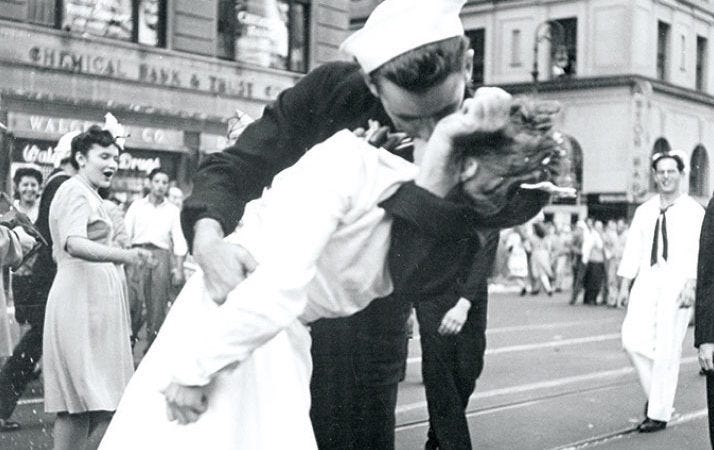
Nobody alive in 1942 knew they were part of the Greatest Generation.
That designation was popularised by Tom Brokaw in 1998, more than half a century after the fact. The people it describes never got to wear it while they were still alive. In 1942, they weren’t the legends we remember today either - they were scared, broke kids who had grown up in the Great Depression and watched democracies succumb to fascism. They had no privileged knowledge of how history would unfold, nor any assurance that history would be particularly kind to them.
Then they fought the most destructive war in human history, and when the war ended, they did something perhaps even more remarkable: they rebuilt. They rebuilt democracies, established international institutions, negotiated treaties and constructed mechanisms intended to restrain the very forces of human nature that had brought civilisation to the brink of destruction. They understood, through experience rather than abstraction, how precarious civilisation was.
I keep coming back to this because I think many of us have learned to look at them the wrong way - we treat them almost as a different species, as though greatness were an inherent quality of those born at that particular juncture in history.
In retrospect, we have endowed them with a historical inevitability that they themselves could never have experienced. We forget that they had to make their choices without knowing what those choices would eventually amount to.
And therein lies the first lesson.
The historical circumstances of moral agency
The Greatest Generation didn’t choose to grow up during the Great Depression, nor did they choose the Second World War. Many were drafted, not all were heroes, and the societies they subsequently rebuilt carried profound injustices of their own. To romanticise them would be to deprive them of their humanity and, paradoxically, diminish the significance of what they accomplished.
Their greatness lay in how enough of them responded to the circumstances they inherited. Millions upon millions of individual decisions: to fight, to work, to ration, to endure, and afterwards, to rebuild. They undertook the extraordinary task of constructing a world whose principal beneficiaries would be people other than themselves.
And just look at what they inherited: failing systems, collapsing banks, mass unemployment, fragile democracies falling into the hands of strongmen, and a broken social contract. Sounds eerily familiar, doesn’t it?
We like to think of our predicament as historically exceptional - there is a certain psychological comfort in that assumption I guess, because if our circumstances are unprecedented, perhaps our failure to overcome them is excusable.
But much of what troubles us today would be painfully familiar to our great-grandparents. Housing markets that increasingly exclude younger generations from ownership, a collapsing labour market, institutions that fewer and fewer people trust or respect, major war returning to European soil, and the creeping realisation that the social contract we were promised was renegotiated and made void before we ever got to the table.
This has now fuelled an entirely new generational conflict. Millennials and Gen Z look at the Boomers as the principal beneficiaries of the sacrifices made by the Greatest Generation and feel betrayed that the same prosperity and security were not passed down to them.
Now, there are legitimate grounds for grievance, but I would caution against allowing resentment to become the organising principle of our generation. Resentment keeps our moral imagination permanently oriented towards the past, and it makes our conception of justice contingent upon the correction of what was done to us, rather than upon what we might still do for others.
There is an old Yiddish saying I particularly like: God gives burdens, but He also gives shoulders.
I don’t take that to mean that every burden is just, or that everyone is capable of bearing whatever life imposes upon them. I take it as an injunction against surrendering our remaining agency to circumstances beyond our control.
The Greatest Generation didn’t get to choose its century, nor its battles. Neither do we. The only thing we get to choose is what kind of ancestors we become. So let us choose wisely.
The ontology of powerlessness
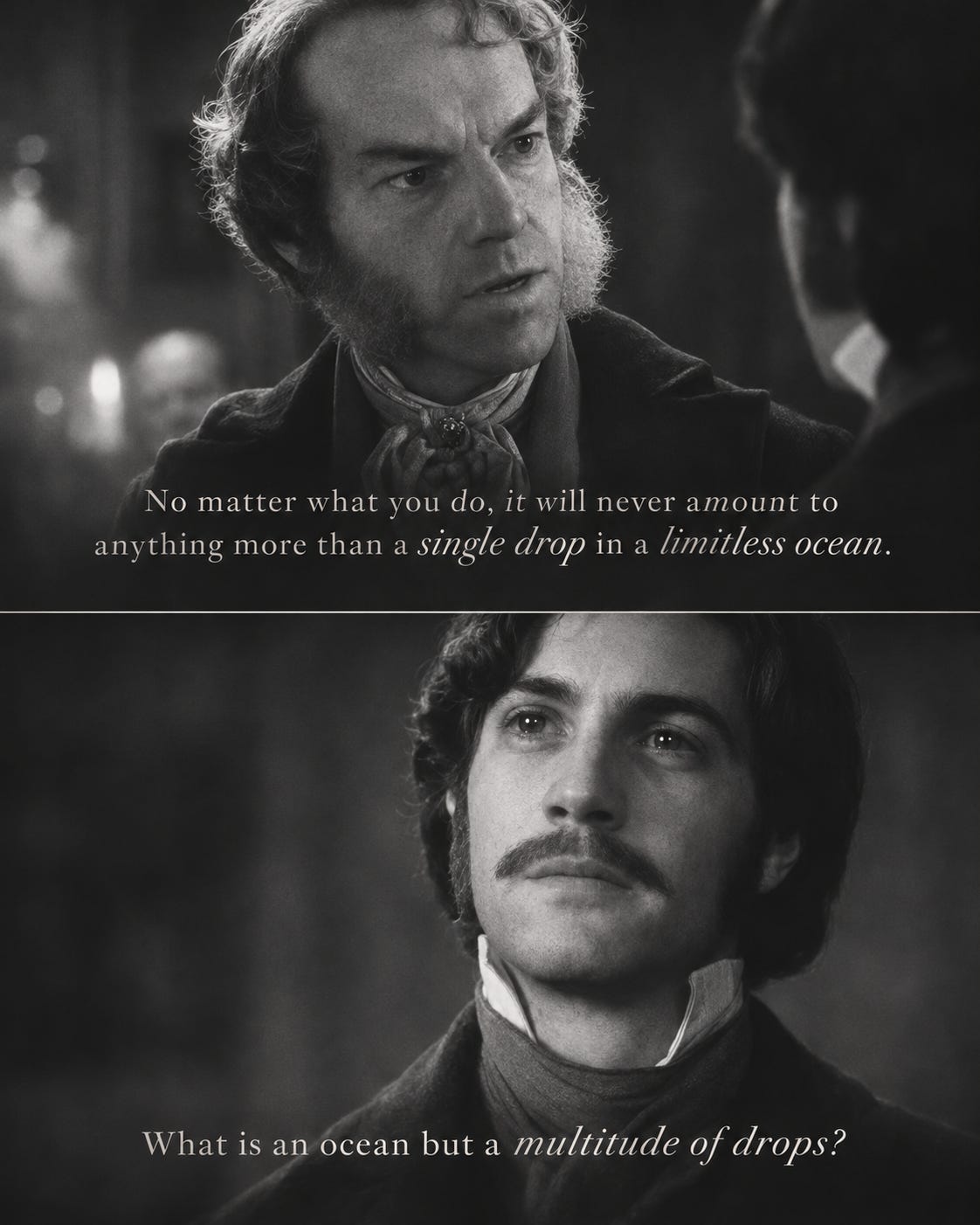
Near the end of David Mitchell’s Cloud Atlas, Adam Ewing, a young man who has resolved to dedicate his life to the abolition of slavery, imagines his father-in-law sneering at him. Whatever he accomplishes, his life will amount to one drop in a limitless ocean.
Ewing’s answer is the line I can’t shake:
Yet what is any ocean, but a multitude of drops?
That sneer articulates perhaps the most consequential philosophical error of our time: the conflation of individual insignificance with individual impotence.
I’m just one person. Nothing depends on me.
Don’t get me wrong, I’ve been guilty of this many times over. We dress it up as humility or realism, when in practice it often serves as a moral alibi, and honestly - and I hate to admit it - moral cowardice too. What would my one vote, my one deed, my one voice, my one act of resistance change in the grand scheme of things? It’s futile, right?
The problem with that line of reasoning is that it mistakes a property of the individual for a property of the collective - while each individual act might appear inconsequential in isolation, the cumulative effect of millions of such acts constitutes the very reality in which we live.
It reminded me of Václav Havel’s greengrocer in his 1978 essay The Power of the Powerless. Every morning, the greengrocer puts the regime’s slogan in his shop window - whether or not he believes it is irrelevant. He displays it because doing so is expected of him, because refusing to do so might come at a cost, and because everyone around him is engaged in the same ritual. Autocratic regimes derive much of their power from such daily reproduction of legitimacy by regular people.
However, the moment the greengrocer removes the sign, he has done something far more consequential than merely expressing dissent - he has exposed the fact that the reality everyone experiences as external, immutable and overwhelming is, in part, a reality they participate in constructing. Havel understood that power is not exclusively something exercised from above, but it is also something reproduced from below.
The same is true of corruption, institutional decay and social trust. Institutions exist independently of any particular individual, but they cannot exist independently of human conduct altogether. Their resilience depends on countless people honouring obligations that no institutional mechanism could ever fully enforce.
We have become remarkably adept at describing systemic failures as though systems were autonomous entities operating outside the realm of human responsibility. Yet what is a system without the people who sustain it? What is corruption without the thousands of individual decisions that normalise it? And what is institutional integrity without the people who uphold it, particularly when doing so comes at a personal cost?
This is not to suggest that the individual can simply wish away structural problems - power is asymmetrically distributed, incentives matter, and the price of dissent can be immense. But structures only constrain human agency; they do not abolish it.
The gardener that carried the Ring-bearer
The idea that an ordinary person, unremarkable in almost every conventional measure of greatness, can alter the course of history has occupied our literary imagination for centuries.
Tolkien, who survived the Battle of the Somme, lived through two world wars and witnessed the worst of what humanity was capable of, understood this exceptionally well. The fate of Middle-earth ultimately rested upon people whose aspirations had very little to do with power, glory or historical significance.
It took me several re-reads of the Lord of the Rings and growing into a full-fledged adult to recognise that Samwise Gamgee was the true hero of that fantasy tale.
A gardener whose dreams are, by comparison, almost embarrassingly small. He wants to return to the Shire, drink beer, eat good food, tend his garden and marry his childhood sweetheart. For a long time, I thought Sam’s secret was a blind, sometimes even annoying optimism that my Balkan brain simply couldn’t comprehend: a delusional, outright audacious conviction that everything would eventually work out.
But on closer reading, I realised something else - somewhere in Mordor, Sam begins to relinquish the expectation of ever returning home, drinking beer, eating good food, tending his garden and marrying his childhood sweetheart. The circumstances give him increasingly little reason to believe that he will survive this journey. Yet he continues walking up that mountain anyway.
In his Athrabeth Finrod ah Andreth, Tolkien distinguishes between two forms of hope. Amdir is an expectation of a favourable outcome derived from what we know of our circumstances. Estel denotes a deeper, ultimately theological trust that is not extinguished by the absence of favourable evidence.
I think Sam embodies the latter. His loyalty to Frodo survives the collapse of his expectations, and while he has no particular reason to believe that carrying his friend up the mountain will save Middle-earth, he does it anyway.
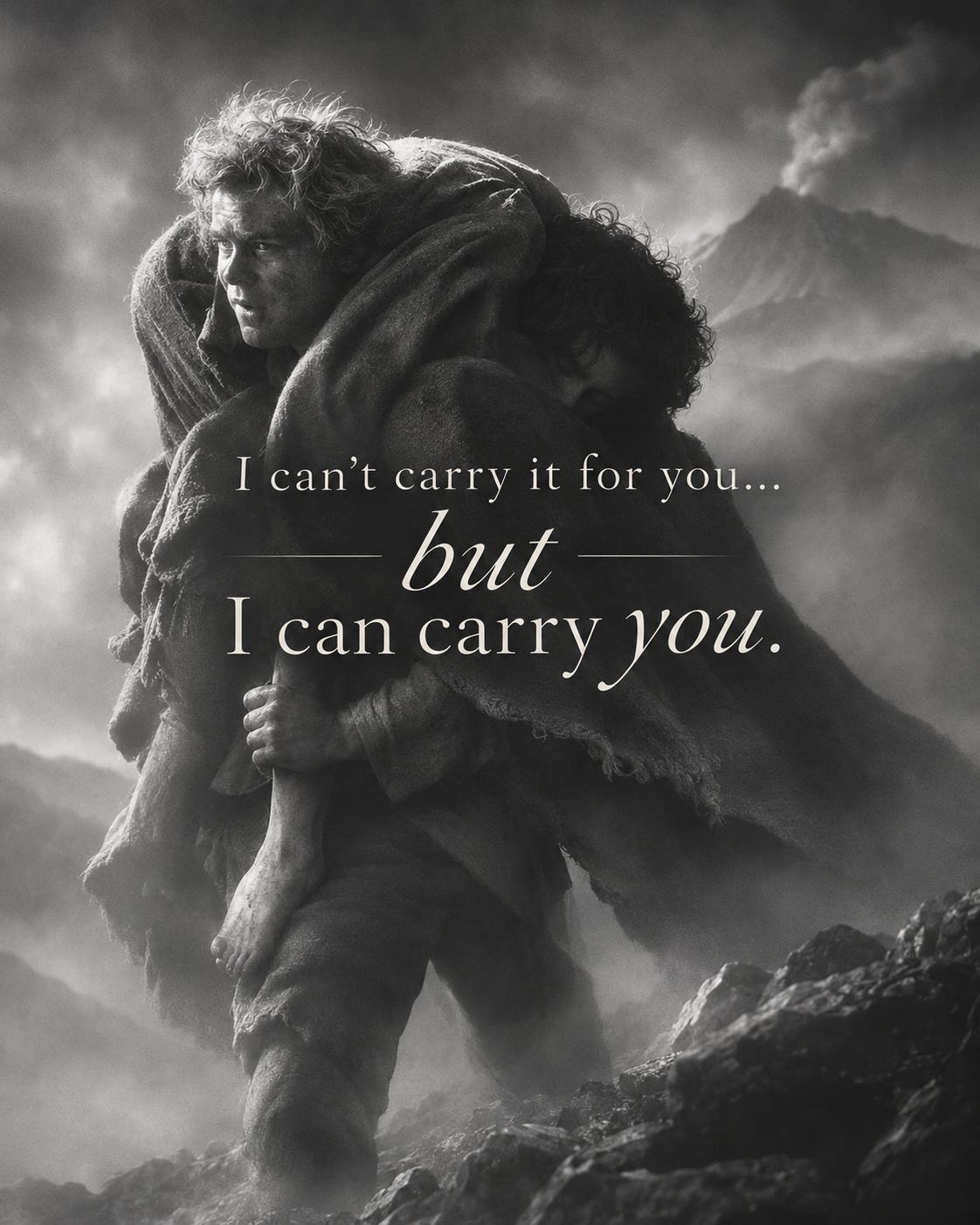
At the very end of this journey, Tolkien does something philosophically extraordinary (no spoiler alert, I’m sorry, but if you don’t know this story, you’ve been living under a rock!) - Frodo fails. At the very edge of the fire, he claims the Ring for himself, and the quest is ultimately fulfilled through Gollum, who is only there because, years earlier, Bilbo and subsequently Frodo chose to show him mercy.
Neither of them could have anticipated the historical consequences of that mercy - had they attempted to justify their decisions through a purely consequentialist calculation, they might well have concluded that killing Gollum was the more prudent course of action. Yet, at the end of it all - the salvation of Middle-earth emerges from a constellation of morally significant choices made by people who had no knowledge of their eventual convergence.
Tolkien’s narrative places particular emphasis on the epistemic limitations of the individual: we rarely know the full consequences of our own actions, much less the consequences of our actions interacting with those of countless others. There is something deeply humbling about that, isn’t it? We may never know what a small act of mercy prevented, what a gesture of kindness set in motion, or what possibilities were extinguished by an act of indifference.
And even if a merciful act never produces some extraordinary consequence, its moral worth need not depend on one - the good we do is not rendered meaningless simply because we cannot trace its effects through history.
Yet what is any ocean, but a multitude of drops?
Faith beyond the jurisdiction of reason
We’ve become a generation of very good analysts (I am one) - we can explain, in exhaustive detail, why every system is structurally deficient, why every institution is dysfunctional and why every attempt at meaningful reform is likely to fail. But somewhere along the way, we began mistaking this intellectual disposition for wisdom, and I suspect that many of us, myself included, have become far more cynical than we care to admit.
Cynicism is seductive because it affords us the appearance of intelligence without imposing upon us the obligations of courage. If you expect nothing of the world, you can never be disappointed by it, right? If you undertake nothing of consequence, you can never fail at anything of consequence, right? It is an extraordinarily effective mechanism of psychological self-preservation. Trust me, I know. But I also know it is a terrible philosophy upon which to build a civilisation.
The epistemological error lies in assuming that because reason can establish the improbability of success, it can also establish the futility of the endeavour. These are two entirely different propositions.
Reason can tell us what is probable - it can help us determine which course of action is more likely to succeed. But probability alone cannot tell us whether something is worth doing - that requires a prior moral judgement about what we consider valuable.
Sophie Scholl was 21 years old when she was executed by the Nazis in 1943 for her participation in the White Rose resistance movement. Her actions did not topple Hitler, she never lived to see the regime fall. Had she evaluated the moral worth of her actions exclusively through their immediate political efficacy, she might have concluded that distributing a handful of leaflets in Nazi Germany was a profoundly irrational undertaking. The value of her resistance cannot be reduced to its probability of success - in refusing to become a willing participant in the moral degradation of her society, she affirmed a conception of human dignity whose validity did not depend upon the victory of the cause she served.
This, I think, is what Havel meant when he distinguished hope from the conviction that things would turn out well. Hope resides in the belief that an endeavour possesses meaning independently of its outcome, while faith does not require the abandonment of reason - it requires an understanding of its jurisdiction.
There is no inherent contradiction between being profoundly pessimistic about the trajectory of our civilisation and remaining committed to its preservation. The two can coexist in perfect harmony. Antonio Gramsci famously invoked the expression “pessimism of the intellect, optimism of the will.” I think we have the first half down cold, it is now time to nail the second half.
The moral economy of civilisation
There is one uncomfortable asymmetry at the heart of civilisation: those who build its foundations are rarely the principal beneficiaries of their work.
The people who establish institutions, defend freedoms, construct infrastructure and preserve knowledge often do so at considerable personal cost. The benefits of their sacrifices are subsequently enjoyed by people who had no part in making them.
Civilisation is, in this respect, an intergenerational undertaking that cannot be adequately explained by immediate self-interest. This presents a fundamental problem for a society increasingly preoccupied with the maximisation of individual utility - how do we persuade people to invest in institutions whose benefits they may never enjoy? To defend principles whose observance might put them at a competitive disadvantage? To preserve freedoms for people who do not yet exist and who can neither reward nor thank them?
What happens when every generation expects to inherit the accumulated sacrifices of its predecessors, but none considers itself obliged to make comparable sacrifices for its successors?
Eventually, just like generational wealth, the inheritance is exhausted. One of the cruelest ironies of prosperity is that it can obscure the conditions that made it possible. Subsequent generations come to experience peace, institutional stability and material security as the default setting, rather than as historically contingent achievements requiring continuous maintenance.
We inherit the benefits of decisions whose necessity we gradually cease to understand, and when the time comes for us to bear the costs of preserving them, we experience those costs as an infringement upon our entitlements.
This is evident today in our unwillingness to invest in defence, in strategic resilience, in infrastructure, and in institutions whose usefulness cannot be demonstrated within a single electoral or financial reporting cycle.
For decades, we treated many of the redundancies that made our societies resilient as inefficiencies to be eliminated - we subordinated long-term security to short-term economic optimisation, we externalised risks and deferred costs, frequently to people who had no say in the decisions that generated them. What we call a crisis of institutions is therefore also a crisis of our relationship with time - we have become increasingly incapable of thinking and acting beyond the temporal boundaries of our own self-interest.
On the nature of sacrifice
When I speak of sacrifice, I don’t mean we’ll all be dying in a trench. For most of us, sacrifice in 2026 looks far less cinematic and heroic. It means spending years building or reforming institutions instead of chasing the next short-term win. It means defending the truth when doing so costs us socially or professionally. It means accepting that defence and resilience come with a high price tag, and being willing to pay it. It means holding our own political, social and cultural tribes to account, rather than reserving our moral indignation exclusively for our adversaries. It means raising children, building communities, mentoring younger people, and beginning things whose completion we may never witness.
But sacrifice itself is morally neutral.
Every tyrant in history has demanded sacrifice - the willingness to suffer or die for an idea tells us remarkably little about the moral worth of that idea.
Consider the distinction between someone who willingly sacrifices his life in the service of Russia’s imperial war against Ukraine and someone who risks imprisonment for opposing that very same war. Both may demonstrate endurance and a willingness to incur immense personal costs, yet the moral distinction resides in what those costs are incurred for.
We ought to be particularly careful, because the radical ideologies currently competing for the allegiance of younger generations are perfectly capable of satisfying their desire for meaning, belonging and sacrifice. The human yearning to serve something greater than oneself is not inherently benign - it has built civilisations and destroyed them. I had a friend in my early 20s - a guy from a rather troubled background - who ended up being this hardcore left-wing, Antifa vegan. I used to joke with him that I am glad the vegans found him before ISIS did, because this could’ve gone in either direction depending on who got to him first.
The challenge we are faced with is not to cultivate the willingness to sacrifice, but to cultivate the moral discernment necessary to determine what deserves our sacrifice in the first place.
And that discernment requires principles which remain valid even when their application becomes inconvenient to us. Nobody is asking someone who can barely make rent to assume responsibility for the entirety of Western civilisation. Our obligations are necessarily mediated by our circumstances, our capabilities and the spheres in which we exercise influence.
But having limited power is not the same as having none at all - and perhaps our first obligation is to exercise whatever power we do possess without waiting for the rest of the world to become worthy of our efforts.
If not us, who? If not now, when?
More than 2000 years ago, Hillel the Elder posed three questions that have lost none of their relevance:
If I am not for myself, who will be for me? If I am only for myself, what am I? And if not now, when?
It is the middle question that interests me most - it speaks to the inadequacy of a conception of human existence organised exclusively around the self. We are creatures whose lives are made possible, materially and morally, by the actions of people we have never met.
We speak languages we did not invent, we draw upon knowledge we did not discover, and we inhabit institutions we did not build and exercise freedoms for which we did not fight. Even our capacity to conceive of ourselves as autonomous individuals rests upon an extraordinary accumulation of collective human effort.
What, then, do we owe to those who will come after us?
In the same ancient text, Rabbi Tarfon offers what might be the most liberating formulation of moral responsibility: we are not obliged to complete the work, but neither are we free to abandon it. That’s the deal. We won’t finish it, we may not even live to see whether it worked, like the old man who plants trees whose fruit he’ll never taste.
A 100 years from now, almost nobody will remember our names, our arguments, or what any of it cost us. If we succeed, our grandchildren may enjoy the fruits of our efforts with the same historical innocence with which we enjoyed those of our great-grandparents. And we should be fine with that.
George Eliot understood this concept very well when she concluded Middlemarch with one of the most beautiful passages ever written in English literature:
For the growing good of the world is partly dependent on unhistoric acts; and that things are not so ill with you and me as they might have been, is half owing to the number who lived faithfully a hidden life, and rest in unvisited tombs.
Unhistoric acts. There is something profoundly beautiful about the idea that the moral architecture of civilisation rests upon the accumulated efforts of people whose names history never thought worth recording.
That, ultimately, is what the Greatest Generation was - behind the names that made it into our history books, there were millions of people whose lives remained historically unremarkable, but whose choices, taken together, altered the course of human history.
What is an ocean, but a multitude of drops, right?
I don’t know whether our generation will rise to the historical occasion - the analyst in me can furnish a rather extensive list of reasons why we might not. But I have come to understand that my inability to foresee our success does not absolve me of my responsibility to contribute to it. Perhaps that is what I would like those students to take away from my future lecture - we do not need to wait for history to confer upon us some grand collective purpose. We do not need to wait for better leaders, more favourable circumstances, or assurances that our efforts will bear fruit. The people we look back upon with admiration had no such assurances either.
We owe the future more than an eloquent explanation of why we failed it - Tte work is ours now.
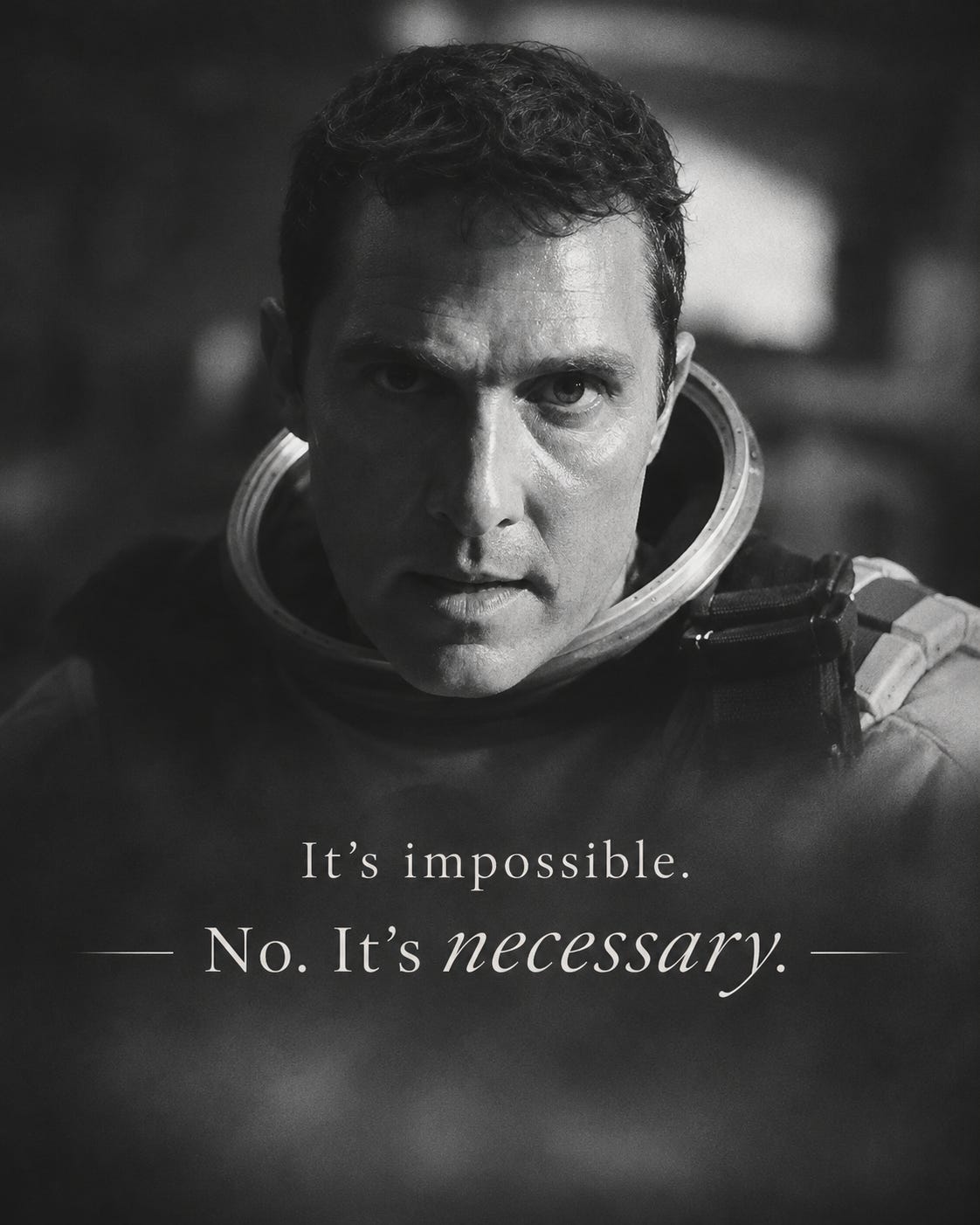
It is not impossible. It is necessary.
Your thoughts and reflections read like a memorable college commencement address. It's an inspirational summoning. Brilliant!
Your essays should be placed in book format so future generations are able to learn from your wisdom. Also, a print edition would give you the wider audience you richly deserve.