

Every empire in history has followed the same basic economic logic: the metropole is richer, more developed, and more industrialised than its colonies. The British Empire extracted raw materials from India and Africa to feed the factories of Manchester and Birmingham. The Spanish Empire drained silver from the Americas to fund the courts of Madrid. The French Empire turned North African agriculture into feedstock for the French economy. The center was wealthy, while the periphery was poor. The wealth, as a rule, always flowed inward.
The Soviet Union broke this pattern so completely that most Western analysts still haven’t fully absorbed the implications.
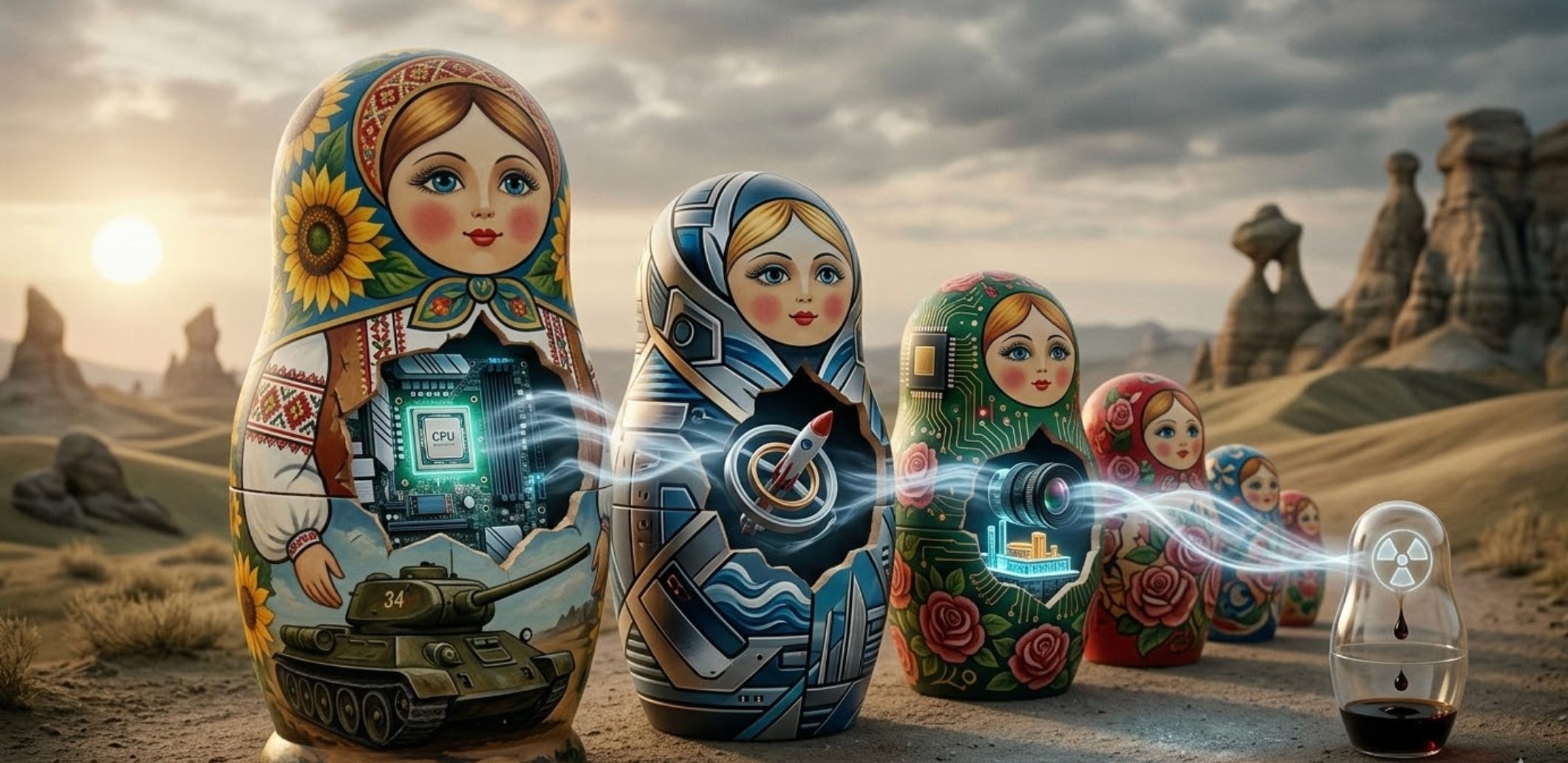
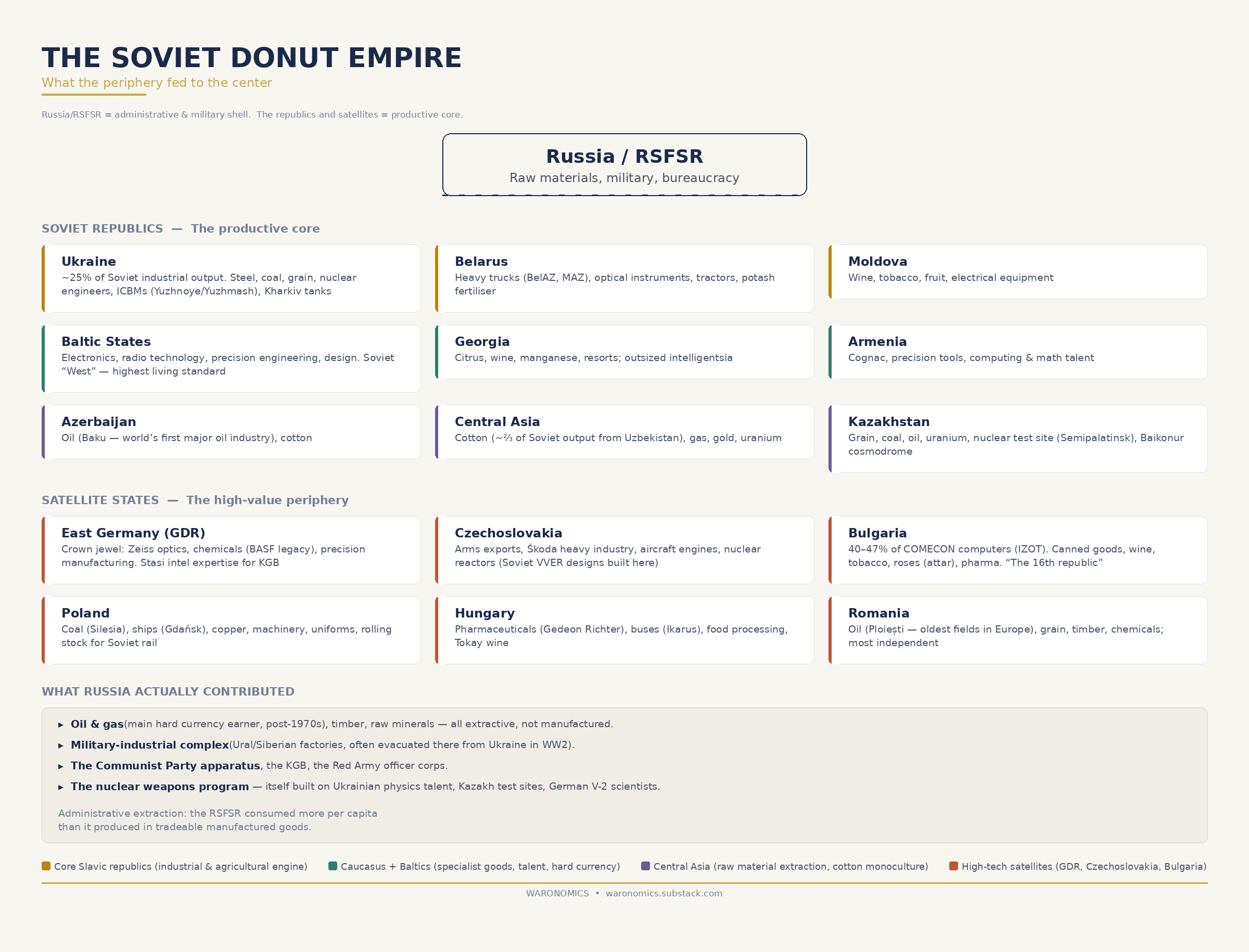
Sarah Paine, the Naval War College historian whose work on great-power competition has become essential reading in strategic circles, coined a term for what the USSR actually was: a “donut empire.” The productive core wasn’t at the center. It was at the edges. Russia itself - the Russian Soviet Federative Socialist Republic, the RSFSR, the supposed heart of the Soviet project - was the hole in the middle. It provided the bureaucracy, the army, the KGB, and some raw materials. The republics and satellites provided everything else: the industry, the engineering, the agriculture, the technology, the human capital that made the system function.
Understanding the donut empire is the single most important analytical key to understanding why Russia behaves the way it does today - why it invaded Ukraine, why it cannot let go of its former periphery, why Putin’s imperial nostalgia is not only sentimental and ideological, but also structural. Russia didn’t lose an empire in 1991, it lost its manufacturing base, its engineering talent, its agricultural surplus, its technological capacity, and its economic raison d’être. What remained was a raw materials exporter with nuclear weapons and an identity crisis.
Let me walk you through this map.
Ukraine: The Loss That Broke Everything
Let’s start with Ukraine, because Moscow always does.
The Ukrainian SSR was not just the most important Soviet republic outside Russia. It was, by many measures, more industrially productive than Russia itself on a per-capita basis. Ukraine hosted roughly a quarter of total Soviet industrial output. Its farms produced more than 1/5 of Soviet agricultural output - the famous chernozem black soil that made Ukraine the breadbasket of the empire and, before that, one of the great agricultural zones of the ancient world. The Donbas coal-metallurgical complex was the beating heart of Soviet heavy industry. Ukrainian steel mills, chemical plants, and machine-building factories formed an interconnected industrial ecosystem that Russia could use but never replicate.
But the real strategic loss wasn’t coal or wheat. It was the engineering talent.
In Dnipro - a city so militarily sensitive that it was closed to foreigners and at one point erased from English-language maps - sat Yuzhnoye Design Bureau and its manufacturing partner Yuzhmash. Together, they constituted the single most important missile production complex in the Soviet Union. Yuzhmash built the R-5M, the USSR’s first nuclear-armed rocket. It built the R-16, the first widely deployed Soviet ICBM. It built the R-36M - the SS-18 “Satan,” the largest intercontinental ballistic missile ever deployed. At its peak, the plant was producing up to 120 ICBMs per year. Khrushchev reportedly boasted that it churned out rockets “like sausages.”
Kharkiv built the T-34, the tank that broke the Wehrmacht, and later the T-64. The nuclear physics talent that underpinned the Soviet weapons program drew heavily from Ukrainian universities and research institutes. When the centrally directed transfer of wealth from Ukraine flowed outward - amounting, by some estimates, to one-fifth of Ukrainian national income - it was financing the development of other parts of the Soviet Union, notably Russia and Kazakhstan.
When Ukraine declared independence in 1991, Russia didn’t just lose territory, but a manufacturing civilization that it never recovered.
The Baltic Window: Where the USSR Pretended to Be European
If Ukraine was the engine, the Baltic states - Estonia, Latvia, Lithuania - were the showroom.
The Baltics had the highest living standards in the Soviet Union. They had the most sophisticated consumer goods, the strongest design culture, the most advanced electronics manufacturing. Tallinn and Riga were where Moscow went when it needed something that looked like it belonged in Europe. The precision engineering, radio technology, and electronics production that came out of the Baltic republics represented a qualitative tier of output that the RSFSR simply could not match.
The Baltics had been the eastern edge of the European industrial and cultural world for centuries - first under the Teutonic Order, then the Swedish Empire, then as some of the most developed provinces of the Russian Empire. Soviet occupation didn’t erase that industrial heritage, but exploited it. The Soviets needed a “western” manufacturing base, and the Baltics were conscripted into the role.
The speed with which the Baltic states reoriented toward Europe after 1991 - and the ferocity with which they have resisted any Russian reconquest - becomes completely legible through the donut lens. They were the most European part of the empire, they knew it, and they experienced Soviet rule as an occupation that extracted their productive capacity for the benefit of a less developed imperial center. That memory shapes Baltic security policy to this day.
Bulgaria: The 16th Republic and the Communist Silicon Valley
I’m going to spend more time on Bulgaria than a Western reader might expect, because this is a story I know from the inside and because it illustrates the donut thesis more dramatically.
Bulgaria was nicknamed “the 16th republic” - not quite formally part of the USSR but so tightly integrated that the distinction was often academic. And what Bulgaria provided to the Soviet system was, in proportion to its size, astonishing.
At its peak in the 1980s, Bulgaria supplied around 40 to 47% of all computer hardware produced within the COMECON economic bloc - from Berlin to Vladivostok. The electronics industry employed some 300,000 workers in a country of eight million and generated roughly 8 billion rubles per year. The IZOT brand - Computing, Recording and Organizational Technology - became synonymous with Soviet-bloc computing. Bulgarian factories produced mainframes, minicomputers, personal computers, disk drives, tape storage, and peripherals. The Pravetz personal computers, Apple II clones engineered in the town of Pravetz (named, with characteristic communist modesty, after the hometown of party leader Todor Zhivkov), became the standard educational computer across the Eastern Bloc.
How did a small Balkan country become the Communist Silicon Valley? A cocktail of Soviet central planning, Japanese licensing, and a remarkably effective espionage programme. In the 1960s, Bulgaria obtained Japanese licenses from Fujitsu and began manufacturing computers. Within COMECON’s division-of-labour framework, computing was designated as Bulgaria’s speciality. Heavy state investment followed. Zhivkov visited Japan in 1978, returned astonished by microelectronics advances, and accelerated investment further. New factories were built across the country. Covert partnerships - espionage, essentially - brought in Western components and designs.
By the late 1980s, Bulgarian-made computers flew on the Soviet space station Mir, equipped nuclear research facilities in India, and ran statistical offices in Mozambique. The electronics sector became the second-largest industrial workforce in the country. Bulgaria ranked third in the world in computer production per capita.
And then 1989 happened, and all of it collapsed almost overnight. The guaranteed COMECON market vanished, Western competition arrived. The factories that had supplied nearly half the computing power of the socialist world were allowed to disintegrate in the chaos of transition. The knowledge didn’t entirely disappear - it migrated West and seeded Bulgaria’s modern IT industry, and today Sofia is a strong tech hub - but the scale of what was lost remains staggering.
Add to the computers: canned goods, wine, tobacco, rose oil (Bulgaria held a near-monopoly on attar of roses, the essential ingredient in high-end perfumery), and a growing pharmaceutical sector. A country of eight million was punching at a weight class far above its size - all of it flowing into the Soviet system.
The Crown Jewels: East Germany and Czechoslovakia
East Germany was the technological pinnacle of the Soviet bloc, and it wasn’t even close. Zeiss optics in Jena, precision instruments from Dresden, chemical production built on the legacy of BASF and the pre-war German industrial base. The GDR manufactured the highest-quality goods in the entire system - and the Stasi’s relationship with the KGB was genuinely symbiotic in ways that went beyond intelligence sharing. East German organisational methods and technical tradecraft were things the KGB studied and adopted, not the other way around.
Czechoslovakia was equally indispensable if less flashy. Škoda heavy industry, aircraft engines, arms exports that generated hard currency for the bloc. And critically, nuclear reactor engineering - the Soviet VVER reactor designs were built in Czechoslovakia, a legacy of the engineering culture that dated back to the Austro-Hungarian industrial core. Prague and Brno were manufacturing centres with centuries of accumulated expertise that Moscow could direct but never duplicate.
Poland contributed Silesian coal, Gdańsk shipbuilding, copper, machinery, and the rolling stock that kept Soviet railways running. Hungary provided pharmaceuticals through Gedeon Richter, Ikarus buses that appeared in cities across the Soviet Union, and food processing capacity. Romania, the most independent-minded of the satellites, still supplied Ploiești oil - from Europe’s oldest oil fields - along with grain, timber, and chemicals.
Every one of these countries was, on average, more educated and more economically developed than Russia proper. That is the inversion Paine identifies - the colonies were richer than the coloniser.
Kazakhstan: The Most Exploited Republic
Kazakhstan is arguably the most dramatic case of imperial extraction in the entire Soviet system.
Start with Semipalatinsk. For four decades, from 1949 to 1989, the Soviet Union conducted 456 nuclear weapons tests at a site in the Kazakh steppe - an area of 18,500 sq. km. that Moscow’s security chief Beria declared “uninhabited,” though it was not. The total explosive yield was 250 times greater than the bomb dropped on Hiroshima. Over a million Kazakh citizens are now officially recognised as victims of radiation exposure. The contamination spans over 18,000 sq. km. Children in the area continue to be born with genetic mutations, the full health data from the early decades of testing remains classified to this day.
Kazakhstan also hosted the Baikonur cosmodrome - the launchpad for Sputnik, for Gagarin, for the entire Soviet space programme. It provided uranium for the nuclear arsenal, grain for the Soviet breadbasket, coal for the industrial base, and oil for the economy. In return, it received a Russian-speaking settler population that was systematically used to dilute Kazakh identity - a demographic strategy that Putin’s rhetoric about “protecting Russian speakers” makes chillingly familiar.
When Kazakhstan finally shut the Semipalatinsk test site in 1991 - one of newly independent President Nazarbayev’s first acts - Russian scientists departed without leaving information about the locations of many tunnels and boreholes. The environmental and human legacy was simply abandoned.
What Russia Actually Was
So what did the center of this empire actually contribute?
Oil and gas - which became the main hard currency earner from the 1970s onward. Timber. Raw minerals. All extractive industries, not manufactured goods. The industrial capacity Russia did possess was either transplanted from elsewhere - Ukrainian factories physically evacuated east of the Urals during the Second World War - or built by German engineers imported after 1945. The nuclear weapons programme itself was constructed on the backs of Ukrainian physics talent, tested on Kazakh soil, and enabled in its early stages by captured German V-2 rocket technology.
The one thing Russia genuinely ran from the center was the coercive apparatus. The Communist Party. The KGB. The Red Army officer corps. The planning bureaucracy that directed the allocation of resources from periphery to center. This is exactly what a parasitic imperial center requires to sustain extraction from more productive colonies - and it is exactly what collapsed between 1989 and 1991 when the coercive glue weakened.
When the coercive apparatus could no longer hold the system together, the productive periphery walked. Every single one of them. The Baltics walked first and fastest. Ukraine walked with a referendum in which more than 90% voted for independence. The Central Asian republics walked with varying degrees of enthusiasm but universal finality. And what was left - what Russia “inherited” from the Soviet collapse - was not the core of a great empire, but the hollow center of a donut: a raw materials exporter with nuclear weapons, a massive army with a shrinking industrial base to support it, and an identity crisis that has not been resolved in three decades.
Why This Matters Now
The donut empire a useful analytical framework for understanding Russian strategic behaviour in the 21st century.
Putin’s obsession with Ukraine is not just sentimental, but also structural. Ukraine was the republic without which the Soviet system - and any successor Russian empire - simply cannot function as a major industrial power. Without Ukrainian engineering, manufacturing, agriculture, and human capital, Russia is Saudi Arabia with permafrost: a petrostate with delusions of grandeur. Putin knows this. The entire Russian strategic elite knows this. The invasion of Ukraine in 2022 was not a security operation against NATO expansion, but an attempt to recapture the productive periphery that the donut empire lost in 1991.
The same logic explains Russia’s behaviour toward the Baltics, its pressure on Kazakhstan, its de facto occupation of Belarus, its constant meddling with the domestic affairs of Bulgaria, and its desperate efforts to maintain influence across the entire former Warsaw pact space. Russia is not trying to rebuild the Soviet Union out of nostalgia, it is trying to rebuild the economic base that it never possessed independently and cannot generate on its own.
And here is the part that Western policymakers consistently miss: this is not a problem that sanctions alone can solve. Russia’s economic weakness is not a temporary condition caused by Western pressure. It is a permanent structural feature of a country that was always the administrative shell of someone else’s productive capacity. The sanctions hurt, certainly. But Russia was economically hollowed out long before 2022. It was hollowed out in 1991. Everything since has been an attempt - through energy leverage, through military coercion, through political manipulation - to compensate for the loss of the periphery that did the actual work.
The Balkan Candor
I am writing this demystification for a specific reason: to sober up the many people in the West who still assume that Russia was a powerful, sophisticated empire, and that the rest of us - Bulgarians, Ukrainians, Poles, Czechs, Balts, Georgians, Kazakhs - were poor peasants who just happened to be part of it. Grateful subjects of a civilising force.
Let me be blunt: the opposite is true. Every single nation I have discussed in this piece - its language, its culture, its identity - existed for centuries before the Principality of Muscovy even appeared on the map. Bulgaria had an regional empire that decapitated Byzantium emperors and a written alphabet when Moscow was a forest clearing. Ukraine’s Kyivan Rus’ was a European civilisation while Russia’s future capital was a trading post on a swamp. The Baltic peoples, the Georgians, the Armenians, the Poles, the Czechs - all of them built literate, complex societies long before Russia coalesced into anything resembling a state. Russia did not civilise its periphery, it fed off it.
Russia is, by every meaningful developmental metric outside of raw military tonnage and hydrocarbon extraction, a third-world country. It has been one for most of its history. The nations it occupied and exploited still suffer from the scars of that historic oppression - stunted institutions, broken trust, economic distortions that take generations to unwind. But here is what makes me genuinely furious: when Western commentators lazily brand all “Slavs” or all “Eastern Europeans” as backward, as corrupt, as culturally inferior, they are thinking of Russia specifically - and smearing the rest of us with a reputation we did not earn and do not deserve. The countries Russia colonised were, in most cases, more developed than Russia itself. That is the entire point of the donut.
Great piece! I don’t think there has been enough analysis and research on the USSR from the perspective of colonialism and imperialism. Too many people aren’t aware of how much of a multiethnic empire of old the USSR truly embodied.
This is one of the best analyses I have read about this conflict in a long time. Kudos!