


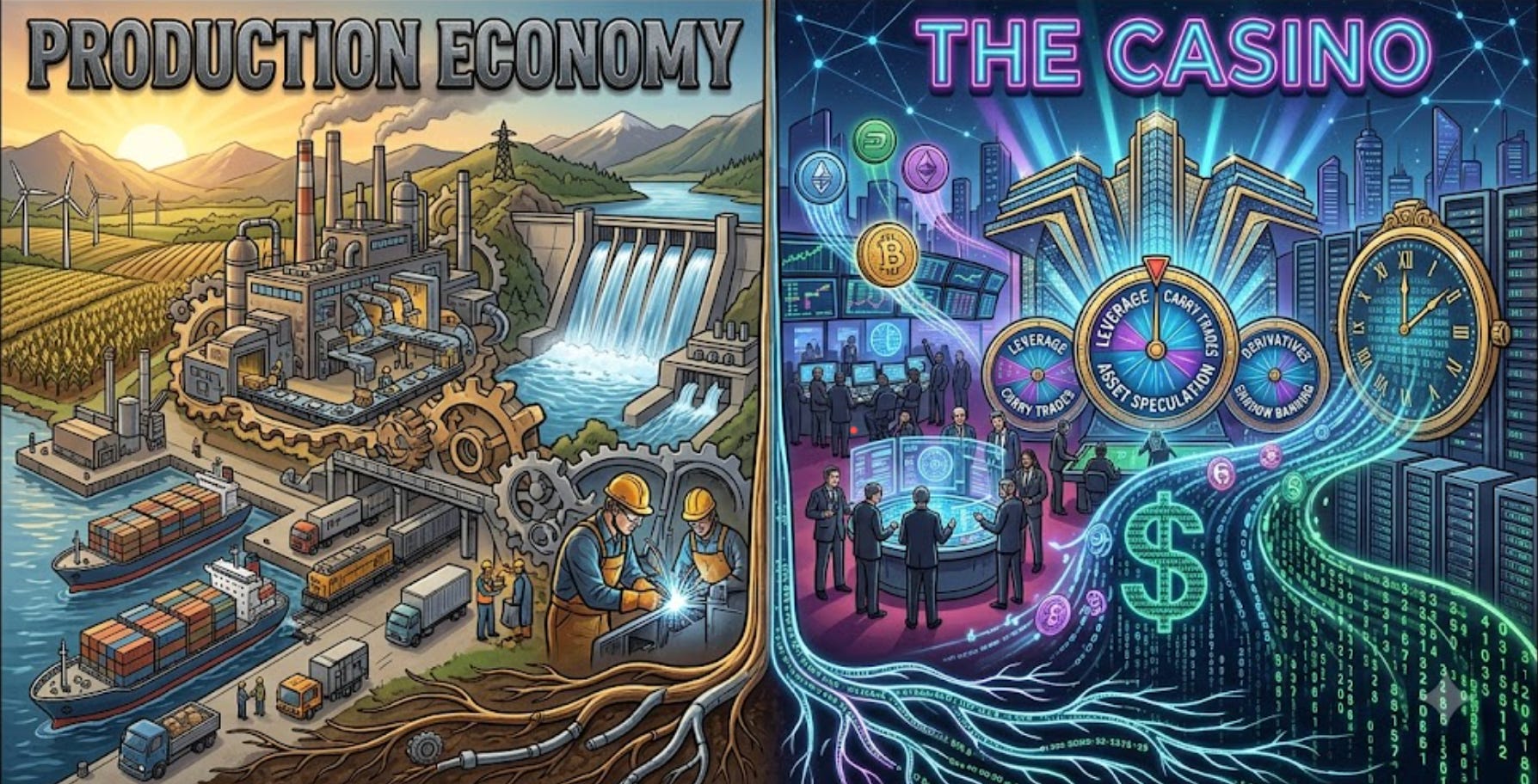
I’ve been sitting on this draft for 3-4 months. Like most of what I write, I couldn’t quite make it land, so it just sat there gathering dust. It’s time has come, hope you find it useful.
There is a belief that has entrenched itself deep into the Western economic thought: the belief that an advanced economy can just specialise in high finance, software, branding, “design,” and “ideas,” and outsource the physical world - the rare earth minerals refining, energy, steel, the chips, the transformers, the artillery shells, the welders, all of it - to whoever will produce it cheapest. Production, in the last several decades, became a service you rent. Economy-as-a-Service. Because why own a factory when you can own a spreadsheet and masquerade wealth generation?
More than a decade ago, I knew a trader who made a lot of money speculating on currency markets. We argued about macroeconomics constantly, but because I wasn’t trading and I wasn’t rich, he dismissed my views as ignorant and outdated.
His position was simple: the Western world would NEVER return to production and manufacturing, because that was dirty, low-status, low-paying work that could - and should - be outsourced to someone else. The West, he insisted, should stick to services.
I tried to explain that services do not power the grid. They do not produce the components needed for industrial machinery. They do not build the infrastructure you depend on, work the agricultural land that feeds you, or manufacture the fighter jets and missiles that defend the sky above your head.
But in a world where status (money) is mistaken for wisdom, common sense doesn’t carry much weight.
Needless to say, we no longer speak. I told him that his casino days would be over sooner or later, so he better cash out his monopoly money while he still can. He blocked me.
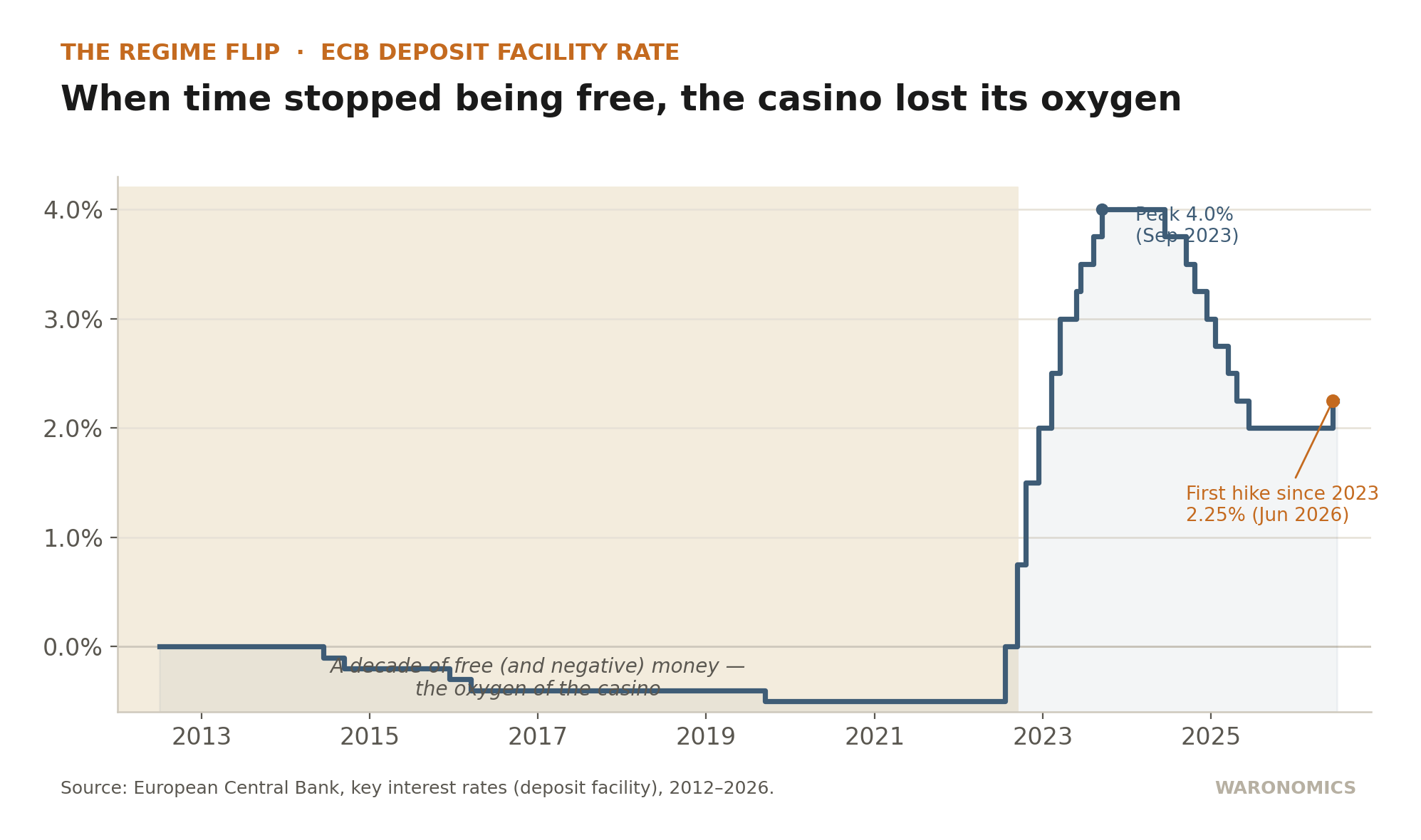
Then, on June 11, the European Central Bank raised interest rates for the first time since 2023 to fight war- and energy-driven inflation. Days later, Christine Lagarde warned that AI could trigger a financial crisis. There it was: the same central bank that spent a decade inflating paper wealth is now choking it to contain inflation in the real economy, while warning about the bubble its own era of easy money helped create.
The world my father built
My father was a civil engineer. I spent my childhood and early teens watching him work - sourcing construction materials, hunting for qualified people, and building real, physical things. Apartment buildings, houses, factories, parks, roads, fire safety systems installed to whatever the latest regulation demanded, because in his world, getting it wrong meant someone died. It was hard, demanding work, especially in the Balkans in the early 2000s, when nothing arrived on time and corruption was rampant. The stress of it all killed him at 50, which is why I never followed in his footsteps.
But the world he lived in, and by extension the one that I was raised in, was a physical one. Factories ran to produce, manufacturers competed locally and regionally. A man who could wire the electrical system for an entire building was respected and well paid, because the building did not get its electricity from an Excel spreadsheet managed by a guy in a suit sitting in an AC-cooled office.
And then, by the time I finished university and entered the workforce, that world had quietly been dismantled. Economies went “service-based.” Producers of physical things - from the food we eat to the materials we use to build our own power grids and our own missiles - were outsourced, aggressively, to the lowest bidder. T-shirts and sneakers to Vietnam, fine. I understand comparative advantage, and it’s not like these products are of national security significance. But outsourcing the majority of your productive capacity to a geopolitical rival always struck me as an insane gamble - and I have never, not for a nanosecond, trusted the Chinese Communist Party. Growing up where I did, in the family that I did, you develop an allergy for the word “communism” and anyone willing to use it, or God forbid, paint it in a positive light.
150 bucks paycheck
When I was 14, my mother found me a summer job that paid 150 bucks a month - about 70 euros. When I got that first paycheck, the most money I had ever held that was mine, I wanted to buy something for everyone in the family. I spent all of it in under a week. It shocked me, because I had worked hard for a full month for that money, and in five days - poof, it was all gone.
I was angry at the time, but later in life I felt grateful, because it taught me the real value of money at an age when many people still believe money is free. So when, years later, cheap money flooded the world and I watched people conjure wealth out of nothing - market speculation, crypto, vaporware startups, every flavor of rent-seeking imaginable - I was constitutionally suspicious. I could have made a lot money riding those waves, I know that. But I would have had to look at myself in the mirror knowing I was just another pawn in a pyramid scheme. The many kids that pile on to bully the quiet one has never been an argument for me to join in.
Now that I’m older and have a just a little bit wiser, I see the structure clearly. For decades, central banks and their political appointees protected the financial system at the direct expense of the production one. Carry trades, derivatives, asset speculation, credit by non-bank players like insurers, funds, and off-balance-sheet vehicles, far from any regulator’s eye - took priority over the unglamorous business of making physical things: manufacturing, energy, materials, logistics, the actual supply chains that keeps us alive.
That order is now breaking right in front of our eyes. Cheap money, cheap energy, cheap Chinese manufacturing, just-in-time inventories, offshore finance, and the bedrock assumption that paper wealth always outranks physical production - that entire era is reaching its logical end, whether anyone (especially people in finance) likes it or not.
Production versus the Casino
Years ago I was in Las Vegas for a tech conference, and in my free time I just walked and watched people feed their money into slot machines and roulette tables, waiting for the hit. I have never gambled in my life. My grandfather used to say the lottery is in the hands - meaning there is no easy money, only work. But standing in those casinos, watching the machinery of hope and loss, I understood that the Western economy now runs on exactly the same premise.
You gamble that an AI goes boom, while a carmaker goes bust. You speculate on crypto, you bet on Polymarket, you buy into funds propped up by precisely the kind of people that the Will Emerson character describes in Margin Call - the line where he explains that everyone wants the lifestyle the financial system subsidises (big houses and big cars they can’t really afford) but also wants to play innocent and pretend they have no idea where it came from. He’s right, that has been the whole arrangement for several decades. We downgrade our production capabilities and hollow out entire regions of our countries, while we overcrowd the cities with desk jobs and create an entirely new - and extremely fragile - laptop class.
At the end of all this there are only a handful of winners, and those are the only ones you hear about: the man who made millions on a single trade, the guy who bought crypto at the bottom and sold at the top. None of it is productive, of course. What you don’t hear about is the much larger pile of losers, because a casino markets itself with its handful of jackpot winners and quietly buries everyone else. And there are a lot of everyone else, because the house always wins. That is how a hyper-financialised economy works: it punishes the production that creates real value - try finding a Western VC willing to fund anything upstream, anything that involves a furnace or a factory, when they could instead gamble on an AI horoscope app with a faster exit.
At the end of the day only the top percentile, the people who already own the assets, benefit from the system, with the occasional lucky entrant waved through the velvet curtains to keep the dream alive for the rest of the peasantry. Everyone else is sold the fantasy of frictionless abundance: just day-trade, just go viral, just TikTok influence your way to easy wealth.
This is changing.
The needs of the real economy - energy security, defence production, materials, resilient supply chains, and above all controlling the inflation that lands on ordinary people - are starting to override the imperative to keep the speculative markets afloat. You see it politically in re-shoring and friend-shoring, and in the return of a phrase that was unspeakable for decades: industrial policy. You see it structurally in the fact that interest rates can no longer sit at zero, but are steadily rising.
Zero rates were the oxygen of the leveraged casino. When inflation is driven by real-world scarcity - energy, labour, materials, war - rates have to stay high to fight it, and high rates suffocate the casino we call the financial system. The ECB’s deposit rate now sits at 2.25% and is moving the wrong way for the speculators, because the central bank is fighting an energy shock it cannot wish away. Rates go up to defend the price of bread, the casino loses.
Cheap money vs expensive money
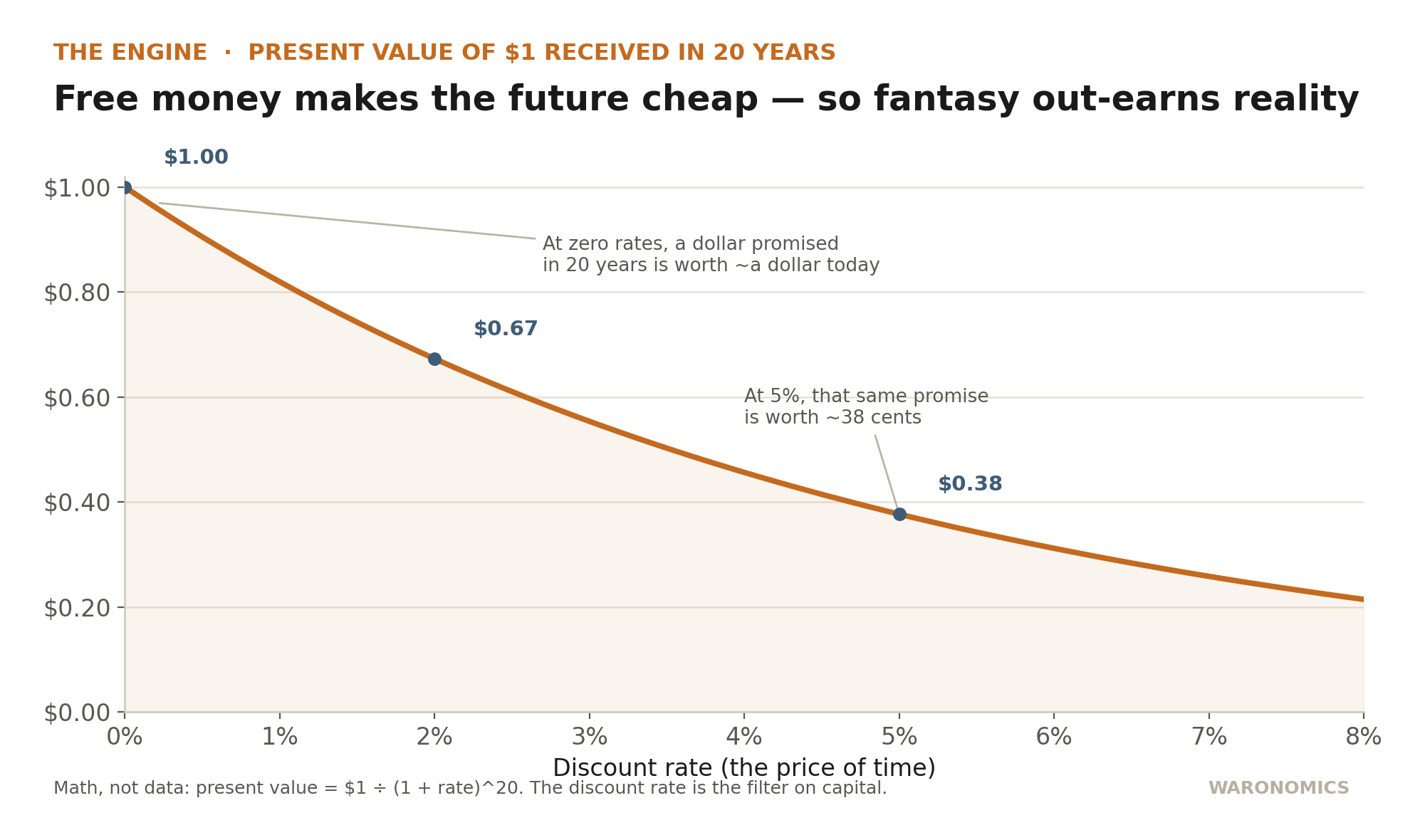
Look at the machinery underneath every valuation. The worth of any asset is its future cashflows divided by a discount rate. Push that rate toward zero and the denominator stops punishing distance and doubt - a dollar some pre-revenue company promises you in 2040 starts to count almost as much as a dollar a steel mill earns you today. Cheap money doesn’t merely permit fantasy, it lets fantasy out-compete reality, because fantasy’s payoff is always in the future. Raise the rate and the whole thing inverts: now you have to deliver returns inside a horizon you can actually see, and that mechanically rewards the things that produce cash now over the things that promise to disrupt the world eventually.
When money becomes scarce, they get allocated to the productive economy, not slop.
This is not a novel idea, Hayek described it almost a century ago and called it malinvestment. Hayek’s point was not just that cheap credit inflates asset prices, it was that cheap credit systematically misdirects real, physical resources - labor, materials, engineering talent - into projects that should never have been built. The slop was never only financial, it was the misallocation of the actual productive sinew of the West: a decade of our most capable engineers building food-delivery apps and ad-targeting algorithms instead of power grids and chip fabs. The bust everyone fears is not the catastrophe, the bust is the market taking those misallocated resources back and channelling them toward things people actually need.
As Nassim Taleb postulated in Skin in the Game: when capital is cheap to borrow, risk-takers do not bear the downside of their failures, leading to reckless bets and systemic fragility. Conversely, when money is scarce, managers are forced to be disciplined because they personally absorb the losses.
So watch what cheap money actually funded: crypto, meme stocks, profitless “story” growth, zombie firms that should have died years ago, the entire AI-app gold rush. In every case the return comes from the next buyer or from the leverage - not from anything produced. Greater-fool economics requires cheap money, but let cash pay 4% and the chase simply stops. The fool’s game deflates on its own.
Cheap money does not reward production; it removes the punishment for not producing.
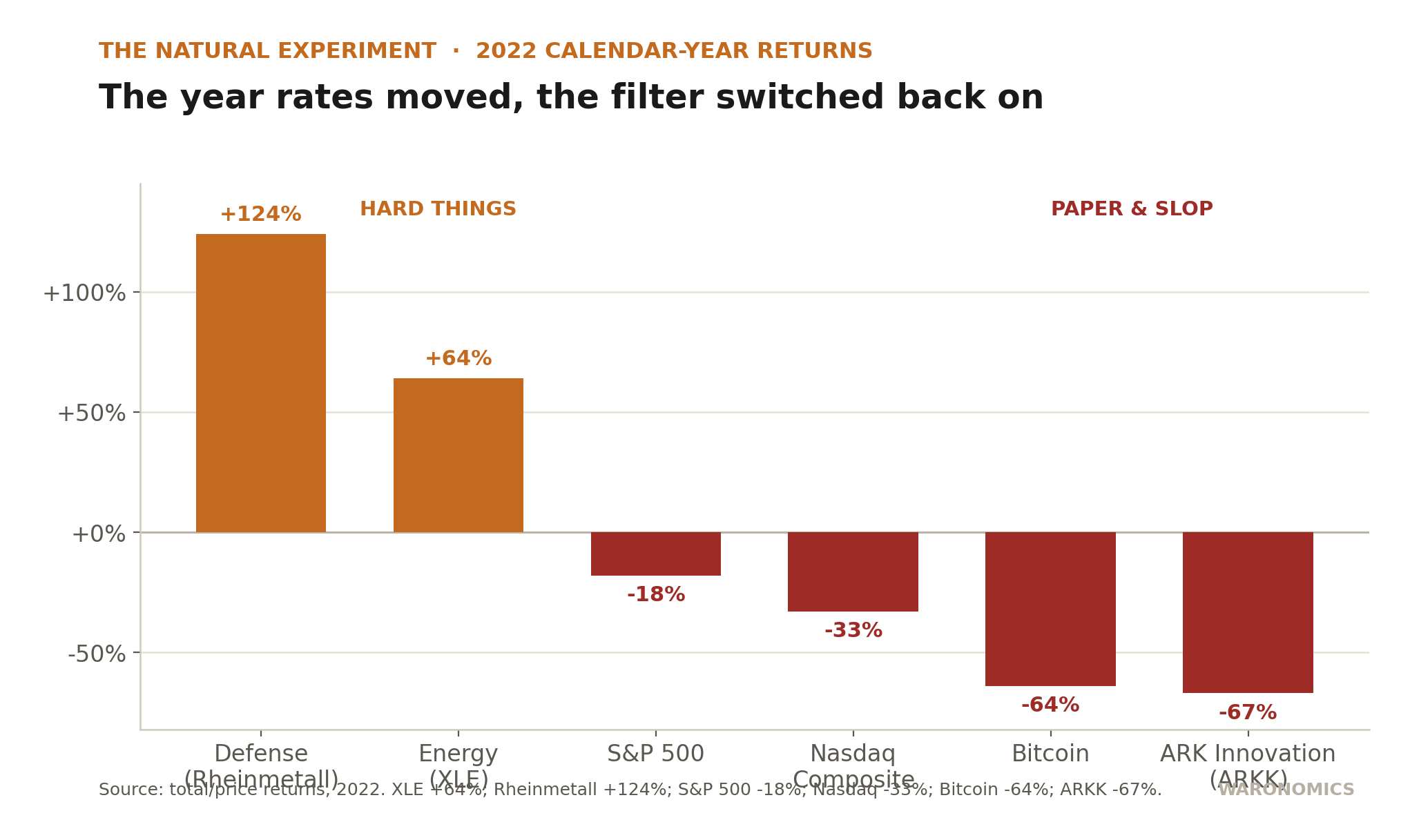
The history is unkind to anyone who wants to argue otherwise. In the 1970s, high inflation and high rates annihilated financial assets while hard things - oil, metals, gold - held their value, and the blue-chip paper darlings of the previous decade were slaughtered.
That is the whole mechanism, in one sentence: cheap money is a subsidy to non-production, scarce money ends the subsidy, and from there capital flows to wherever the real returns are - which, in a world whose binding scarcities are physical, means the real economy. Scarce money doesn’t build the factory, it just ends the world in which not building it was the smart move.
Two economies at odds
Just to clarify:
The productive economy is the real one: factories, energy, shipyards, food, semiconductors, logistics, steel, chemicals, mining, defence manufacturing, skilled labour, infrastructure. Things that exist throughout the weekend, when the financial markets are closed.
The financial economy is leveraged paper: speculative real estate, derivatives, private credit, shadow banking, carry trades, buybacks, asset bubbles, offshore structures - financial engineering that generates returns without necessarily generating any useful capacity.
For decades the paper side won every argument - that trader from the beginning of the essay projected the current trends to infinity, believing that production will never be needed in the West ever again. Companies were rewarded for offshoring, for borrowing cheaply, for maximising margins and pleasing shareholders with their ever more impressive bottom lines. On the spreadsheet it all looked perfect, but the real - physical - world is no spreadsheet to be managed. A ship optimised to look efficient in calm weather is a ship engineered to shatter in a storm. We optimised the entire West for calm weather, and when the weather changed - not even suddenly - we were poorly prepared to handle it.
Now the physical world is collecting its’ due invoices, and the shocker is that the physical world does not accept paper wealth.
You cannot finance-engineer an artillery shell, or outsource your electricity grid to a hostile power and call it efficiency. You cannot run a war economy on a PowerPoint slide deck, print copper at the Federal Reserve, or LNG terminals, or high-voltage transformers, or ships, or a trained welder.
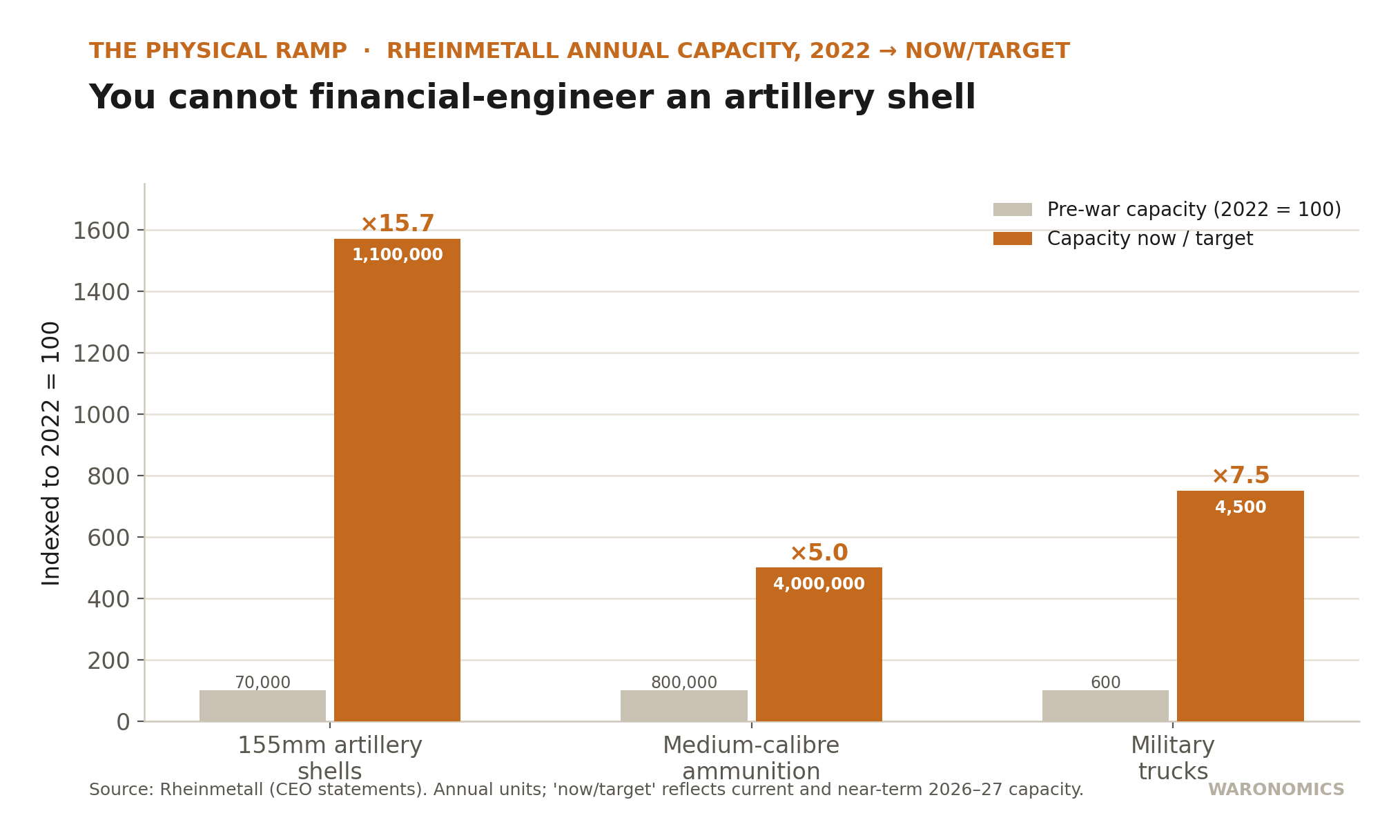
Look at what it actually takes to rebuild the production capacity Europe abandoned. Before 2022, Rheinmetall produced roughly 70,000 artillery shells a year. It is now scaling toward 1.1 million - and its CEO says Germany alone now out-produces the United States in conventional ammunition. European artillery output is on track to roughly double to around two million 155mm shells in 2026, up from a near-handmade trickle three years ago. Total European defence spending crossed €400 billion this year; Poland is spending close to 4.7% of GDP. New propellant lines are going up in Bulgaria and Romania - in the places the Excel spreadsheet wrote off as too poor and too far east to matter.
The spreadsheet era is being replaced by the warehouse era
The post–Cold War order optimised supply chains for one variable: cost. Just-in-time, maximally globalised, zero slack because the priority was financial return and the world was assumed to be permanently peaceful. Slack was waste. Inventory was a sin. A warehouse full of strategic stock was money sitting idle.
In a world of war, de-globalisation, and great-power competition, that priority inverts. The new objective is resilience and domestic capacity - even when it is financially expensive, even when it disrupts markets, even when the spreadsheet hates it. And the thing that gets sacrificed to pay for it is no longer production. It’s finance.
Let me be very honest here - don’t get your hopes too high up, becsuse re-shoring is brutally hard, and a lot of these announcements will not survive contact with reality. You cannot re-shore one factory and pat yourself on the back - you have to re-shore the entire value chain, or you’ve just moved your dependency one rung up the ladder and nothing more. As of 2024, only about 5% of manufacturers sourced all their raw materials locally. The US still has almost no domestic upstream for the purified elements, specialty gases, and chemicals that semiconductors require, and the critical minerals for batteries are barely mined there at all. The same forces breaking the financial casino - higher interest rates and policy shocks - are also making real re-industrialisation harder. Rebuilding productive capacity requires long-term, multi-billion-dollar bets. Those are much easier to demand than to finance when capital is no longer cheap. There is no clean version of this. The transition is going to be slow, costly, painful and ugly.
The Balkan Candor
Growing up, my mother said one word to me, again and again, until it lodged permanently: занаят. A craft. A trade. A practical, hard-won skill - learned through apprenticeship and your own two hands - that cannot be easily replaced and will always be needed. Get a занаят, she’d say. Something they can’t take from you.
And every Balkan taxi driver I have ever ridden with, from Bucharest to Athens, has given me the same unsolicited crash course in geoeconomics: we destroyed our own production, everything went to China and India, now we all just sit in front of computers, and what happens when the computers stop? The irony is they were all right. Every one of them. Your average Balkan taxi driver understands industrial policy - intuitively, in his gut - better than 90% of the Ivy League–credentialed officials in Washington and Brussels who outsourced the continent’s productive sinew.
So here is where we are. We kicked the can down the road for decades, assuming someone else would eventually solve the problems we manufactured for ourselves. Nobody did. And now we are walking into the most painful economic correction in living memory - the unwinding of an entire civilisation’s bet that paper wealth can permanently outrank production. Trust me: nobody is going to enjoy it.
My advice? Suck it up, buttercup. And understand that if we do this correctly - if we rebuild the capacity to make our own energy, our own materials, our own defence, our own food - we will live in a more serious and more secure world 20+ years from now than the brittle, financialised one we’re leaving behind.
So instead of clutching your pearls over the falling paper value of an overpriced two-bedroom in some mediocre neighbourhood of an European capital, accept that the age of paper wealth is ending, and prepare for what’s coming. Mentally, if nothing else.
Excellent article and nails the failings of today's financialised world. I am currently sitting on an economic policy group for a political party wrestling with financial/City types. Because they have made so much money from that world they have a very high opinion of themselves, and financial power gets used to shape political power. Directly through party contributions and indirectly through market power. They have little interest in the longer term investment needed to build up real businesses, and even innovative, useful new businesses are regarded as something to buy and sell off as soon as possible to the highest bidder.
Governments live in fear of them and central banks are too often just part of the same club. It will take a serious threat to change things. After all, it took the Great Recession and World War II to change things before
I agree a massive recession is coming. Its cause is the central banking economic cycle, which now dominates all economic cycles. They fight recession with lower interest rates and credit expansion. The credit is debt, compounded by the fractional banking system. Interest paid exceeds the rate of inflation, so society spends more on financialisation and living standards fall. But this also leads to inflation, which they fight - like the ECB now - with higher interest rates, thereby punishing us all and creating the next recession.
The entire financial system is rotten to the core. Central banks have much to answer for.