

Pick a sport - any sport you enjoy watching - and picture its finest athlete. The sprinter, the climber, the midfielder. We look at that body and we read a story into it: discipline, sacrifice, willpower, an almost moral superiority of effort, the athlete becomes a symbol of something abstract. But strip the symbolism away and look at what is actually holding that performance up, and you find something far less romantic. You find calories. Protein, fat, carbohydrates. The athleticism we admire is, at its base, the controlled combustion of nutrients - actual, physical nutrients that had to be grown, farmed, harvested, slaughtered. No amount of training plan, no Garmin on the wrist, no data-rich coaching dashboard generates a single unit of that energy. It only measures and directs it. The energy itself comes from soil, livestock, sunlight, and water.
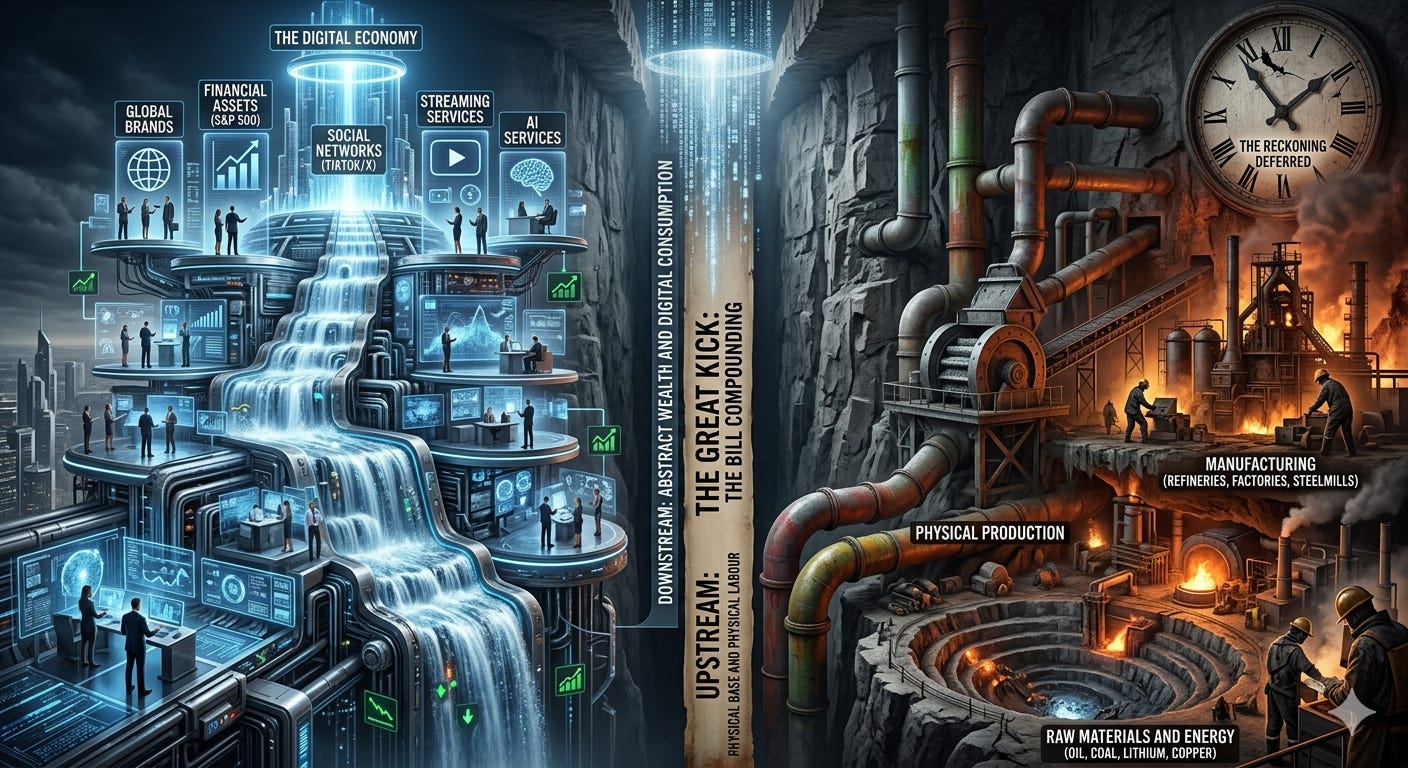
Hold that image, because it is the whole essay in miniature. Everything sophisticated in today’s world rests on something physical. This platform you are reading me on is a staggeringly complex piece of software running even more complex processes across a sprawl of dependencies - and every layer of it is backed, upstream, by energy and raw material. The data centre. The cooling. The chips. The copper. The lithium. A bank, a next-generation smartphone, a missile-defence system, a logistics network: each one is the visible tip of a long physical column running back into mines, fields, refineries, and power stations. The digital world is not separate from the physical one. It never was. It is a particularly elaborate way of organising the physical one.
And yet for the better part of half a century, the West has behaved as though the two could be divorced. As though value could be conjured at the level of the symbol - the brand, the balance sheet, the share price, the narrative - while the unglamorous business of making things was someone else’s problem, ideally someone else’s problem in another hemisphere. We have built an economy that looks productive and increasingly is not. Decades of cheap money, financialisation, and a steady abstraction away from physical production have manufactured the appearance of wealth without the substance of it.
This is not, in the first instance, a financial bubble. It is an epistemic bubble - a collective confusion about what an economy actually is, what it makes, and who it is for. We have inflated more than asset prices, we have inflated our own understanding of our own wealth. And the treacherous thing about an epistemic bubble is that it does not pop. It deflates - slowly, over decades, then all at once in a single bad quarter, and always later than the people living inside it expect.
The Treasury Market: A Short History of American Prosperity
I want to start somewhere unfashionable, because a recent online exchange sent me there. I found myself arguing with American nationalists - a category of person I would’ve never thought possible - and it clarified something. There is now a large enough minority in the United States that has been told a false story about its own country: about its history, and above all about the source of the most extraordinary run of prosperity in recorded human history.

The view that America is “a historic people with a heritage” rather than an economic project - a popular sentiment, and a historically illiterate one.
So let me say the unfashionable thing plainly. America is a de facto economic zone. That is not an insult. It is the foundation of its greatness. Unlike the classical European nation-states - built on common ethnicity, language, ancestry, religion, and ancient soil - the American republic was founded as a civic and economic project: a constitutional order designed to protect liberty, property rights, commerce, and individual advancement.
The colonies were culturally fragmented from the very start - English, Dutch, German, Scots, Irish, French, African, and more. What fused them over the following centuries was not blood and not heritage but a shared political framework and a mutual economic interest. Even the Revolution carried this signature. The colonists did not rebel as a separate people throwing off foreign occupiers; they rebelled because they believed the Crown had violated their rights - taxation without representation, the suppression of self-government, interference with colonial commerce. The United States was founded less as a traditional nation and more as a voluntary constitutional order: an economic and political zone organised around liberty, markets, property, and opportunity.
And there is nothing whatsoever wrong with that. It is, beyond reasonable argument, the most ambitious and radical socio-political experiment in recorded history. America developed the way it did precisely because it enabled unprecedented freedom in enterprise, ownership, and association - and that freedom, in time, produced a level of prosperity no society had ever known. If I were American, that is what I would take pride in. Not a fantasy ethnostate; not the grievance identity politics that the left and the right are now, with equal enthusiasm, pouring petrol onto from opposite ends of the fire.
But that is not the whole story.
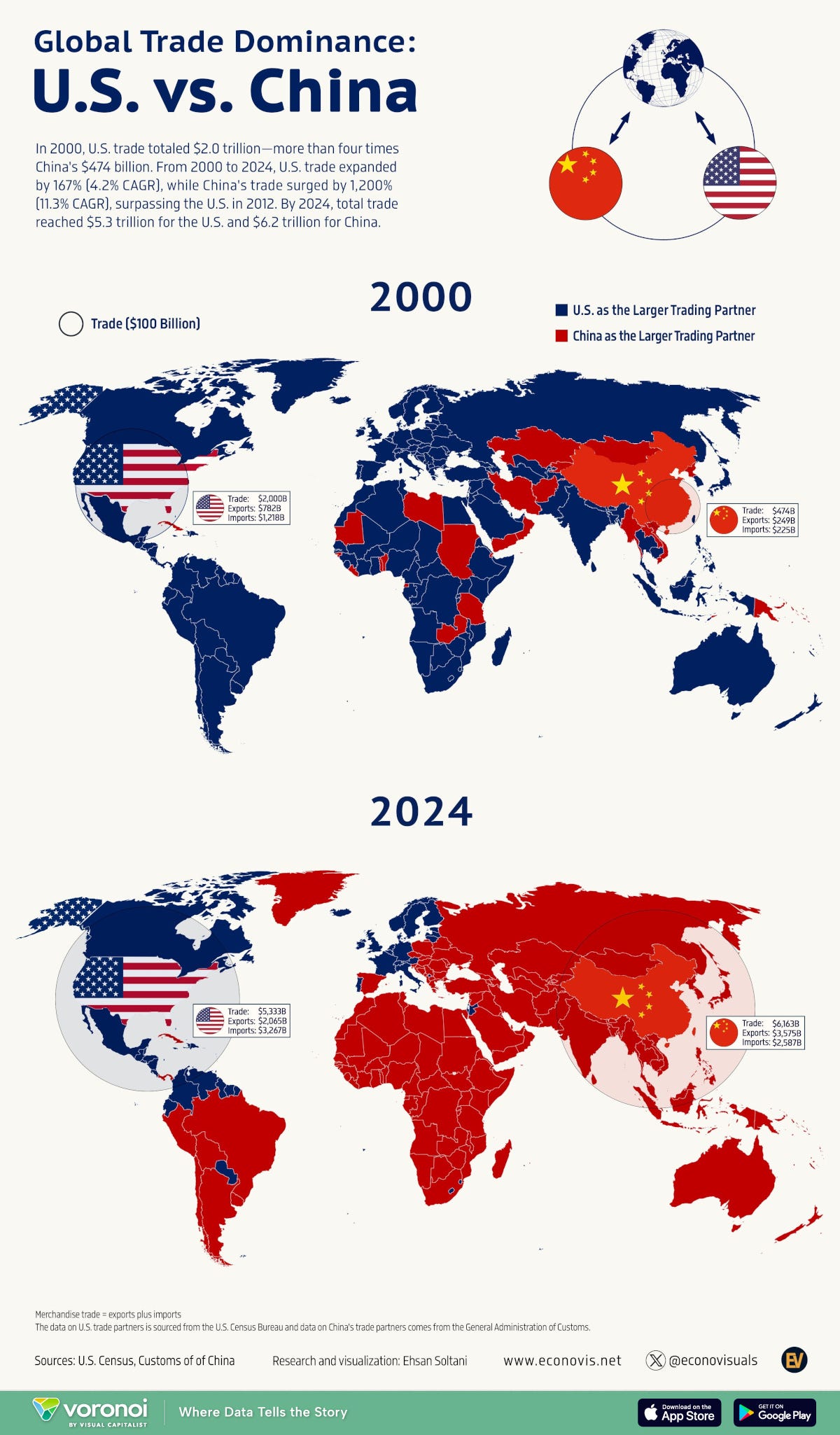
Yes, America is prosperous, and has been for a long time. But the last fifty-odd years bred a dangerous delusion that now threatens the very prosperity it grew out of. The United States was once both an industrial powerhouse and a service economy - it produced physical goods and it produced services. And then it was handed a gift that turned out to be a curse: it became the issuer of the world’s reserve currency. That single fact allowed financial elites, industrial leaders, and - above all - politicians to become catastrophically poor stewards of an inheritance, and to sell it off a slice at a time while the books still looked magnificent.
How dollar hegemony actually works
Strip away the jargon and the global Treasury system is, in plain terms, a tax levied on the rest of the world and paid to the United States. It is collected in three currencies: cheap credit, consumed goods, and eroded savings. This is the emergent property of running the world’s reserve currency - it lets the issuer live beyond its means.
Cheap credit: borrowing at the world’s expense
When an ordinary country borrows, the market demands an interest rate that reflects the risk it is taking on. High debt, weakening institutions, political instability - each of these pushes the cost of borrowing up. It is a discipline, and a healthy one.
The United States is exempt from that discipline. It enjoys a multi-trillion-dollar credit line at below-market rates, effectively subsidised by foreign central banks that have no real alternative but to participate. A comparable debtor - Italy, say, or Brazil - carrying similar fundamentals would face punishing yields or the conditions of an IMF programme. America faces neither. The tax on foreign nations forgo the higher returns they could have earned elsewhere, and accept thinner yields on US Treasuries instead. They are, in effect, paying a subscription fee for access to the system.
Consumed goods: importing wealth, exporting paper
The United States has run a trade deficit, almost without interruption, since 1971 - the year the dollar’s last formal tether to gold was cut. In recent years that deficit has run on the order of three-quarters of a trillion to a trillion dollars annually: that much more in real goods and services flowing in than flowing out. The obvious question is the one too rarely asked: where does the money come from?
It comes from issuing more dollars and more Treasuries - financial instruments, not real things. The exchange runs like this. China, Germany, Japan, Denmark and the rest ship out cars, electronics, pharmaceuticals, clothing, machine tools - real, physical wealth, the product of real labour and real energy. And America ships back Treasury bonds and dollar reserves: promises denominated in a currency the United States itself controls and can print at will.
Eroded savings: the quiet confiscation
This is the most subtle of the three, and the most insidious. When foreign governments and central banks hold US Treasuries as reserves - which is to say, as their national savings - the real value of those savings is determined by three things, none of which the holder controls: 1) US inflation, which erodes purchasing power; 2) dollar depreciation, which shrinks the value in local-currency terms; 3) and US monetary policy, which is calibrated for American interests and not for foreign holders.
Washington has reached for all three repeatedly. In the 1970s, stagflation and a collapsing dollar wiped out a large slice of foreign-held dollar assets in real terms. After 2008, quantitative easing flooded the world with dollars and diluted every holding already in existence. After COVID, inflation running at seven to nine per cent for the better part of two years silently confiscated wealth from every foreign Treasury holder on earth.
Bretton Woods, Nixon’s closing of the gold window, and the petrodollar built this machine over decades. It became the financial framework the world simply ran on - and nobody corrected it, because for a long time it suited everyone in the room. Until, quietly, it stopped suiting them.
Here is my charge, and it is a moral one. American politicians, academics, and economists had a DUTY - a genuine civic duty - to explain to their own public how their own system actually worked: that a meaningful share of American prosperity was a structural design, and not solely the fruit of American virtue and hard work. Had the public understood that, it could have made an informed choice - to defend the arrangement clear-eyed, or to reform it deliberately. Instead it was flattered with a myth. And a public fed a myth about the source of its wealth cannot possibly steward that wealth well. It is, right now, watching the structural advantage erode and reaching for explanations - immigrants, foreigners, the other party - that have nothing to do with the actual mechanism.
Quantitative Easing: The Original Sin
If dollar hegemony is the inherited condition, quantitative easing is the self-inflicted wound - and the moment the epistemic bubble truly began to inflate.
After 2008, central banks printed money on an extraordinary scale to prevent the financial system from seizing entirely. In the narrowest sense, it worked: the system did not collapse. But look closely at the mechanism, because the mechanism is the whole story. The way QE “works” is by inflating asset prices. That is not a bug of the software, but its’ core feature. And the moment you say that out loud, the next question answers itself. Who owns assets? The top decile. Who does not? Everyone else.
And now we are caught in the trap that was always implicit in the design: we cannot un-print it without collapsing the very asset prices the so-called recovery was built upon. COVID-era QE then doubled the bet. The result is a genuine policy prison - rates must stay low enough to service a mountain of debt, but rates that low keep re-inflating the bubble. There is no graceful exit from a room you sealed yourself into. There is only the choice of which wall to walk through.
The Stock-Market Illusion
One of the hills I will die on is that the S&P 500 is not the American economy. It is the profit-extracting capacity of roughly five hundred large corporations. Those are not the same object, and confusing them is one of the load-bearing errors of the entire epistemic bubble.
Consider what GDP and the index actually record. When Amazon automates a warehouse, the efficiency gain shows up as growth and as a higher share price. The workers it displaces show up nowhere in the positive column - and arguably nowhere at all, until they surface later as a social cost the same spreadsheet was never built to see. The scoreboard is designed to register one side of the ledger. We then read the scoreboard and announce that the economy is healthy.
Then there are share buybacks - perhaps the cleanest single illustration of financialisation I can think of. Through the QE era, companies took on historically cheap debt and used it not to build new capacity, not to raise wages, not to invest in the physical base of the business, but to buy back their own shares. That mechanically lifts the share price and, not coincidentally, the value of executive compensation packages tied to it. It is entirely legal. It is worth knowing that it was effectively not legal before 1982: open-market buybacks at this scale exposed a company to market-manipulation liability until the SEC, under a deregulatory Reagan-era Commission, adopted Rule 10b-18 and created a “safe harbour” for the practice.
The market printing all-time highs while median real wages stagnate is not a paradox - it is the system functioning exactly as it was designed to function.
Artificial Intelligence: The New Trillion-Dollar Illusion
One of the costs of being an attractive economic zone is that you inevitably attract bad actors as well as good ones. So enter the new era of South-African-born billionaires who appear to regard the United States and its citizenry as little more than a very large, very liquid ATM.
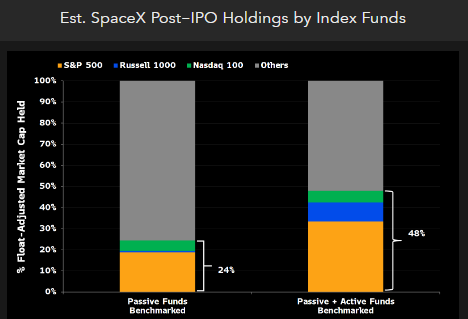
Bloomberg’s Eric Balchunas lays out the mechanics: passive S&P 500 funds could be obliged to buy roughly a fifth of public SpaceX shares within six months of an index inclusion.
Elon Musk’s ambition to become the world’s first trillionaire does not rest on a great mass of people freely choosing to buy what he is selling. It rests on structural buying. Once a company is admitted to a major index, every passive fund benchmarked to that index is obliged to buy it - mechanically, on a schedule, regardless of whether the price makes any sense. As Bloomberg’s Eric Balchunas sets out, S&P 500 funds alone could be compelled to absorb something like a fifth of public SpaceX shares within six months of inclusion, with the Russell 1000 and Nasdaq 100 hoovering up more on top.
Then set the SpaceX S-1 figures beside the proposed valuation and the gap stops being amusing. For 2025 the company reported revenue of roughly $18.7 billion and a GAAP net loss of roughly $4.9 billion - the loss driven overwhelmingly by the AI segment folded in through the xAI merger, which on its own bled several billion dollars while Starlink quietly carried the whole edifice. And the IPO is being floated at a target valuation in the region of $2 trillion. Trillion. With a T!
Is AI a bubble? Yes - and that is the less interesting half of the answer
The case that AI is a bubble is strong, and it rhymes - almost note for note - with manias we have already lived through. The dot-com frenzy of 1999 and the SPAC craze of 2021 followed the identical script: an enormous flow of capital into a technology narrative, racing far ahead of any proof of the underlying economics. The tell is always the same. Valuation detaches from cash flow and re-attaches to story.
And the valuations genuinely are difficult to defend with a straight face. Take Nvidia. As I write, a single company that designs chips (designs, the physical production spans across Asia and Europe) is worth more than the entire annual economic output of Germany - more than the full GDP of a nation of 83 million people who actually manufacture cars, chemicals, machine tools, and pharmaceuticals. You do not have to be a quant to be able to spot something is off. You only have to remember that one of those two things is a physical economy and the other is a market capitalisation.
Now the other side - and I hold it sincerely, because the dot-com comparison cuts both ways. The internet was real. The 1999 valuations were not. And yet the people who said “this is a bubble” and the people who said “this changes everything” were both right, because those are two different claims. The bubble can burst and the technology can still go on to remake the world. “Transformative technology” and “sensible investment at today’s price” are simply two different sentences. You can rationally believe the first and reject the second.
And here is the caveat I will not allow the bubble talk to swallow by reflexive cynicism. AI is a genuinely powerful tool when serious people point it at serious problems. There are researchers using it right now to accelerate drug discovery, to harden defence systems, to push materials science forward, to design medical treatments tailored to a single patient’s biology. One man used AI-assisted DNA sequencing to develop a personalised cancer vaccine - for his dog! That is precisely what a real tool is supposed to do in the hands of someone with a real problem. The people moving medicine, science, engineering, and security forward with these systems are the real article, and they will still be doing serious work long after the valuations have corrected.
The bubble is real regardless of whether the technology is. Both things are true at once. AI will produce extraordinary results in the hands of serious people solving serious problems - and the market priced around it is inflated, narrative-driven, and will correct, painfully, the way these things always do. Holding both thoughts at the same time is not contradictory.
When the Music Stops
So zoom all the way out. Stand back from the money printer and the scoreboard and the emptied factory and the chip company worth more than Germany, and ask the question this whole essay has been walking towards. What does an economy built on this foundation actually look like when the music stops?
For decades the people in charge - the political class, the business elite, the leadership of entire industries - have been kicking the can down the road. Every one of them, within their own tenure, faced the same choice: a painful adjustment now, or a comfortable deferral that quietly becomes someone else’s problem later. Every one of them, almost without exception, chose deferral. And the deferral was never free. It compounded. Each kick made the next adjustment larger, and each larger adjustment made the next kick more tempting still, so the problem did not sit patiently still while it waited — it grew. Decades of “not on my watch” do not add up to stability. They add up to a bill, and the bill has a due date.
For two generations the West ran a quiet cultural campaign. Through schools, through parents, through every status signal a society knows how to send, we told young people that the good life was a service job: an office, a desk, a screen. We told them, never quite in these words but unmistakably, that the physical economy - production, manufacturing, the skilled trades, the people who actually make and fix and build - was poor people’s job. We, the West, did not merely offshore the upstream. We taught our own children to look down on it. We hollowed out the prestige of the productive economy - and were then genuinely surprised when the productive economy itself hollowed out. It is difficult to staff what you have spent forty years teaching people to despise.
The result is that we now have at least two full generations - Gen Z and the younger Millennials - who own essentially nothing of the system they are being asked to defend. The assets inflated out of their reach years ago. Housing has become a claim held by the generations proceeding them. Equity ownership is concentrated at the very top, where it has been parked since 2008. They were sold a service economy and arrived to discover the service economy could not pay for a house. They hold no stake. None. Hence, why so many of them flock into crypto markets, TikTok influencing or even worse activities - like OnlyFans.
The lesson of every society that has ever tried this is brutally simple. When young people have no stake in the system, they do not patiently reform it. They will burn it down to feel its warmth.
This is where the Treasury system, QE, the buybacks, the index mechanics, and the trillion-dollar listings stop being separate stories and resolve into one. They are all the same move, performed at different altitudes: inflate the symbol, defer the reckoning, let the next person inherit the gap between what the economy looks like and what it is. The bill for that gap is not denominated in dollars. It is denominated in legitimacy — and that is the one currency a central bank cannot print.
BALKAN CANDOR
I grew up in a part of the world that has a long, unsentimental memory of systems that looked solid right up until the morning they were not. The Balkans do not romanticise stability, because we have watched it evaporate too many times to mistake it for a law of nature. So permit me a piece of regional candour.
The West did not get poorer. The West got confused - it mistook the measurement of wealth for the wealth itself, the share price for the factory, the brand for the supply chain, the index for the economy. It became a civilisation of brand managers sitting on top of a physical base it had quietly handed to someone else, and then it priced its own cleverness as though the base would always be there to be commanded.
Money is a measuring instrument - and we have spent fifty years sanding the markings off the ruler and then congratulating ourselves on how much longer everything has become.
So here is my question for you: if the wealth around you were measured in energy and raw material and finished goods instead of in dollars and market capitalisations - how rich would your country actually turn out to be?
Deep and thoughtful reminder of at least a half century of market failures.
It is the same intellectual query of the classical economists of the enlightenment.
Stripped of detail, it is our failure to set the value of money and failure of markets to value purchases. Markets correct. As you point out, they always do. And as you also note governments and their bankers/multi-nationals are forcing these failures for profit instead of protecting markets creates the pressure for correction.
Leaders are squeeze their last profits and looking for off-shore safe havens. Completely abandoned their obligations to regulate fair and honest markets.
Adam Smith's "invisible hand" works. It is the basis of China's domestic renaissance. If the Western Trading Bloc and GATT returned to the concept of protecting markets instead of rigging them...........
Thank You for an important survey of today's world and how we got here.
This is brilliant and offers a proper dose of reality.