


For the last two decades, the geopolitical commentariat has been obsessed with “The Thucydides Trap”- the inevitable clash between a ruling hegemon (the U.S.) and a rising challenger (China).
But the data suggests we are analyzing the wrong problem. We aren’t living in an era of rising powers anymore, instead we are entering the age of stagnation and decline of where the defining feature of the Great Powers is not their dynamism, but their inevitable entropy.
We did ourselves a massive disservice by not remembering history in its entirety and instead picked the 25 best years humanity has ever experienced and decided that’s the default setting.
The Industrial Revolution broke humanity out of the Malthusian trap, creating a brief, 200-year anomaly of explosive growth. That window is now closing as productivity flatlines and demographics collapse across both the developed and the developing world, the Great Powers are realizing that organic growth is no longer possible. When a state can no longer grow by creating wealth, it must grow by taking it.
What we are essentially witnessing is not a fight between Great Powers, but a knife fight between geriatrics in a lifeboat. And that makes the world infinitely more dangerous.
The End of the Economic Miracle
To understand the desperation of Beijing, Moscow, and Washington, you have to look at the ledger. The era of easy growth is over.
For nearly all of human history (year 1 to 1820), global income per person rose by barely 0.017% annually. Poverty was the norm. The Industrial Revolution shattered that ceiling, allowing populations and wealth to explode simultaneously. But the tailwinds that drove that era - coal, steam, oil, and a surplus of young workers - are turning into headwinds.
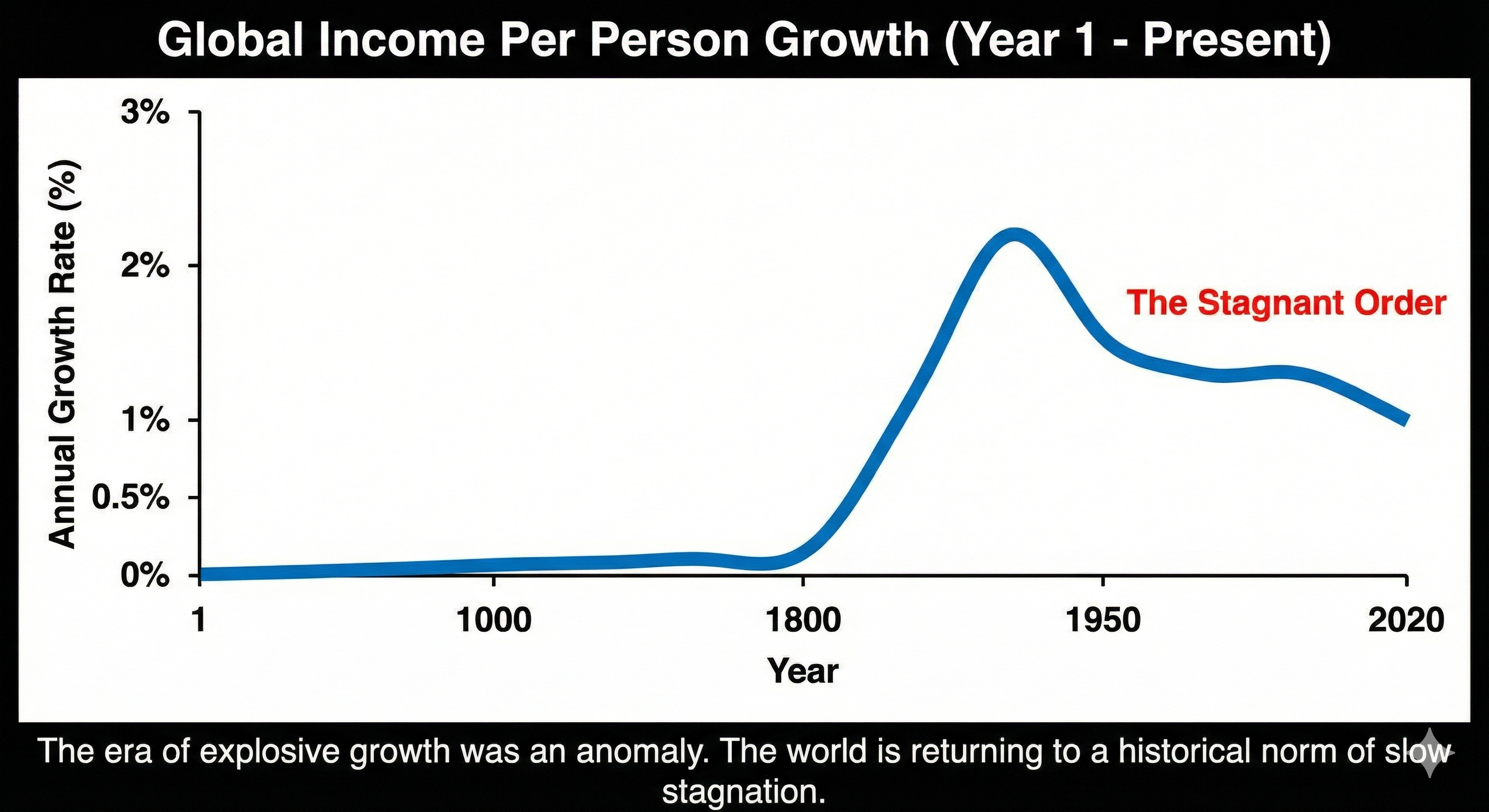
The modern tech sector loves to promise that AI will save us, adding trillions to the global GDP. But the reality on the ground is grim. Productivity growth in advanced economies has fallen close to zero. We have traded the steam engine for the algorithm, but an algorithm cannot physically care for an aging population. Hospitals need nurses more than they need AI-powered, blockchain-first solutions. Digital efficiency does not solve physical bottlenecks.
The result? A world drowning in debt. In the U.S., debt edged down slightly post-2015, but in China, it has topped 300% of GDP. We are leveraging the future to pay for a present that isn’t growing.
The Demographic Winter
The economic stagnation is compounded by a biological reality: the world is not reproducing at the rate we have gotten accustomed to especially in the last 50+ years.
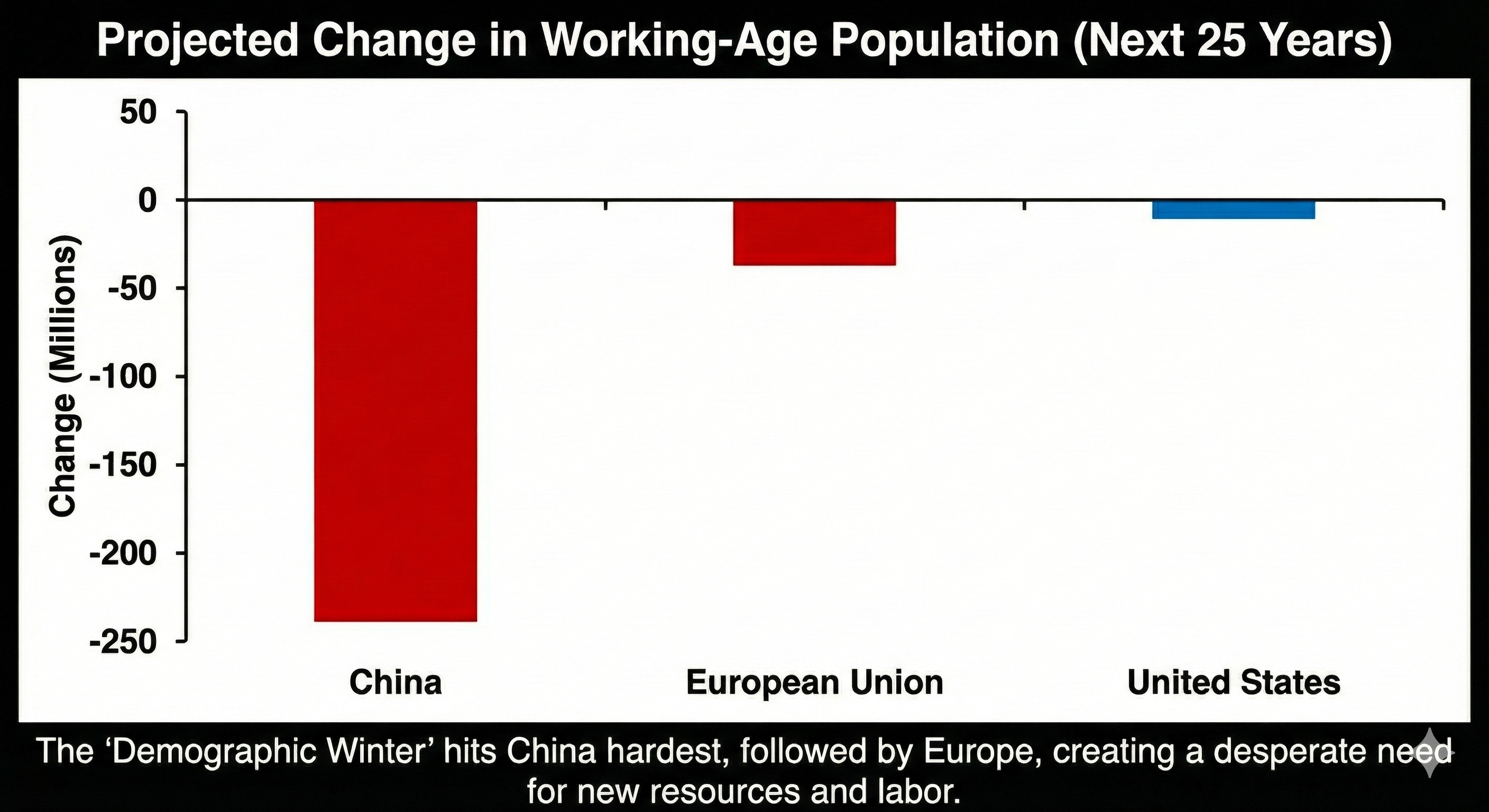
We are witnessing a demographic crash - in the next 25 years, China will lose roughly 240 million working-age adults - a decline of 24.5 percent. To put that in perspective, that is more than the entire labor force of the European Union vanishing.
Russia is already on its death bed. Europe is shedding workers by the millions. Even the United States, usually buoyed by immigration, faces a drag on growth as boomers retire.
The only outlier is India, which many hope will be the “next China.” But India suffers from a crippling lack of human capital. As of 2020, nearly a quarter of its working-age adults had never attended school. It has the bodies, but it lacks the skilled industrial base to replace China as the world’s factory (for the time being).
Expansion as a Survival Strategy
This brings us to the terrifying conclusion. If you are a leader in Beijing, Moscow, or Washington, and you look at these trend lines, you see a closing window.
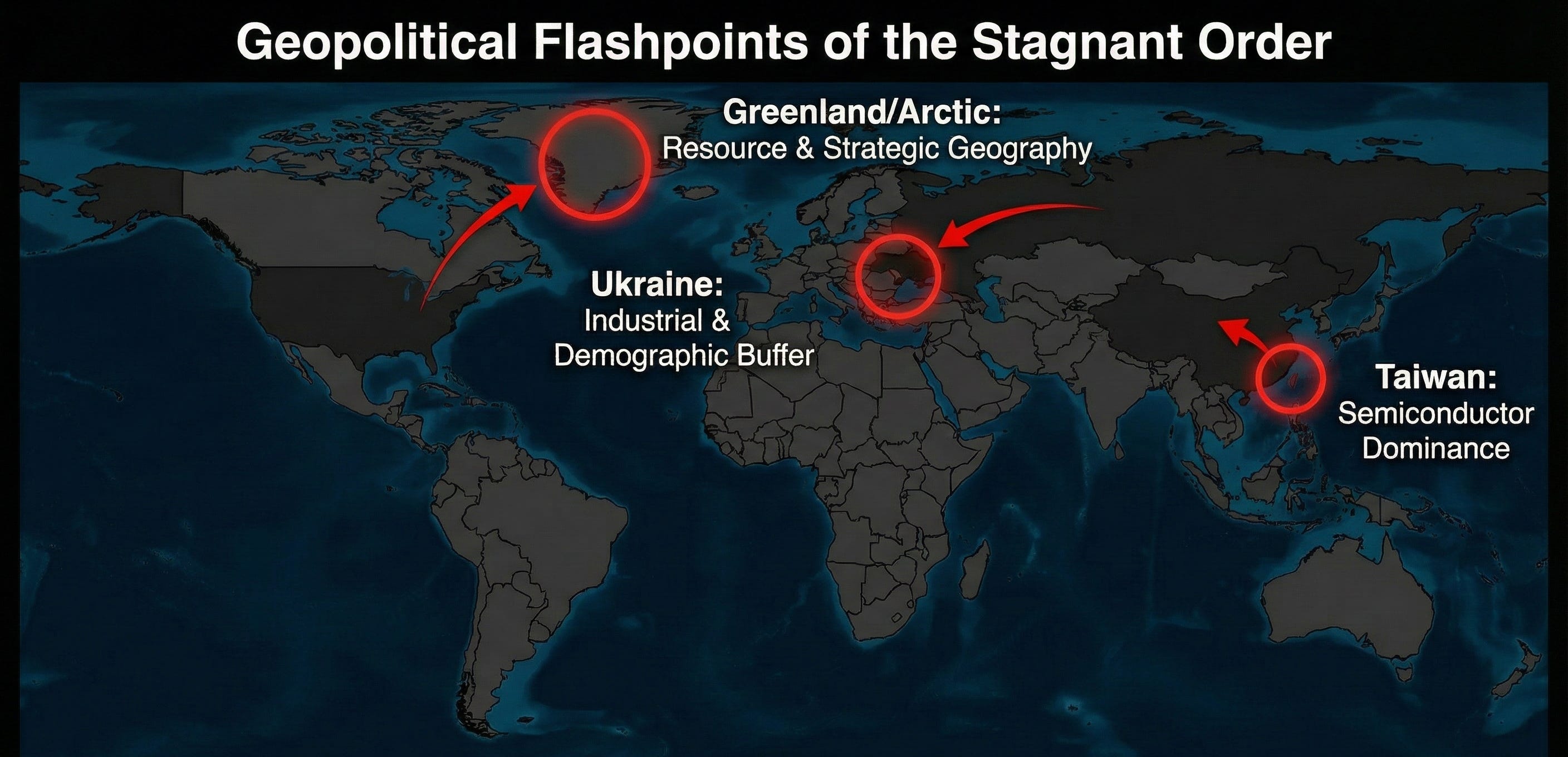
In a growing world, commerce is a positive-sum game. In a stagnant world, geopolitics becomes zero-sum. If you cannot grow your economy through innovation and demographics, the only way to increase your national power - or secure the resources needed to maintain your standard of living - is territorial expansion.
This is the strategic logic behind the current flashpoints.
1. Russia and Ukraine: While Putin’s invasion of Ukraine is highly ideologically driven, it didn’t happen solely out of Soviet nostalgia. He invaded because Russia is a “dying nation” in the Lord Salisbury sense. With a shrinking population and an economy entirely dependent on resource extraction, capturing Ukraine - the crown jewel and intellectual powerhouse of its last decaying empire- was a bid to secure a massive industrial and agricultural base and a demographic buffer. Essentially, a looting expedition disguised as a crusade. As Dugin said - there’s no Russia without Ukraine.
2. China and Taiwan: China’s “rise” is over. Its GDP relative to the U.S. has actually fallen from 70% to 64% between 2020 and 2024. Xi Jinping knows that China will get old before it gets rich. The obsession with Taiwan is not just about nationalism (albeit, that is a huge part of it - similar to Russia); it is about seizing the crown jewel of the semiconductor industry - the one asset that could theoretically jumpstart their stalling productivity - before the demographic collapse renders the PLA incapable of fighting.
3. The United States and the Periphery: Even the United States is not immune to this logic. While currently positioned better than its rivals (thanks to energy independence and the dollar), the U.S. is increasingly protectionist. The occasional floating of ideas like “buying Greenland” or the aggressive posturing in the Arctic isn’t madness; it’s a rational recognition that in a resource-constrained future, strategic geography matters more than “free trade.” The U.S. is pivoting from being the global guarantor of trade to the aggressive guardian of its own hemisphere.
The Last Gamble

History shows that “dying” empires are often more aggressive than rising ones. Germany in 1914 and Japan in 1941 both feared their windows of opportunity were closing. They chose war not because they were confident of easy victory, but because they feared the certainty of future decline.
We are seeing the same dynamic today. Conquest is arguably harder than ever - nuclear weapons, precision drones, and energized insurgencies make holding territory a nightmare (just ask Russia). But for nations facing the slow strangulation of debt and depopulation, the high-risk gamble of expansion looks preferable to the certainty of fading into irrelevance.
The 21st century won’t be defined by the peaceful transition of power. It will be defined by the violent thrashing of empires refusing to go gently into that good night.
One small correction: Birth rates actually fell with industrialization. It’s the reduction in death rate and increase in lifespan that drove the population increase. Underlying all of this is of course the discovery of fossil energy sources. If we were an intelligent species we’d be working furiously on renewable sources that can deliver high net energy (overhead for economic growth) as the fossil party is almost over.
This is a strong corrective to the “rising power” obsession. What feels especially important here is that stagnation doesn’t just reduce growth, it compresses decision space.
When systems stop expanding, leadership choices get made under tighter constraints, shorter time horizons, and weaker feedback. That combination tends to favor irreversible moves over patient optimization.
In that sense, expansion isn’t only about seizing assets, it’s also about locking in control before capacity erodes further.
The danger isn’t just that declining powers lash out, but that constraint itself reshapes what looks “rational” at the top.
That’s what makes this era structurally unstable, not merely competitive.