


Waronomics is free to read, but entirely reader-supported - if you find this work valuable, you can support it by becoming a paid subscriber or buy me a coffee.
The funeral procession for MAGA may have officially begun, but I wouldn’t order the flowers just yet.
Yes, the American electorate delivered its verdict on November 3, handing Democrats control of both chambers of Congress and repudiating the Trump administration in Republican strongholds that would have seemed politically untouchable only two years ago. But before anyone mistakes the results for a sudden restoration of the American electorate’s political principles, we should the details because that’s where the Devil hides.
Americans vote with their wallets.
According to Reuters’ election-night reporting, nearly 9 in 10 voters considered the cost of living a crucial or major factor in their decision. Approximately 2/3 blamed Trump for high prices, while 7 in 10 wanted Congress to impose greater checks on presidential power.
The unpopular war with Iran, corruption concerns, tariffs, and the administration’s conduct also contributed to the result, so this was not exclusively an economic referendum.
Yet the economy was central to the political swing. The administration promised to restore affordability (on day one, as far as I remember from the campaign promises). Instead, voters continued to face considerable pressure on their purchasing power, exacerbated by renewed energy inflation and geopolitical disruption. Had ordinary Americans felt materially better off, how much of the administration’s other conduct would they have tolerated? We cannot know for certain, but we can speculate that a lot would’ve been forgiven had the median American household didn’t experience the economic hardship it is seeing now. Truth is, economic prosperity has historically afforded political leaders considerably more room for error. One of the reasons Trump was re-elected is because after the COVID layoffs and inflation, people associated his tenure - however chaotic and flawed - with better affordability. In 2024, they were remembering the prices of 2016 and wanted to revert back to that status quo.
The Democrats have now received an extraordinary political opportunity, but they should not confuse it with an unconditional endorsement of their ideological programme.
The more important question is what this new balance of power actually changes, because while the election has altered the political landscape in Washington, it has done remarkably little to change the structural problems facing the United States.
And those are becoming increasingly dangerous.
I. The Benefits: Restoring institutional accountability
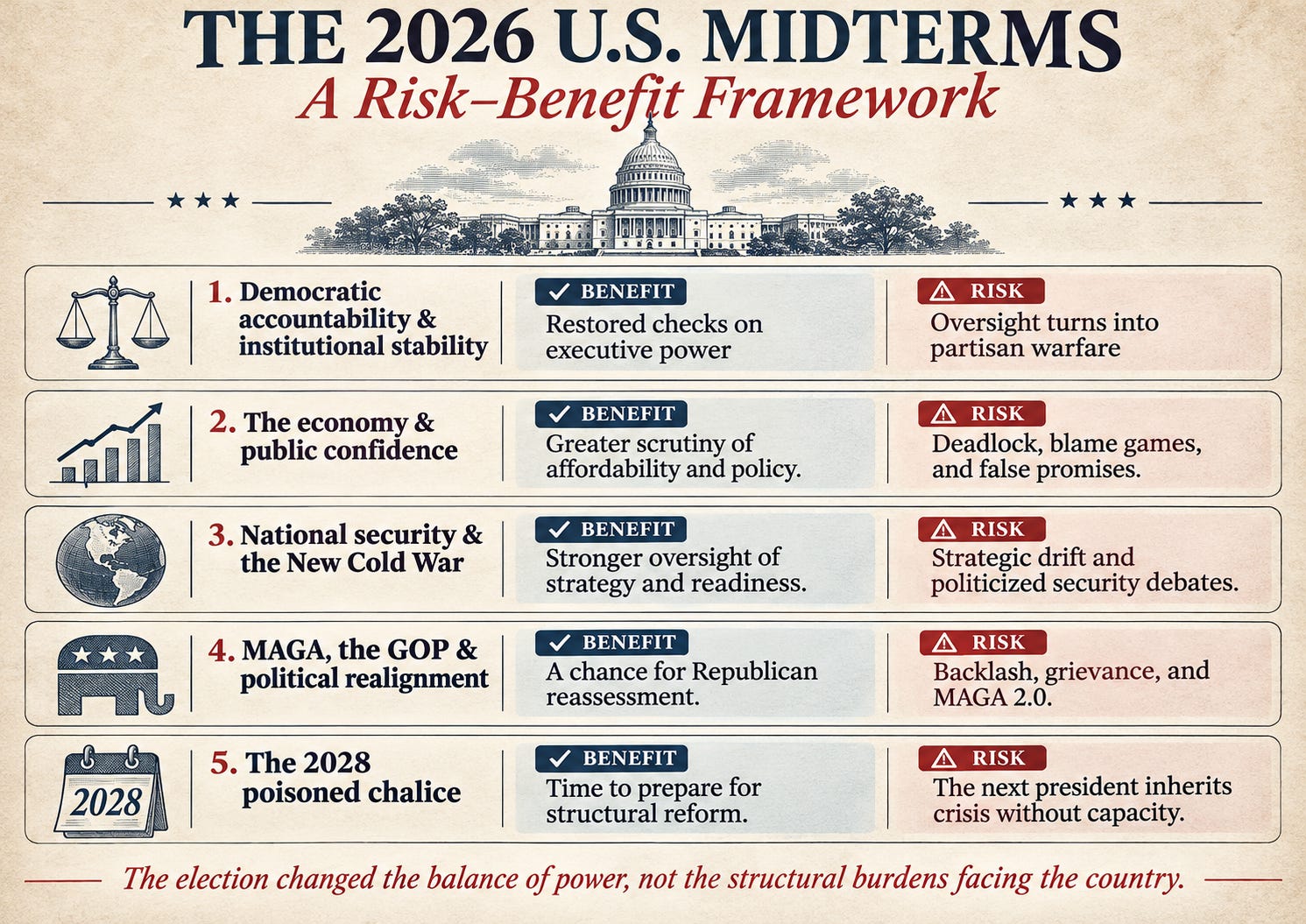
The most immediate benefit of the midterms is the restoration of meaningful congressional checks on the executive branch.
From January 2027, a Democratic-controlled Congress will possess the institutional means to scrutinise the administration’s decisions, investigate misconduct, challenge executive overreach, and exercise greater control over appropriations and appointments.
This is not merely a question of domestic political accountability, but has international security implications too.
At a time when the United States is engaged in an increasingly dangerous geopolitical confrontation, the quality of American national-security leadership has consequences far beyond its borders. The Pentagon, intelligence community, State Department, and broader defence establishment cannot afford to become arenas for personal loyalty tests and ideological experimentation like they’ve been in the past.
Congressional oversight offers an opportunity to examine military readiness, the consequences of the Iran war, procurement decisions, defence-industrial weaknesses, and the qualifications and conduct of senior officials.
There is, however, a crucial distinction between accountability and political vengeance.
Investigations should be evidence-based, legally defensible, and proportionate to the seriousness of potential misconduct. Their legitimacy depends on applying consistent standards, including when those standards prove inconvenient to the investigators themselves. Indiscriminate political retaliation would risk transforming genuine accountability into another chapter of America’s endless partisan warfare.
The objective must be to restore the credibility and functionality of institutions, not simply replace one political faction’s loyalists with another’s.
There is also a potential benefit for the Republican Party, which we can all agree has severely damaged its credibility by engaging in de facto dereliction of duty by confirming people like Pete Hegseth and Tulsi Gabbard.
An electoral defeat of this magnitude creates an opportunity for internal reassessment. Republicans must now contend with the political consequences of Trump’s leadership and the degree to which their party’s institutional identity has become inseparable from him.
But electoral defeat does not necessarily produce ideological reform. It can just as easily produce resentment, radicalisation, or a search for a more politically disciplined successor.
Which brings us to the risks.
II. The Risks: Political paralysis and the economics of blame
Divided government is not inherently dysfunctional. In fact, the American constitutional system was deliberately designed to prevent the concentration of power. But checks and balances work only when political actors remain capable of exercising their powers responsibly.
Democrats will control Congress. Trump will remain president until January 2029, retaining his veto, substantial executive authority, and important instruments of foreign and trade policy. Congressional majorities cannot simply govern in his place.
The next 2 years could therefore produce either a constructive institutional restraint - or destructive political paralysis, and the state of the economy makes that distinction especially consequential.
There is a legitimate concern that Democrats, having regained control of Congress, may become associated with the country’s deteriorating economic sentiment. Historically, American voters have tended to hold presidents more directly responsible for economic outcomes than Congress, but that does not give legislators immunity from political accountability.
Budgetary confrontation, government shutdowns, legislative obstruction, and the absence of credible economic proposals could all diminish public confidence in the new congressional majority.
Meanwhile, Trump retains an obvious political counterargument: if Washington ceases functioning, he can blame the Democrats controlling Congress. The danger is that both parties spend the next 2 years competing to assign responsibility for the economy rather than confronting the structural conditions contributing to deteriorating household purchasing power.
And there is another trap for the Democrats, especially their DSA leaders: mistaking the election for a mandate to resume the culture wars.
Voters concerned about housing, groceries, energy, healthcare, and employment are not necessarily expressing wholesale agreement with the Democratic Party’s internal ideological factions. When you need to tap into your 401k to cover your monthly bills, culture wars are at the bottom of your priority list and reviving any of that would backfire very quickly.
For the Republicans, the corresponding danger is equally apparent: responding to an economic backlash with more ideological confrontation instead of examining the material consequences of their policies.
Neither party can manufacture prosperity through political messaging, and neither can indefinitely substitute cultural antagonism for economic competence.
The next presidential election will take place against an economic background that may be far more difficult than either party is prepared to acknowledge.
III. The economy: GDP Is not a measure of national resilience
There is an uncomfortable contradiction at the heart of the current American economy. People quote me GDP data and the construction of data centres as gospel, but as I have repeatedly argued that GDP is the BMI of economics, GDP measures economic value creation. It does not, by itself, measure household financial security, industrial capacity, supply-chain resilience, or a country’s ability to sustain a prolonged geopolitical confrontation.
A nation can generate extraordinary value from financial services, software, intellectual property, and technological innovation while simultaneously depending on foreign suppliers for critical minerals, industrial machinery, electronic components, and defence production.
The GDP figures can look impressive right up until a geopolitical crisis exposes the dependencies hidden beneath them.
And there is an additional problem.
Politicians routinely promise to fix inflation, often without explaining what that means. Inflation can be reduced through monetary policy, supply-side improvements, and changes in aggregate demand, but lowering the rate of inflation does not reverse the cumulative increase in prices.
For households, the meaningful question is not simply whether inflation declines from 4% to 2%, it is whether their real disposable income and purchasing power improve.
Restoring affordability in the midst of a new Cold War, where global maritime trade is under threat of drones, energy flows are disrupted, and the vulnerability of internationally integrated supply chains are exposed for adversaries to exploit is not something that can be solved by political rhetoric, or even within a single presidential term.
Which raises the most consequential question of this entire election cycle.
IV. The poisoned chalice of 2028
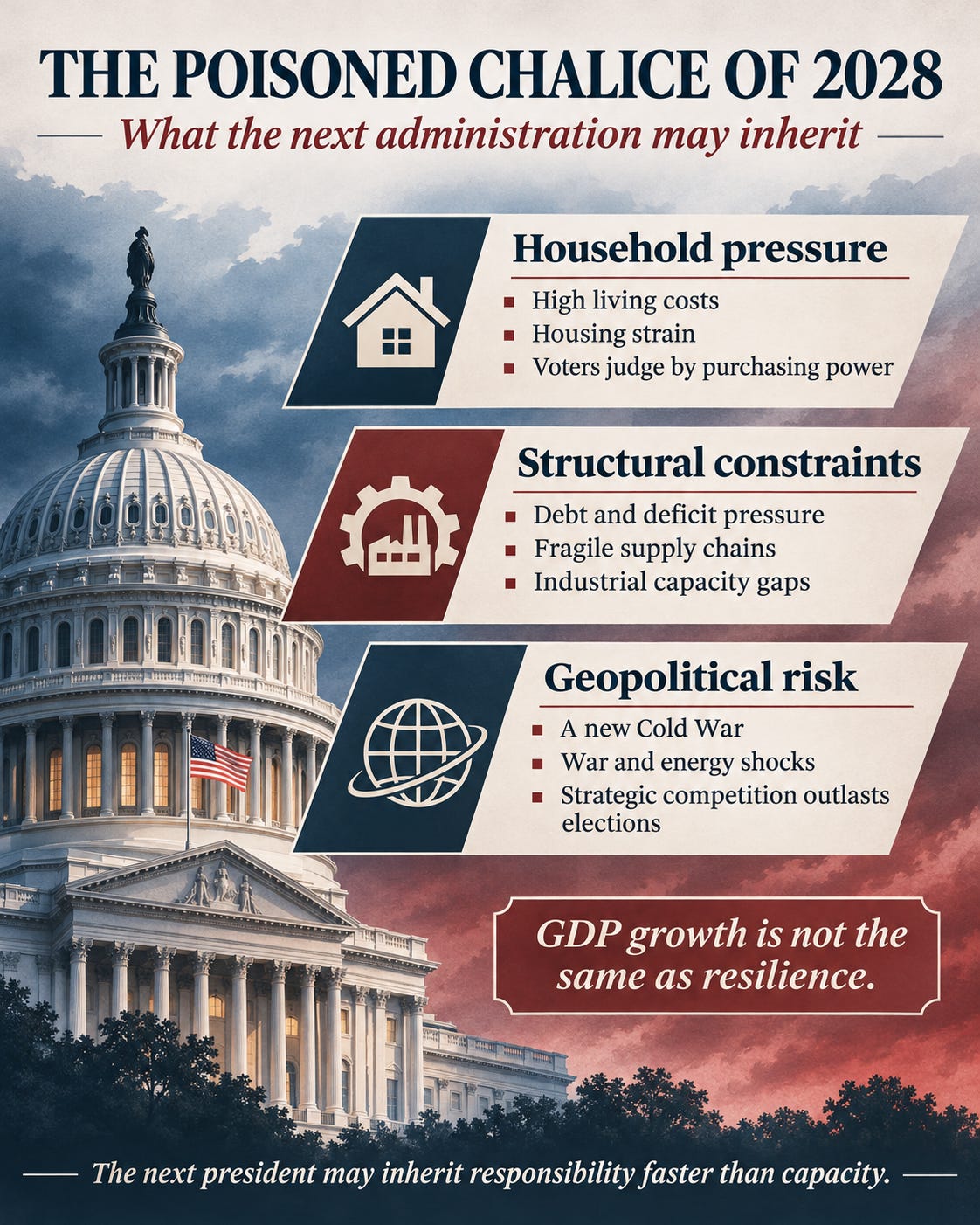
What if winning the presidency in 2028 turns out to be a poisoned chalice? Consider what the next administration may inherit.
The Congressional Budget Office’s February 2026 baseline projected a federal deficit of approximately $1.9 trillion for fiscal year 2026 and public debt equivalent to 101% of GDP. Under its baseline assumptions, debt rises to 120% of GDP by 2036.
These pressures are compounded by demographic aging, rising debt-service costs, and the increasing fiscal demands associated with healthcare and retirement programmes.
Meanwhile, the United States faces an industrial challenge decades in the making.
A 2025 Government Accountability Office report identified risks associated with the Pentagon’s dependence on foreign suppliers across a defence supply network exceeding 200,000 companies. In many cases, the government lacks sufficient visibility into the deeper tiers of that network.
It is crucial to understand that one of the most powerful levers of U.S. prosperity and global power projection has been their military industrial complex, and there is a huge difference between designing an advanced weapon and manufacturing it at scale are very different capabilities. You cannot replace missing shipyards, machine tools, specialised workers, chemical processing facilities, or critical-mineral refining capacity with an executive order.
Nor can you solve those problems simply by appropriating another 100 billion dollars. Industrial capacity requires physical infrastructure, sustained capital investment, skilled labour, secure inputs, and TIME.
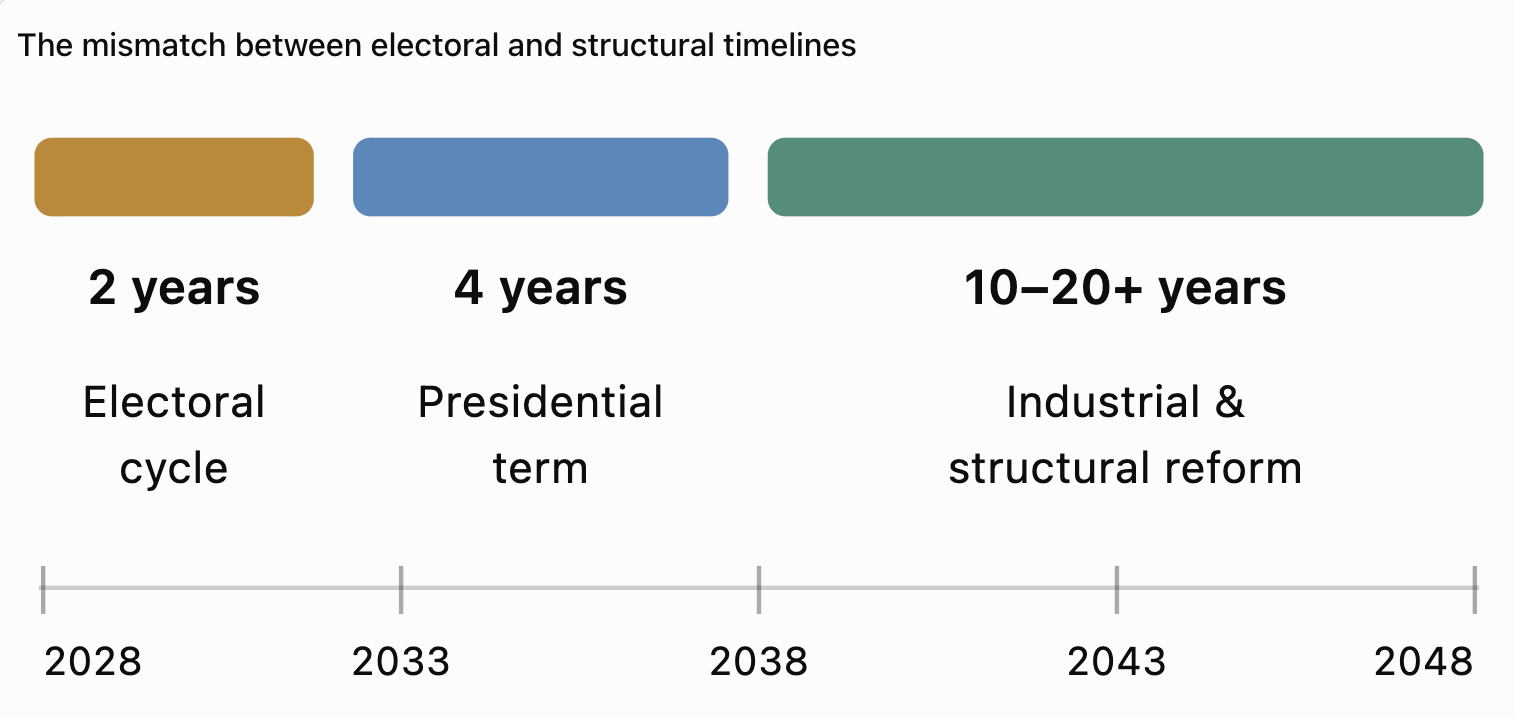
And time is precisely what modern electoral politics discourages governments from considering.
The ongoing war in the Middle East has already demonstrated how quickly geopolitical disruption can translate into rising energy costs and economic pressure far beyond the immediate battlefield.
The IMF’s October 2026 World Economic Outlook identifies escalating conflicts, renewed trade tensions, fiscal vulnerabilities, and uncertainty surrounding AI investment among the major risks facing the global economy. A future American president will therefore inherit responsibilities that extend far beyond domestic economic management.
And herein lies the paradox.
The more serious the structural problems become, the more politically costly their solutions are likely to be.
Rebuilding industrial capacity may require years of investment before meaningful results appear.
Fiscal consolidation may impose immediate economic and political costs.
Reducing strategic dependencies can increase prices in the short term.
Strengthening deterrence demands resources that compete with other national priorities.
Meanwhile, voters will continue expecting lower prices, higher wages, improved services, and immediate improvements in their standard of living.
Every administration operates on a 4-year presidential cycle, with congressional elections halfway through. Yet many of the reforms necessary to restore American economic resilience require 10, 15, or 20+ years.
The costs that arrive during one administration will see the benefits arrive until several administrations later. Who explains that to the electorate?
A politically responsible government could therefore be required to undertake measures that undermine its own immediate popularity, and that creates a deeply uncomfortable incentive problem for any future administration.
Why accept the political costs of necessary reforms when your successor may receive the economic benefits?
Why invest in industrial capacity that will not become operational, let alone reap benefits, until after several elections in the future?
This does not mean serious leaders will necessarily avoid seeking office in 2028 - history offers numerous examples of capable people assuming responsibility during national crises. But it does mean that the political system may increasingly struggle to reward the kind of leadership its strategic circumstances demand.
V. The Strategic Verdict
The 2026 midterms offer genuine opportunities for institutional accountability, renewed congressional oversight, and a reassessment of American political leadership.
The greatest danger, however, is interpreting the election as a solution to problems it has merely exposed.
MAGA may have suffered an extraordinary political defeat, but does not mean the economic grievances, institutional distrust, cultural resentment, and dissatisfaction with the political establishment that sustained the movement have disappeared.
Nor does a Democratic victory mean the underlying structural problems of the American economy are suddenly more manageable. The next two years will test whether the newly divided government can exercise institutional restraint while preserving the capacity to make consequential decisions.
After that comes the far greater challenge: the 2028 presidency.
The United States may enter its next political cycle facing growing fiscal constraints, uncertain global economic conditions, increasingly contested supply chains, and an international security environment that leaves little room for strategic complacency.
None of these problems will disappear because one political party has defeated another.
Elections can replace a government, but they cannot replace the industrial capacity, institutional credibility, or strategic advantages a country has spent decades eroding.
The funeral procession for MAGA may have begun, but unless American political leadership confronts the structural failures that made its rise possible, 2026 may prove less a political funeral than an intermission.
And whoever inherits the presidency in January 2029 may discover that winning the election was considerably easier than governing the country.
While this remains a canny political analysis, I feel it underplays the key factor that millions more Americans have rediscovered the true SALUTARY value of VOTING.
And this surely points to a re-establishment of the innate decency which the world had long learned to experience from this (once) great democracy.
While what you’re saying is right, this misalignment of incentives isn’t a new problem. How come the same political system did enable strong leaders to tackle them in the past? Was it because the world hadn’t yet entered the Information Age and 4 years was enough time for meaningful reform if you aren’t being challenged on TikTok daily? Or is it that the problem isn’t the political system but the fact we’ve used accelerating technology to torpedo healthy debate and reason and substitute with dopamine hits for the masses? If the strong thinkers are really strong, they need to think of how to solve this problem of rewarding short-termism before tackling reforms you mention we need.