


Waronomics is free to read, but entirely reader-supported - if you find this work valuable, you can support it by becoming a paid subscriber or buy me a coffee.
The next major economic crisis will be defined by shortages of physical things: energy, food, fertilisers, metals, semiconductors, medicines, ammunition and industrial components.
Domain-dependent analysis looks at the various systems in isolation: shipping disruption is a logistics problem; oil and gas is an energy problem; fertiliser is agricultural; inflation belongs in the domain of central banks, sovereign debt belongs to finance ministries, and protectionism belongs to trade policy.
In reality, they are all one deeply intertwined system. And that system has a feedback loop, a vicious circle if you will:
War disrupts physical supply → scarcity creates inflation → governments intervene → fiscal pressure rises → monetary policy becomes restrictive → investment becomes more expensive → political pressure drives protectionism and export controls → trade fragments → productive capacity becomes harder to build → scarcity gets worse.
This is not just another recession, nor a commodity supercycle, or “deglobalisation.” It is the process by which a global economic architecture built around abundance, efficiency and dependable access starts reorganising itself around scarcity, security and allocation.
Warfare - Supply chains - Money flows
The energy market is being rationed by purchasing power
Kpler tracking cited by Reuters shows only one Qatari LNG cargo - about 70,000 tonnes - exited Hormuz in August, versus a 6.51-million-tonne monthly average in the three months before the war. Asian September arrivals are estimated at 20.09 million tonnes, the weakest September in 8 years. Gas shortages are slowing or stopping factories in Bangladesh, while Pakistan has announced fuel-conservation measures; Europe is drawing more cargoes while storage remains about 16 percentage points below its five-year average.
Assessment: the Gulf shock is reallocating scarce LNG through purchasing power. Europe can replenish depleted storage by outbidding price-sensitive Asian buyers, but the adjustment is being absorbed through South Asian blackouts, industrial downtime and fiscal restraint. China can substitute some coal, nuclear and domestic gas; Bangladesh and Pakistan have less fuel-switching and financial capacity. This converts a maritime disruption into unequal industrial output losses and gives flexible U.S. and non-Gulf LNG portfolios greater bargaining power.
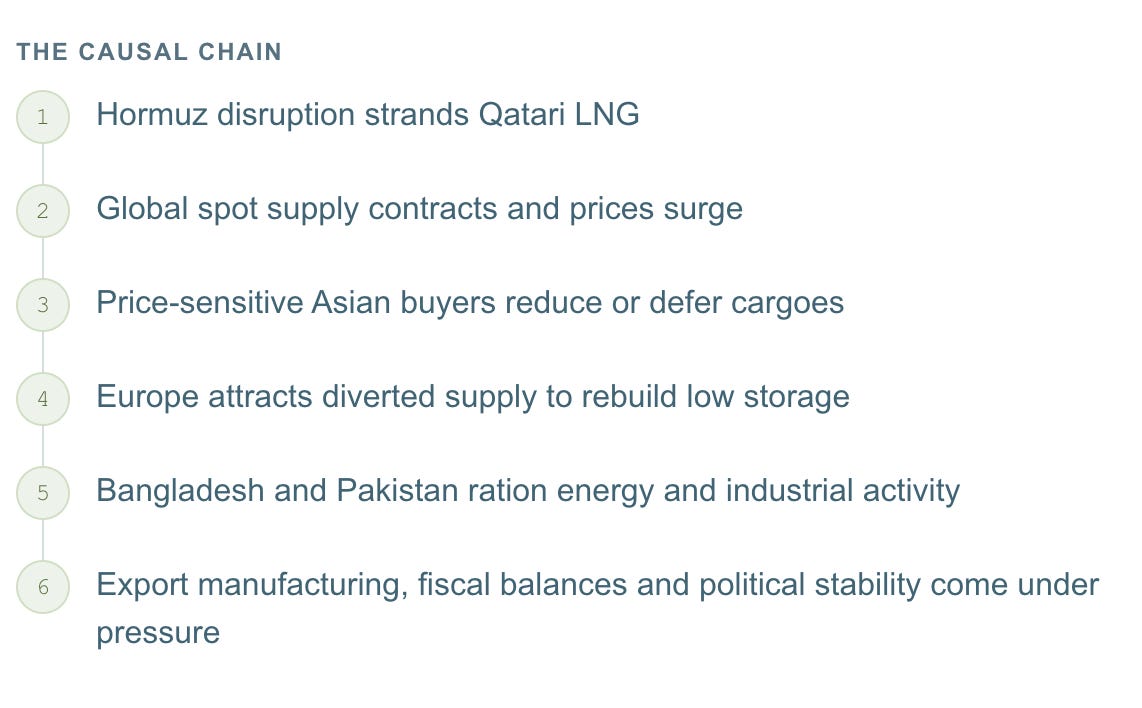

The war premium then moves outward: LNG to electricity —> electricity to industry —> gas to fertiliser —> fertiliser to food —> and food inflation to political instability.
Russia: pessimism, rising prices and voices from the street
Steve Rosenberg, longtime BBC world news longest-serving Moscow correspondent, reviews the attitudes of Moscowites and the local press regarding the rise of scarcity.
The jokes section in russian newspapers are the only ones telling the truth. Some examples:
“A wife complains to her husband that he never takes her anywhere expensive anymore. The next day, her husband takes her to the petrol station.”
“I bought groceries for the week. With the prices what they are right now, the cashier shook my hand on the way out and wished me success with my investments.”
“When I was young, I was poor. After years of hard, honest and painstaking work, I am no longer young.”
Warfare - Supply chains
You can print money, not rockets
The Lead Inspector General’s first report on Operation Epic Fury records a Department of War estimate of $33.4 billion through 29 June, including $22.3 billion in munitions used, and states that expenditure created strategic inventory shortfalls while exposing industrial-base bottlenecks. On 19 September, AP reported that a separate CENTCOM estimate supplied to lawmakers put the cost at $43.6 billion through 3 September, including $28.1 billion in weapons. The later figure is reported from a one-page estimate rather than a published inventory ledger.
Assessment: a regional war has consumed enough high-end U.S. inventory to create a documented readiness trade-off before any simultaneous crisis involving China or Russia. Replenishment is constrained not only by appropriations but by solid-rocket motors, energetic materials, specialised suppliers and skilled labour, weakening the assumption that expenditure can be rapidly converted back into stock.
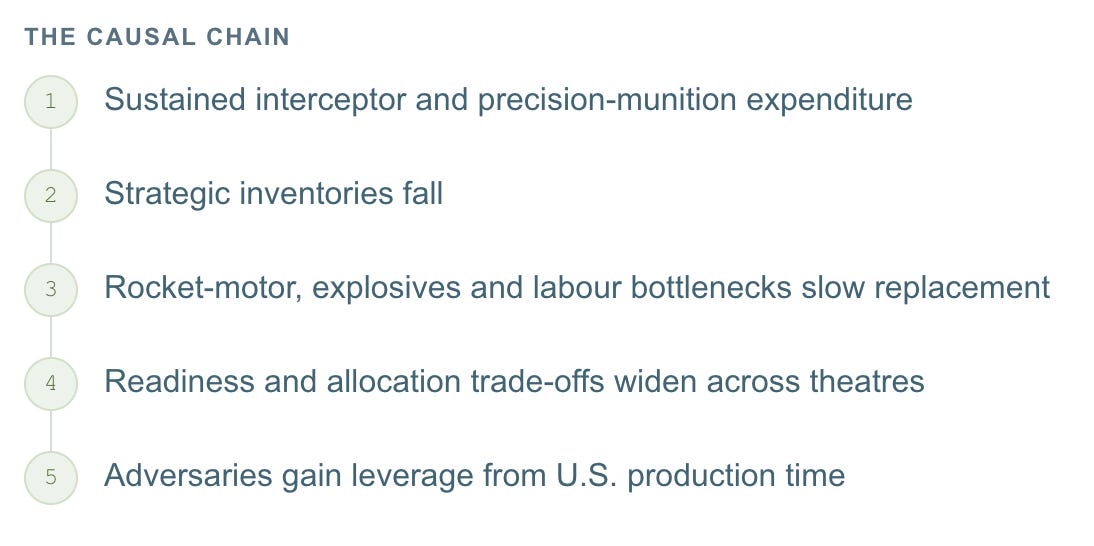
What we don’t know: Classified inventory levels, allocation decisions and exact replenishment times are not disclosed. The official $33.4 billion estimate, the later $43.6 billion CENTCOM figure reported by AP and CBO’s separate estimate use different cut-off dates and methods; none is a cash-disbursement ledger or a public count of remaining rounds. The scale of the cross-theatre constraint is documented, but its operational severity cannot be precisely measured from open sources.

Weapons are also being allocated through diplomacy
Reuters reports that President Trump has delayed approval of an approximately $14 billion Taiwan arms package since his May summit with Xi Jinping and has described it as a negotiating chip. Anduril founder Palmer Luckey said the delay is now affecting the company’s Taiwan business. Anduril already supplies Altius drones to Taiwan and has co-developed the Barracuda-500 missile with Taiwanese partners. The package remains delayed: it is not an approved sale, contract or delivery.
Taiwan’s drone shield is now a negotiating chip: the cost is not only delayed weapons, but uncertainty across the industrial chain meant to build them.
Weapons don’t grow on trees, and China holds tight control over crucial materials and components that make up the defence industry. In a globalised system, hurting one major economy (China) inevitably hurts other interconnected economies (Europe, the U.S., the Global South, etc.)
Important note: Before you believe that China “holds all the cards” during any future negotiations, let’s remember something crucial - China has enormous dependence on upstream energy imports and its’ manufacturing prowess is very sensitive to small upstream cost changes. The war in Iran disrupted the Gulf hydrocarbons —> LPG/naphtha —> ethylene/propylene/aromatics —> plastics/chemicals/materials —> which in turn affects Chinese factories ability to produce —> impacts global manufactured goods.
The second order effects of the Iran war is that it causes global energy inflation, which makes for weaker global consumption and lower demands for Chinese exports.
Warfare - Supply chains
Stockpiling returns: Just-in-time is replaced with just-in-case
Two developments this week demonstrate that governments are preparing for a world in which access cannot be assumed by default.
First, the U.S. Defense Logistics Agency awarded an Elmet Group subsidiary a contract worth about $2 billion to help rebuild the National Defense Stockpile and strengthen the American tungsten supply chain. Tungsten is indispensable to defence and advanced industry, while China dominates much of the global chain.
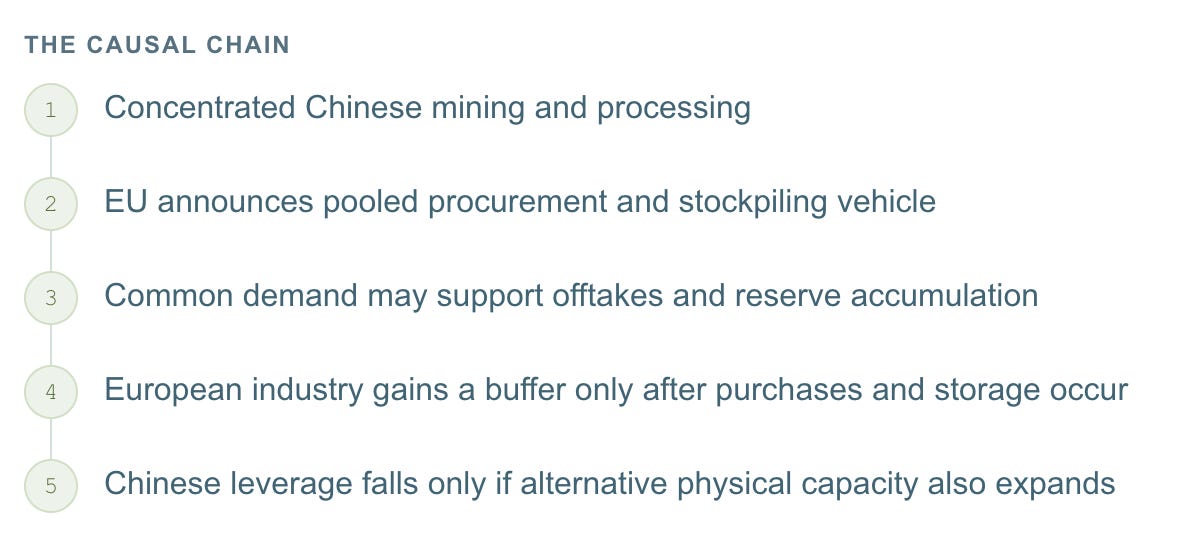
Second, European Commission President Ursula von der Leyen proposed a European Corporation on Critical Raw Materials to procure and stockpile inputs for vehicles, chips, batteries, clean technology and defence. She said the EU remains more than 80% dependent on China for many critical materials and roughly 90% dependent for some rare earths.
Assessment #1: guaranteed demand can finance allied mining and U.S. conversion capacity, but the delivery condition exposes the present bottleneck - government purchasing power cannot stockpile material that has not yet been mined and processed. The policy reduces Chinese leverage only as physical capacity becomes operational.
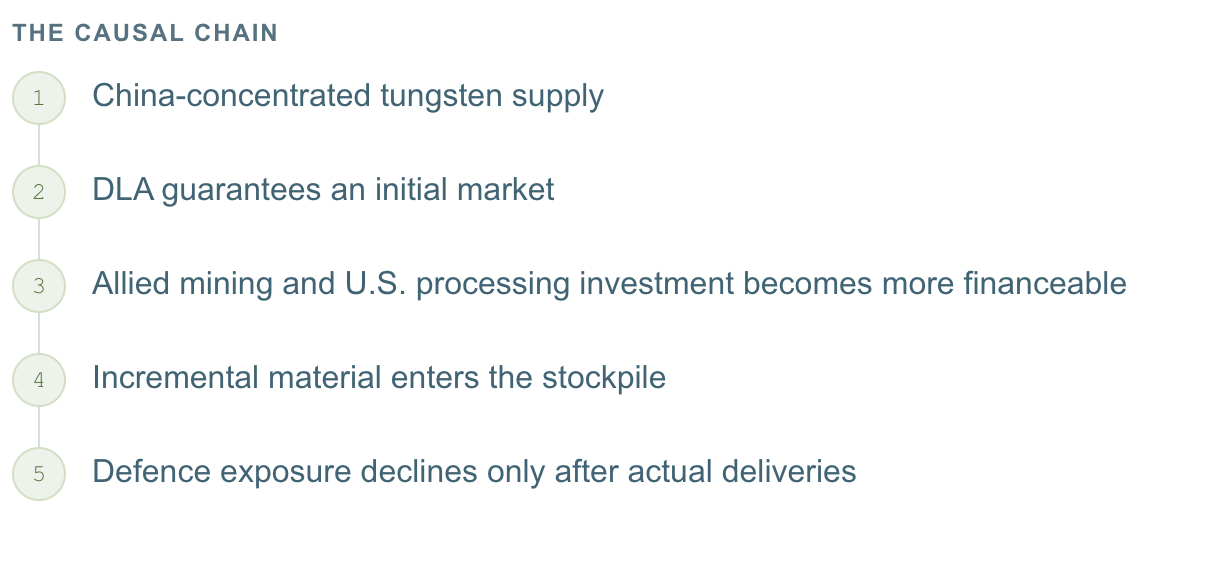
Assessment #2: if implemented with pooled purchasing power and physical reserves, the corporation could turn fragmented national demand into an EU-level buffer against Chinese export restrictions and supplier coercion. It could also bid up scarce non-Chinese supply before new mining and processing capacity arrives. The near-term effect is agenda-setting and potential financing certainty, not immediate diversification.
AI arms race - Warfare - Supply chains
AI discovers geography
The AI race is usually narrated as a contest in models and chips, until the physical reality enters the room.
The U.S. Energy Information Administration expects American electricity generation to rise 2.2% to a record 4,368 billion kWh in 2026 and another 1.7% in 2027, with data centres and manufacturing contributing to demand growth.
National generation growth does not guarantee power where compute needs it. The binding constraints are often local: interconnection queues, transmission, substations, transformers, firm generation, water and cooling. Compute is therefore allocated not merely by capital, but by grid position.
War adds another layer. After Iranian attacks exposed the vulnerability of Gulf infrastructure, the UAE is reportedly revising a planned 5-gigawatt AI campus from one vast site into a more dispersed network. Measures under consideration include underground facilities, blast-resistant construction, backup power and cooling, electronic jamming, and missile and drone defence.
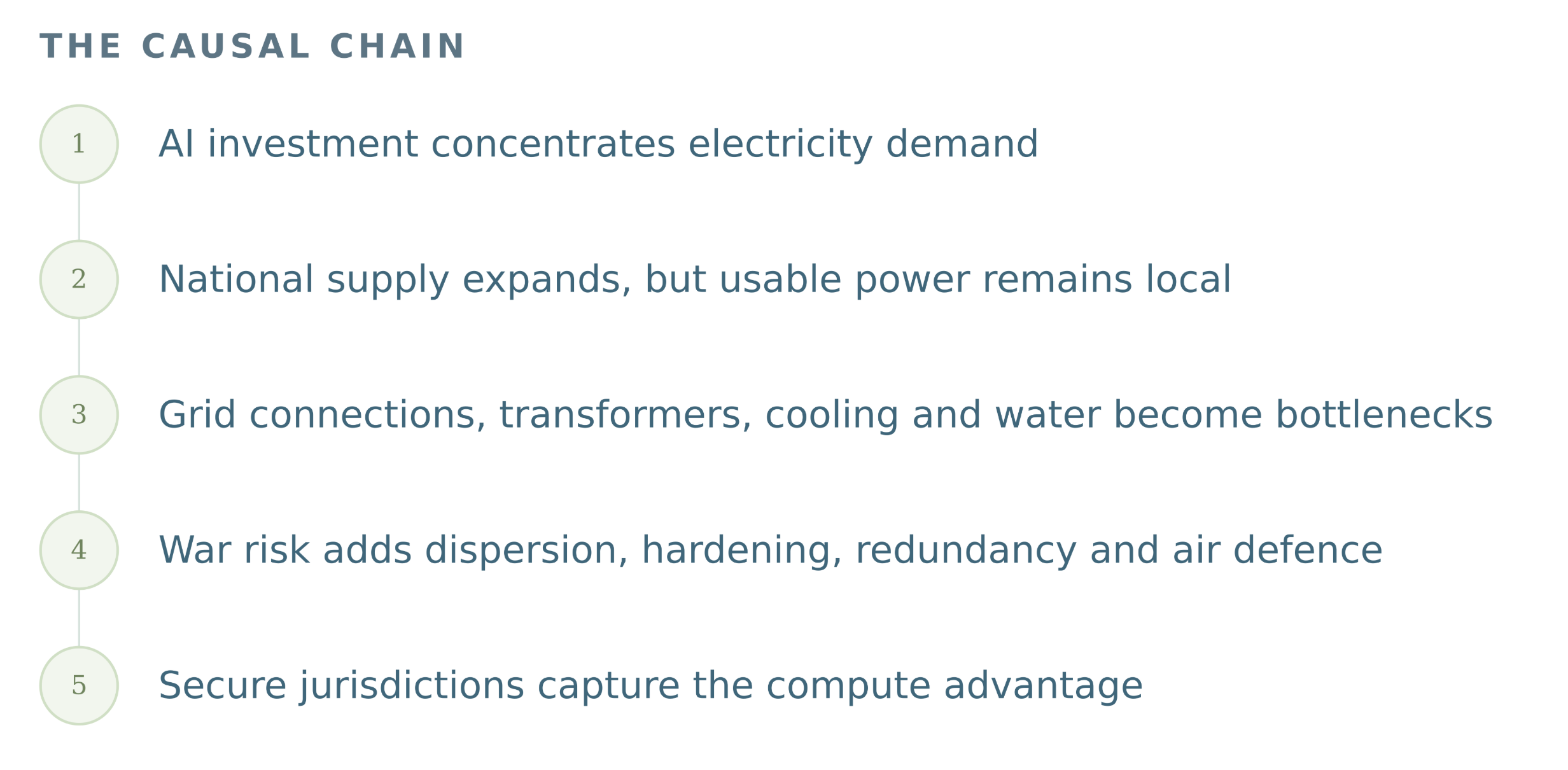
Assessment: Data centres are no longer just commercial assets, but strategic infrastructure with a defensive perimeter.
This will raise the capital cost of compute and reward jurisdictions that can offer reliable power, physical security, political protection and access to advanced chips at the same time. AI “sovereignty” is all about control of the stack beneath them.
Warfare – Supply chains – Money flows
Europe is being prepared for the end of the peace dividend
Merz, Meloni, Tusk and Macron, the Swedes, the Finns - even the traditionally neutral Swiss - have come out with warning statements. Across Europe, leaders are delivering variations of the same warning: the security environment has deteriorated, defence spending must rise, critical infrastructure must be protected and citizens should prepare for the economic consequences.
This is not coordinated scaremongering or preparation for war with russia (that was has been here for half a decade already, and had been multi-fold: kinetic and non-kinetic). This is expectation management - European governments are trying to prepare their citizens for a harder allocation problem before the costs arrive at the ballot box - and before populists promise to restore an abundance that no longer exists.
Assessment: Europe’s post-Cold War prosperity rested on three external subsidies: cheap Russian energy and commodities, low-cost Chinese manufacturing and an American security umbrella that allowed Europeans to underinvest in their own defence. All three are now weakening, becoming conditional or disappearing altogether.
War is a destroyer of wealth - even when the missiles are not landing on your street. It raises freight and insurance costs, disrupts energy and commodity flows, redirects industrial capacity towards defence, forces governments to duplicate supply chains and consumes capital that would otherwise support private investment and consumption.
Europe must now rebuild its militaries, secure its energy system, protect infrastructure, stockpile strategic materials and relocate vulnerable production. That means more public money, labour, industrial capacity and raw materials will be directed towards resilience rather than maintaining the lifestyle made possible by the peace dividend.
Europe is therefore being prepared not only for military danger, but for the end of an economic era. The bill for decades of strategic dependence is here.
Balkan Candor
Buckle up, folks. Globalisation as we knew it - from energy and commodities to trade - is over, and a new one is being built as we speak.
Efficiency asks: Who can supply this most cheaply?
Security asks: Who can be trusted to supply it during conflict?
Coercion asks: Who will still be allowed to buy it?
The global economy is being reorganised around the second and third questions. And the loop goes as follows:
War-risk disruption —> longer routes and scarcer transport —> higher freight, insurance and delivery costs —> more expensive energy and industrial inputs —> food and goods inflation —> falling real incomes and weaker demand —> subsidies and larger fiscal deficits —> higher borrowing costs —> weaker investment in productive capacity —> political volatility and protectionism —> more fragmented trade and export restrictions —> tighter physical supply —> renewed disruption.
Adjust accordingly. Get your finance in order, if you have planned renovation: e.g. making your house more energy efficient, installing a heat pump, etc. - do it now. Not tomorrow, not next month, not next year. Now. If governments are stockpiling, so should you.
Supporting Waronomics financially is an investment I'm happy to make in an era where long form, highly referenced essays have become an "endangered species". Great analysis.
I'm curious if the rapid rise in prices will force a sustainable transition. If so, that that transition will stick.
Regardless, you're right. Globalisation as we know it is over. The post Cold War world is over. We're inbetween then and whatever comes next; and the markets you analyze reflect that.