


The recent fine imposed on X (formerly Twitter) by the EU under the Digital Services Act (DSA) and the furious reaction from Trump-aligned US officials accusing Brussels of “censorship” and “anti-American bias,” while EU officials insist it’s just about transparency and consumer protection is a perfect case study of the power of the information warfare tactics of the 21st century.
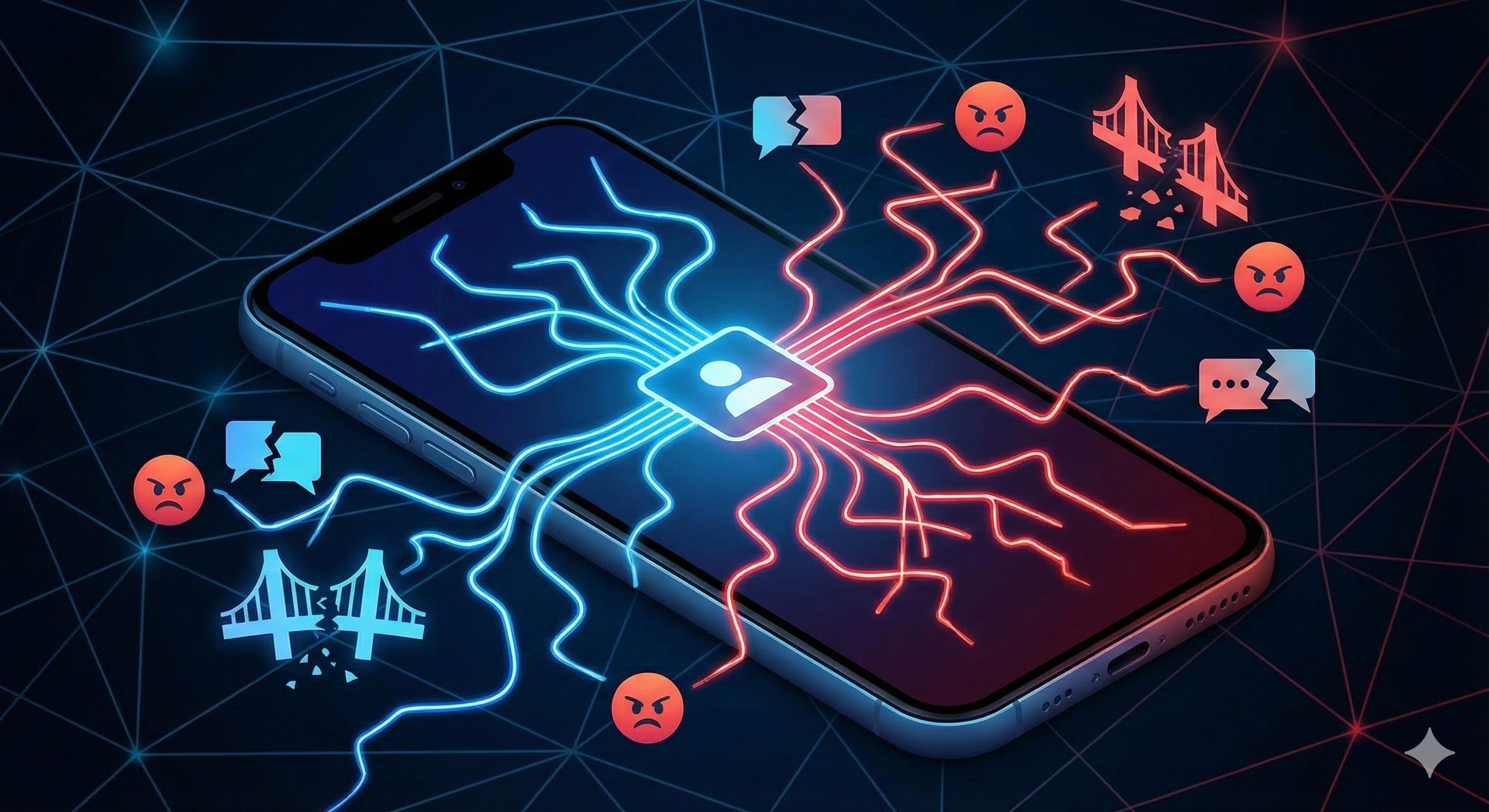
If you want to understand the current trajectory of Western security, look at the information space.
We are witnessing a shift in adversarial strategy. Russia, China, and a cluster of aligned state actors have moved beyond generic “disinformation” (sowing confusion) to a precise campaign of strategic decoupling.
The objective is no longer just to make Western populations distrust their own governments. The objective is to make Washington and Brussels view each other not as allies, but as existential threats to their respective ways of life.
It is a hostile takeover of the transatlantic alliance. And because these narratives bypass policy to trade on the volatile currency of national ego and wounded dignity, the strategy is yielding exceptional returns.
The Wedge Strategy
In intelligence terms, this is a classic “Wedge Strategy.” You identify a fracture in the enemy coalition and apply pressure until it snaps.
For decades, the US and Europe have had policy disputes - trade, data privacy, defense spending. These were manageable friction points. What we are seeing now is the weaponization of that friction into identity-level warfare.
The Adversary’s Calculus
War is expensive. Kinetic conflict with a unified NATO is suicidal. But a West divided into a “Woke, stagnant Europe” and a “Lawless, tech oligarch America” is a collection of vulnerable assets. Russia and China know they cannot win kinetically, hence the employment of such strategies is so fierce and elaborate.
Russia plays the Chaos Arbitrage. Their goal is to erode the political will for Ukraine aid. If Washington believes Europe is a “freeloader” and Europe believes Washington is “unreliable,” the logic of collective defense collapses. Win for both Russia and China.
China plays the Strategic Hedge. Beijing wants Europe to be a “swing state.” If they can convince Brussels that US security policy is actually just “American commercial aggression,” Europe will hesitate to align with US against China in the Cold War of the Indo-Pacific. Win for both Russia and China.
The Mechanism: Validation Loops
The screenshots circulating this week are not isolated social media drama. They are intelligence signals showing how the mechanism works in real-time.


1. The Trigger Event
The EU moves to enforce the Digital Services Act (DSA) against X. This is a regulatory dispute regarding transparency and compliance.
2. The Asymmetric Escalation
The dispute is immediately reframed in Washington not as policy, but as civilizational warfare. Elon Musk posts a meme depicting the EU flag peeling away to reveal a Nazi Swastika, labeling it “The Fourth Reich.” He explicitly calls for the abolition of the EU.
3. The Adversarial Validation
This is the critical step. Dmitry Medvedev (Deputy Chairman of the Russian Security Council) replies to Musk with a single word: “Exactly.”
Simultaneously, Kirill Dmitriev (CEO of the Russian Direct Investment Fund) launches a poll framing “EU is abolished” as the optimal outcome for the world.
This is the loop: An internal Western dispute occurs —> Domestic actors escalate the rhetoric to “enemy” status —> Adversarial state actors validate and amplify that escalation.
Moscow signals to the America: “We agree with you. Europe is the problem.”
Moscow signals to the Europe: “America is your enemy now, you have no allies and you are too weak to stand on your own feet.”
The Vectors of Attack
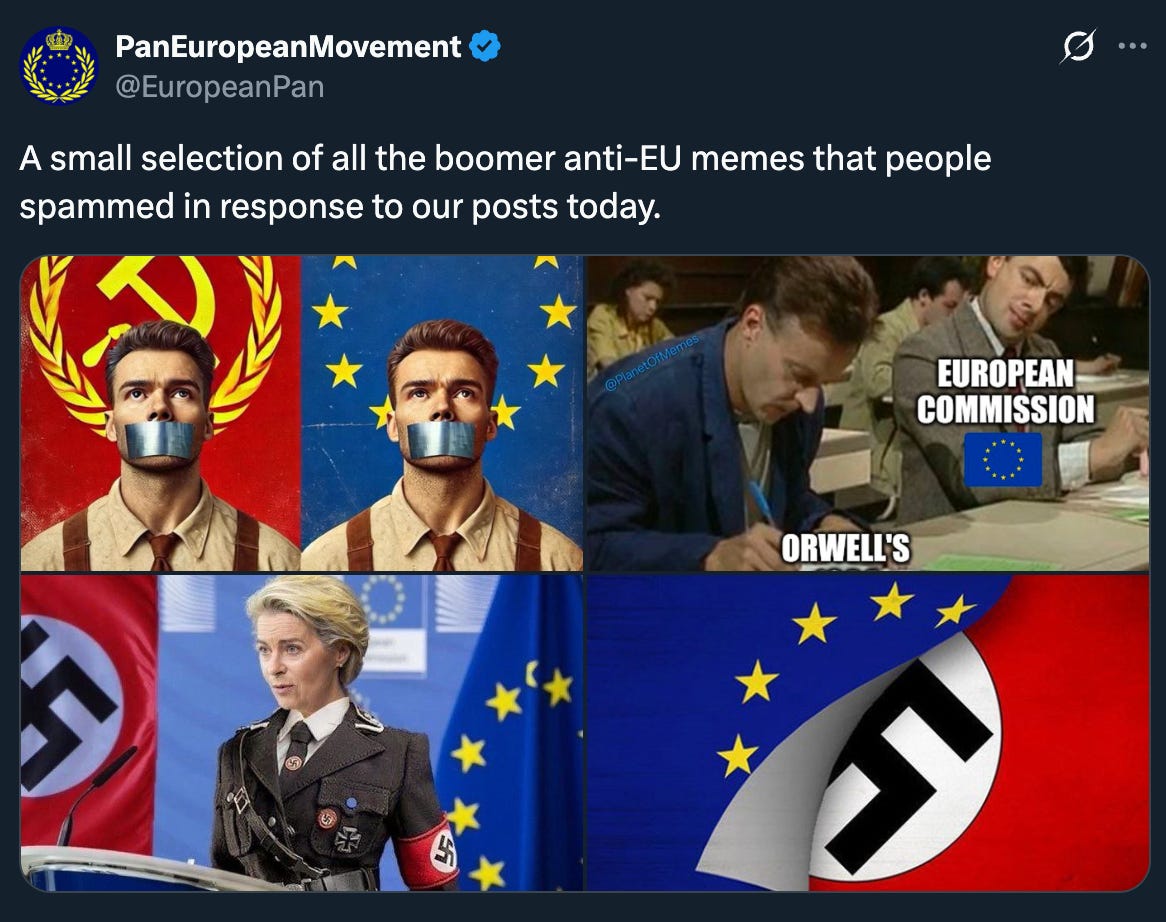
The adversary is currently exploiting three specific structural vulnerabilities in the alliance.
Vector A: Sovereignty vs. Dominance
The US View: Under the incoming administration, free speech is being framed as a projection of American values. EU regulation is seen as an attack on American commercial sovereignty and values.
The EU View: Digital Sovereignty is seen as a survival mechanism against foreign tech dominance.
The Wedge: Adversaries amplify the narrative that EU regulation = Censorship to US audiences, while simultaneously feeding narratives to Europeans that US Tech = Surveillance capitalism. The result is a total breakdown of trust in shared digital infrastructure.
Vector B: The Fatigue Asset
The Reality: The war in Ukraine is grinding into a costly attrition phase.
The Wedge: Russia is effectively selling two different stories. To the US, they sell the narrative that Europe is weak and unwilling to pay its share, freeloading on the American taxpayers that are already struggling with inflation and economic stagnation. To Europe, they sell the narrative that the US is dragging them into another forever war (constant flashbacks to Iraq and Afgnanistan), and Europe would be forced to foot the economic price.
The Evidence: Note the recent reports of the Kremlin praising the new US National Security Strategy for its criticism of European allies. This is “Divide and Conquer” 101. When your enemy praises your strategy, check your blind spots.
Vector C: The Culture War
At that point, identity politics has become a geopolitical vulnerability. Adversaries know that the US and EU have diverging cultural baselines. By caricaturing Brussels as “Globalist bureaucrats” and Washington as “Yank oligarchs,” they make cooperation politically toxic in the eyes of many average citizens.
The Structural Mismatch
Why is this strategy yielding such high returns? Because of a fundamental asymmetry in how the US and EU process information.
The US Market: The American information space is hyper-commercialized and polarized. It favors high-conflict, low-nuance narratives. A meme about the “Fourth Reich” travels faster and further than a 50-page white paper on the Digital Services Act.
The EU Market: The European space is fragmented and bureaucratic. EU “StratCom” units are designed to debunk factual falsehoods (e.g., “The tank was not destroyed”). They are completely ill-equipped to counter narrative warfare (e.g., “The EU is a tyranny”).
The adversary is shorting the alliance, and right now, the trade is winning.
Counter-Strategy: Narrative Hygiene
We need to stop treating these events as “Twitter spats.” They are hybrid warfare operations. The goal of the adversary is to make the US and EU decouple psychologically before they decouple militarily.
The fix requires a shift in doctrine:
Joint Threat Attribution: Washington and Brussels need to explicitly call out when a domestic dispute is being amplified by foreign state actors.
Strategic Silence: Policymakers need to learn that “dunking” on allies publicly provides free ammunition to adversaries. We have diplomacy for a reason - use it! Even if you need to throw profanity at one another behind closed doors later. Every time a US official calls the EU “tyrannical,” a mesmerizing amount of work is saved by the FSB. Don’t do the work of your adversaries.
Acceptance of Friction: The alliance must mature. We are not perfect nations, nor perfect people, but alliances and friendships are not perfect. They are necessary. We will disagree on tech regulation. We will disagree on trade. We cannot allow those disagreements to become the wedge that shatters our shared security architecture.
The alternative is the scenario outlined in the Dmitriev poll: An abolished EU, an isolated America, and a Eurasia managed by Moscow and Beijing.
Absolutely fantastic and spot-on!!