


Dear friends and (un)fortunate readers, I’ll preemptively not apologize for any discomfort caused by my Balkan candor. This Substack exists because people kept asking for it - friends, acquaintances, and social media followers. If you want polished lingo, you can find it elsewhere.
Here, we deal with the world as it is - not the world we wish we lived in, not the product being sold by snake-oil salesmen in politics and business, and not the soothing fiction of “everything is / will be fine.”
The reality is simple: the world is at war.
The Bear Awakening: The First Signs of a World at War
If two Balkan people sit for drinks and cigarettes, they will inevitably talk about politics. It’s just how the universe works. It was late spring of 2015, and I was debating the war in Eastern Ukraine with a dear (and vastly more knowledgable) friend of mine over…drinks and cigarettes. On the topic of Russia, he said something that encapsulated the entirety of the Russian “mysterious soul”:
“Russia has only two modes: they are either at war or preparing for the next one.”
Between 1990 and 2000, Russia endured one of the worst decades in its modern history after the USSR collapsed: inflation crisis, parliamentary crisis, street crime, organized crime, systemic corruption, alcoholism (their default setting), banking collapse, sovereign default, war in Chechnya - the full set. And instead of reflecting and addressing the systematic issues which caused this decade of hell, what did they do? They blamed the West and indulged in antisemitic conspiracies.
Meanwhile, many former colonies finally exhaled, joined NATO and the EU, and began securing their economies and defenses. Not all made it in time. Georgia and Ukraine were left on the doorstep. When Russia finished its preparation phase, it attacked - first Georgia, then Ukraine.
That’s when the new world war unofficially began. Not in 2025, not in 2022 - in 2014.
The Cassandra’s of the East
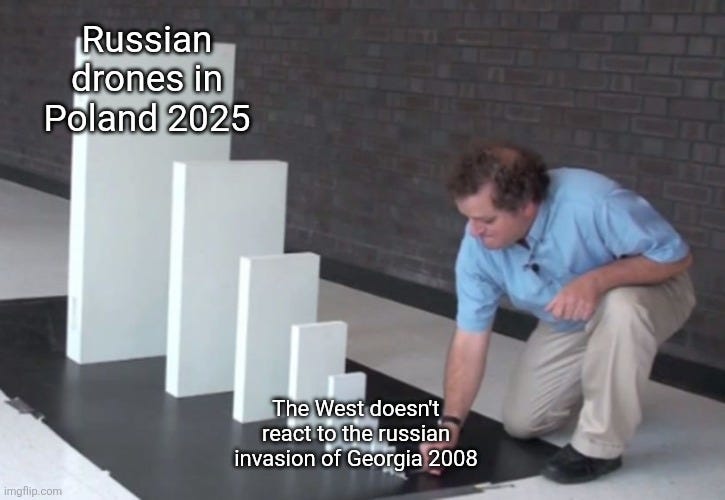
The Ukraine full-scale invasion was no surprise to anyone that’s been paying attention. On August 12, 2008, following the Russian war on Georgia, the Polish president - Lech Kaczyński - joined a rally in Tbilisi where he said:
“We know very well: today Georgia, tomorrow Ukraine, the day after tomorrow the Baltic States, and then perhaps the time will come for my country - Poland.”
Oh, how prophetic his words echoed trough history!1
Lech Kaczyński wasn’t the only one that tried to warn the world about the dangers of the Russian imperial mindset. The fate of Ukraine was prophecized back in 1995 by Dzhokhar Dudayev, the first President of the Chechen Republic of Ichkeria.
“Ichkeria has curbed [Russia’s] appetite, but it has not stopped. There will be carnage in Crimea. Ukraine will still clash with Russia in irreconcilable circumstances. As long as Russism exists, it will never give up its ambitions.”
Dudayev’s prophecy was chillingly accurate. Less than two decades later, Russia invaded Ukraine, annexed Crimea, and set the stage for 2022. The ideology of Russism does not stop at Chechnya, Georgia, or Crimea. Ukraine - core to the story Russia tells about itself - was always the next target.
The ideology of Russism necessitates perpetual conquest, and Ukraine, as the crown jewel of the former USSR and the core of the russian looted identity, was always destined to be its next victim.
Ideology: The Mother of Irrationality
I could argue in good faith (pun intended) that atheism did a huge disservice to the world, and I don’t mean this in any spiritual or theological sense. It created entire generations obsessed with rationality and logic. The world, human nature, people’s actions - all needed to make sense, to follow a logical pattern.
Western, secular minds internalized a fatal fallacy: ideology doesn’t matter.
“Why would Russia wage war? Just trade, get rich, modernize. Live like us.”
“Why would China weaponize manufacturing? We helped lift 800 million out of poverty. Just trade, get rich, modernize. Live like us.”
Sounds rational. But ideology isn’t.
Russia’s war on Ukraine is not about NATO expansion or mythical protection of “Russian speakers.” It’s Russism. Without Ukraine - especially without Kyiv - Russia’s imperial narrative collapses. After Peter the Great, Moscow appropriated the Kyivan Rus legacy to launder the shame of a steppe-empire origin. Russia has a European face and two showpiece cities (Moscow, St. Petersburg), but its institutions and statecraft are heirs to the Golden Horde, not to Europe. That’s why Westerners cannot comprehend neither the barbarity nor the irrational logic of this war.
Russia (as an idea) = Moscow, St. Petersburg, and a claim on Kyiv (they wish).
The Russian Federation (as a fact) = hundreds of conquered nations and peoples, kept poor and pliable, sent to die in colonial wars.
Conquer. Kidnap. Deport. Russify. Keep destitute. Mobilize for the next war. Rinse and repeat.
Ukraine is targeted first for ideology, second for people (the same ones who fed and built Russia’s science and culture), and third for land - one of the world’s great breadbaskets.
Geopolitical power isn’t GDP per capita. If that was the case, Liechtenstein would be shaping the world today. Power flows from control of water, food, energy, metals, and materials - oil, gas, timber, rare earths, aluminum, steel - not from your next AI slop app and vanity metrics. That’s why both the Gulf states and Russia punch above their GDP weight.
World War III: Same Objectives, Different Means
People imagine world war as tanks on the Champs-Élysées. Outdated picture.
The choice isn’t “war vs. peace.” It’s whether we recognize the war we’re in. If a world war defined as a sustained, multi-theater struggle among great-power blocs to coerce outcomes and reshape the world order, then we’re living in it.
The tools have changed - chips, cables, sanctions, drones, ransomware, and narratives - but the aims and stakes haven’t. Front lines now run through supply chains, fiber routes, capital markets, and your social media apps.
What WW3 ACTUALLY looks like now:
Hybrid war is the operating system: NATO doctrine treats “hybrid threats” as cyber, covert action, economic coercion, lawfare, proxies, and information ops - kept below the Article 5 threshold. That’s not prep; that’s the war itself.
Energy, cables, and chokepoints are battlefields: Pipelines and undersea cables - your heat, payments, cloud, SWIFT - are soft targets. Balticconnector and other incidents triggered NATO patrols and criminal probes. Whether negligence, deniable proxies, or hostile states, the pattern is pressure on connective tissue. Strategy by other means.
Sea lanes are contested by non-state actors armed with state-grade weapons: Houthi attacks in the Red Sea forced rerouting around the Cape, spiking costs and idling European factories (see Tesla, Berlin). Economic warfare via drones and missiles on civilian shipping, answered by multinational navies. War effects, no declaration.
Finance and trade are weaponized like blockade and strategic bombing once were: Roughly $300B of Russian sovereign reserves are immobilized; SWIFT restrictions, diamond bans, REE embargo from China, and dual-use export lists are long-horizon tools to degrade war capacity - blockade by modern means.
Tech controls and IP battles are the new arms race: The U.S. and allies keep tightening semiconductor export controls (2022 → 2023 → 2024 → 2025), even rescinding fast-track waivers for giants like TSMC. In parallel, governments and courts are pursuing industrial espionage tied to chips and AI. China is literally sending beautiful women to seduce tech bros and steal trade secrets. This is strategic denial of capability - yesterday’s uranium is today’s EUV lithography, AI accelerators, and EDA stacks.
Cyber is strategic fires against the home front: Colonial Pipeline (2021) showed that a ransomware crew can trigger panic buying and fuel shortages across the U.S. East Coast. The point isn’t the incident - it’s the lever: attackers can impose immediate societal costs far from the front line. That’s strategic effect without crossing a border.
Information is terrain: Disinformation, narrative warfare, and influence ops are continuous. NATO labels these as core hybrid instruments; private platforms and satellite constellations are now quasi-combatants. It’s not PSYOPs as garnish; it’s the main course that shapes diplomacy, supply chains, and elections.
Conclusion
Denial is human. I don’t blame anyone for wanting to look away. Secular, post-Enlightenment brains trained to expect rationality crash when confronted with ideology. But reality doesn’t care.
The world is at war - a world war. The fact your home hasn’t been droned does not make it less real. Kinetic fronts in Ukraine and the Middle East- and soon, perhaps, Latin America - are not siloed. It’s the U.S., Europe, and allies versus China, its vassal state Russia, Iran, North Korea, and a rotating cast of BRICS-adjacent bettors.
Supply chains, access to goods and services, and your prosperity are in play. This war is multi-front, multi-domain, and it will take years - maybe decades - to resolve. When it does, the world will not look the same.
Buckle up!
[Next week on Waronomics Substack —> The ideological operating systems of the East: Russism and Chinese monocivilizational ideology]
It’s worth noting that President Lech Kaczyński, alongside his wife and 94 top Polish military officials, parliament members, and other dignitaries, died in a plane crash near Smolensk, Russia. The Polish delegation attended a ceremony commemorating the 70th anniversary of the Katyn massacre (the mass execution of around 22,000 Polish military officers and members of the intelligentsia by the Soviet secret police (NKVD) in 1940, near Smolensk).
Finally! Very nice essay, I couldn’t agree more.
Excellent article, however, instead of being at the middle of WW III I truly think it just started.
It is a new cold WW, can we say, CWW-V2? Only time will tell.